Jan 17, 2012

HR should act as an enabler for Social Business

Social Media Cafe
Image by Cristiano Betta via Flickr
On the social business news blog Michael Brito posted about the SHRM survey that finds that HR would play an increasingly important role in Social Business.

However the crux of that involvement focuses on "creating and enforcing a social media policy"

To me that sounds like policing - not acting as the enabler and empowering the energy of the employees to be the organizations' advocates on social media.

To do that the focus has to be on building an empowering and trusting culture within the organization and then following that with education and training on the dos and donts of social media. Governance, while it is critical,  cannot be purely on the basis of publishing a policy.

A company cannot be asocial inside and social outside.

HR has to evolve to catch up with the rest of the organization to embrace social.
Enhanced by Zemanta

Jan 12, 2012

Culture is the Employment Brand

No the employment brand does not exist in advertisements or what you tell your marketing agency.

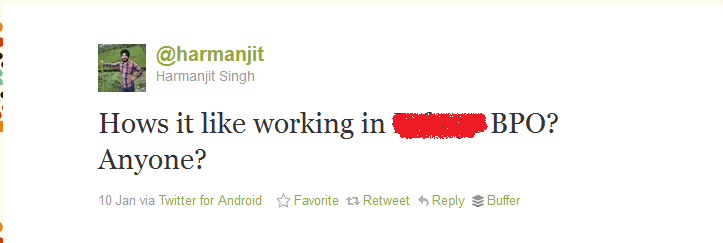
Your company's employment brand is shaped by conversations that are triggered by questions like this on social web these days.
Your employment brand is built and shaped now by such conversations. It is what your employees say to their friends and what their friends reply to questions like the above.

In short, if you want to really impact the employment brand - start with the culture of your organization. Because that is the brand that people actually care about.

Start with being authentic. Open. Upfront. Both externally and inside. Listen. Talk less. Do more.

If you are authentic about the kind of culture your organization has - conservative, experimental, edgy or whatever it is - you will attract people who would be comfortable with that culture.

Sure culture is a messy thing. Not usually articulated easily. It is not the "values espoused" but demonstrated by the "values in action" and hence open to perception and biases.

Culture is also defined in various contexts. If you're a bank then you have a certain kind of culture, right. Not really. Because if you're the bank's BPO or IT center in India then the culture would be either subtly or radically different. If you're in another country the national culture would also shape it.

So how do you showcase your myriad cultures to the myriad applicants who apply to you or the people you want to hire?

Do share what has worked for you.

Online Influencers in Recruiting

The HRExaminer brought out its version 5 of the Online Influencers in Recruiting - this time moving away from Traackr to using HRMarketer's SocialEars to "assess influence"

Surprisingly I am number 6 on the Recruiting list with high scores in the areas of "Social Recruiting" "Recruiting" "Staffing" and "Recruitment Advertising" (strangely, I don't remember having posted/shared anything about Recruitment advertising)

You can see the full list here, and how they scored

Jan 2, 2012

Musing on Identity and community

Ancient Times, Hither Asia
Image via Wikipedia
Communities have always existed and people have given them different names for it. In ancient times the community was about a place. Every village was a community. Every tribe a different community.

As civilisation took root, the ideas of a community became more and more complex. We had communities based on regions, nations (all based on place) , communities based on professionas (what we do - which was taken to an extreme in India - with caste)

The interesting thing to note is that one's community becomes one's network - you get access to a certain world view, specialised skills and knowledge - and are better equipped to deal with certain opportunities.

Then came modern education and training and it lowered the barriers to access but not substantially so. If you could afford it you could be anything.

And then came the online world - which lowered the access to resources and therefore skills.

You could have been a Chartered Accountant's child, or a Doctor's but you could become a writer, artist, photographer, programmer.

Now with ubiquitous access to the net and cheap access devices like the Akash tablet we are bound to see the barriers come crashing down even more, with anyone who wants to getting access to the best teachers and resources to learn skills one wants to learn.

The online world also has communities. Communities of people learning something (skill or talent communities), communities of people interested in solving problems (activist communities, support communities) or communities of interests (lifestyle communities, brand communities).

Earlier communities were the source of your identity.

Now, you can choose your identity and join your community.

So will you choose your identity based on who you are or who you want to be?
Enhanced by Zemanta

Dec 30, 2011

Future of Talent in India - Panel Discussion by BraveNewTalent on 6th January

As 2012 kicks off I am glad to announce that BraveNewTalent is launching a global series of talks - the first of it being in Namma Bengaluru - focused on the Challenges regarding Talent in India.

It will focus on the critical business issues relating to talent and insights around how demographic changes are coming up, new models of education like peer to peer learning, and using digital and social media in the talent space.

If you're a CEO / HR head / Academician interested in these issues, register for it here. Limited seats available :-) 

Dec 26, 2011

Finding great talent in the not-so-usual way

I recently came across reference to George Anders' book "The Rare Find" first by a video talk my friend Gaurav Mishra shared on Facebook and then coming across the review of the book on HRExaminer and an interview of George by Daniel Pink. I then discovered that George was following me on Twitter too :-)

In the interview with Dan Pink he shares the way recruiters normally get it wrong. 
You need resilience to be a great CEO, a great teacher, soldier, investor, etc., etc. But when we hire, we’re taught to regard setbacks — regardless of what came next — as flaws in a candidate. So when we prepare our own resumes, we hide our stumbles. That’s wrong! We should cherish people who have extricated themselves from trouble in the past.
Find the frontier. If you want to be extraordinary, restlessness is a virtue. It’s also a great traveling companion for resilience; if you can combine the two of them, your chances of finding society’s greatest opportunities in any particular decade are huge. Hang out with people just as driven and passionate as you. The great hotbeds of talent are self-sustaining because competitive internal friendships guide rapid progress. When in doubt, come back to autonomy, mastery and purpose.
Personally, I think the greatest recruiters are the hiring managers. In certain industries the real talent scouts are people who have done the job, and so they know exceptional talent when they see it. Talent is also demonstrated in "doing" rather than interviewing. Of course, as he says for some jobs like coding software or writing it is possible to look at the results before you select them. How do you do it for other jobs?

Dec 23, 2011

Leveraging Social Media for Job Hunting

Image representing Facebook as depicted in Cru...
Image via CrunchBase
My colleague Ramon Bez at BraveNewTalent's London office recently wrote an article in The Guardian about how graduates can leverage Social Media for Job hunting. This was after a research that showed UK graduates not leveraging social media for their job hunting. I suspect the same is true of India. 

Here are some insights from the article:

Connect with people
Start following people. Twitter is an amazing tool because even the most seemingly unachievable professional can be found and followed, and there are millions of those there, from the most diverse industries. Facebook and Linkedin are a little more private, but I'm sure you'll find people in your own network from all sorts of backgrounds who just might happen to know about a vacancy that's perfect for you. 
Engage Let people in your network know who you are and what you are looking for. Produce or share content around your professional life and interests. While it may sound intimidating at first to start writing, filming or even tweeting your own ideas, step two will give you a good understanding of your field and the sort of content that is relevant. If you keep your ears open you should be able to find and write lots of useful content.
Share it on Facebook, but especially target it on professional networks such as Linkedin, Twitter and BraveNewTalent.
While our study revealed that job seekers over 55 are less likely to share their job plans (35%), only 7% of 18 to 24 year olds are prone to secrecy, which at least shows a change in mentality. Very often, where the US goes, we soon follow, so we can expect many more people in the UK to find jobs through social media websites in the near future. But those who are starting now surely can get some good competitive advantage.
Enhanced by Zemanta

Dec 20, 2011

UK HR professionals feel most valued

Human Resources
Image by zachstern via Flickr
I get a lot of email from HR students via this blog asking "Should I take HR as a career? My friends/siblings say that only losers go to HR"

Then when they join organizations "I am unable to contribute to this organization. Nobody listens to me. I don't get budgets"

While it is never easy to read such letters - maybe they are the minority. Maybe most HR professionals - the ones who don't write to me - presumably do feel valued at their workplace. Maybe I am coming to conclusion only by listening to the exceptions.

That thought was triggered by this news I came across about UK's HR professionals.

Almost nine in ten (86 per cent) HR professionals believe their work is key to the overall success of their employer, according to a survey of almost 2,200 office workers by recruitment specialists Robert Walters. This is considerably more than the other roles in the survey, risk professionals (69 per cent), bankers (68 per cent), lawyers (65 per cent) and accountants (66 per cent).  

I wonder what would be the percentage if such a survey was conducted in India? Any thoughts?
Enhanced by Zemanta

Dec 19, 2011

Jobs in Social Media - what you need to know

English: Punjabi Samosas
Image via Wikipedia
My latest post on Social Samosa is for young job seekers who are looking for a career in "social media"

So, you’ve recently graduated from college or you’ve been working in a company for a while. You love hanging out on social media platforms like Facebook, and have even got a Twitter account, and maybe a Google+ account too (you really are a geek, aren’t you?) And then you read this news item in the newspaper. How companies are hiring people to Facebook and Tweet for them. “Damn, that is an easy job. Even I can do that!” you think to yourself. What could be easier? And you’ll be getting paid to do it! Uh-oh. Interacting with friends and updating your status on a regular basis is not the same thing as doing it for a firm (either in-house or in a social media agency) 

Here are the things you have to understand


Enhanced by Zemanta