Showing posts with label business books. Show all posts

Nov 16, 2012

Book Review: Socialized by Mark Fidelman - A book on building a Social Business

I received a copy of Mark Fidelman's book, Socialized a couple of weeks ago to review. I have "known" Mark via Twitter where we've had many conversations over the last couple of years. I've avidly followed his column on Forbes, where he's profiled a lot of executives and organizations who are driving change within their companies to leverage social technologies to drive a cultural transformation - as businesses move away from primarily a "command and control" era to "driven by community" leveraging the power of their fans, advocates, influencers and employees.

Mark starts off the book saying that this "social age" is the fifth age of business - after the industrial age, the broadcast age, the management and telecommunication age and the information age.

As each business age changed, some companies could adapt and thrive, and a lot of others actually couldn't and died along the way. Mark's belief is that if organizations want to survive they cannot wish away the reality and if they do so, they are doomed. Some like IBM have made the transition from various ages with nimbleness even with their size, and they are leading the charge in the social era too.

He quotes Andy McAfee, MIT’s principal research scientist for digital business, “analog companies eventually are going to get swept aside by digital companies. It’s my firmest belief about the future of business.”

Interestingly, Mark makes a point that would make most HR and senior business leaders sit up: The old "control and command" structure demotivates employees. While customers are more loyal to socially engaged businesses.

In the rest of the book, Mark lays out the process of change and operations needed to transform a business - from people to vision to assessing the gaps, to getting the organization to rally around a common purpose.

What I liked was the reference to "internal/enterprise social networks" as a "digital village" by Mark, including customers and partners. On HR's role he says "Human Resources should focus more on developing internal communities within the digital village (via the social platform). HR’s role will be to ensure that the platform’s user experience, aesthetics, and collaborative elements support the HR mission of employee recruiting, satisfaction, and retainment. If analytics and sentiment about employee discontent are trending, HR can take meaningful steps to stop the trend or learn from it."


Socialized! How the Most Successful Businesses Harness the Power of Social (Bibliomotion, November 2012), is available 11/15 at US bookstores as well as at all major online retailers.  You can get your FREE copy of Socialized!, when you register for BusinessNext Social, the world’s premier social business conference by November 21st.

Sep 17, 2010

Leveraging Social Media Tools for Learning

New Social LearningImage by cdorobek via Flickr
As a person who's passionate about learning - as well as a social media enthusiast - I have blogged and talked about how social tools could be used for learning within organizations.

So I was quite excited to get a copy of Marcia Conner and Tony Bingham's book "The New Social Learning". Marcia is a Partner at the Altimeter Group and Tony is the CEO of the American Society of Training and Development.


The book is a great collection of leading edge organizations that are experimenting successfully with various social technologies (like internal social networking, microsharing, video-tagging, communities of practice) to enable their employees to learn and connect with each other.


The first good news is that you don't need to be a tech organization to deploy social tools to enable people to learn from each other. The examples in the book range from organizations like the CIA to Booz to Wells Fargo to Coca Cola.

The second good news is that deploying these tools does not mean a lot of expense unlike the earlier investments into technology that enabled learning like LMSs and e-learning content.

The third good news is that trainers can breathe easy. They are not going to be redundant anytime soon - but if they leverage these tools they can help their learners learn better and faster.


What I liked about the book is that it takes each argument that organizations would take against implementing social media tools - and gives reasons why it would work. This is a great resource for HR and learning people who are looking to be change agents. It has tonnes of tips on how to leverage social media for in-person events like conferences and classroom events.

The book also looks at the underlying reasons why social technologies are being adopted - and how organizations have a choice to either get in their employees' way or to use it. There's an appendix on governance which looks at organizations like IBM and how they put in systems and processes that help them become a "social business"

Where I think this book could have been better would be by including a chapter on non-social media savvy HR and L&D people on introduction to how they can use each tool for their own growth and learning. Maybe there's another book idea there?

That aside, this is a must read book for anyone who is working in the areas of employee learning and wants to build a more open and collaborative learning organization.
You can see the book's website here and keep up with it on Twitter at @newsociallearn
Enhanced by Zemanta

Dec 25, 2008

Booz Allen Hamilton's free ebook Capturing The People Advantage

Here's a nice Christmas gift to HR (and others too!) professionals! You can get a free PDF ebook Capturing The People Advantage: Thought Leaders on Human Capital by authors at Booz & Company and Booz Allen Hamilton.

You can download it at http://www.strategy-business.com/HCreader

[Clicking on the button will require you to enter an email id and some data about yourself. The link with the download instructions will be sent to that email id.]

The authors (Richard Rawlinson, a partner with Booz & Company based in London. Walter McFarland is a vice president with Booz Allen Hamilton based in Herndon, Virginia. Laird Post is a principal with Booz & Company based in San Francisco.) interviewed leading HR executives and academic experts in the United States, Europe and the Middle East and Asia to find the latest innovative people strategies in such areas as metrics capabilities, flexibility, “market segmentation” strategies for managing human capital, attracting and retaining talent through employer branding, future talent acquisition strategies, and leadership development and learning programs.

How can expanding multinationals train thousands of poorly educated citizens in India and China into a highly skilled workforce? What should an organization do when a government controlled monopoly is transformed at the stroke of a pen into a public company in one of the world’s most competitive industries? And how can a company adapt to a merger if not one of the company’s 20,000 employees has the same job? These are just some of the questions addressed Capturing The People Advantage.

Hope you enjoy it! I have downloaded it too and will share my thoughts soon :D

Aug 4, 2008

Book Review: The Halo Effect

We in HR are quite used to hearing about the Halo Effect, specially (but not limited to) related to recruiting. It refers to a particular characteristic/trait of the interviewee that biases the interviewer to making erroneous conclusions about his other skills. For example, the interviewee is from a premier school, ergo he/she must be better on the job than someone else who graduated from a lesser known institute.

Phil Rosenzweig's book The Halo Effect and Eight other business delusions that deceive managers however focuses on The Halo Effect that makes consultants, journalists and others make the same mistake when observing organizations and mistakenly make assumptions about why they are successful or not.

He uses the business press to highlight these mistakes and to show how the halo is shaped by an organization's performance. This is the trap that business researchers fall into, primarily by identifying "High Performing/Successful/Excellent/Great" organizations and then trying to study why they are successful. As Phil says - this is flawed.

 When a company is growing and profitable, we tend to infer that it has a brilliant strategy, a visionary CEO, motivated people, and a vibrant culture.  When performance falters, we’re quick to say the strategy was misguided, the CEO became arrogant, the people were complacent, and the culture stodgy.  Using examples like Cisco, ABB, IBM, Lego, and more, I show how the Halo Effect is pervasive in the business world.  At first, all of this may seem like harmless journalistic hyperbole, but when researchers gather data that are contaminated by the Halo Effect—including not only press accounts but interviews with managers—the findings are suspect.  That is the principal flaw in the research of Jim Collins’s Good to Great, Collins and Porras’s Built to Last, and many other studies going back to Peters and Waterman’s In Search of Excellence. 

He also focuses on my favorite wrong conclusions based on statistical studies. The interchangeable way in which people seem to infer that correlation is about 'causality'. He also reminds that in the business world success is always relative - and not dependent on the 10 things an organization needs to do to be successful. As he shows:

I provide a very striking example about Kmart: on many objective dimensions (e.g., inventory management, procurement, logistics, automated reordering, etc.) Kmart improved during the 1990s.  Why then did profits and market share continue to decline?  Because on those very same measures, Wal-Mart and Target improved even more rapidly.  Kmart’s failure was a relative failure, not an absolute one.

So what does he say? Well, that there are many reasons for an organization's performance, which are dependent on taking risks - risks about making strategic choices and risks to execute those choices. These are never certain - and recognising that business world is a probabilistic world can make managers and leaders cope with uncertainty better. I highly recommend the book, if you haven't read it. It has helped me to question all the business 'success formulas' I have studied so far. As he says:

I wrote The Halo Effect because during 25 years in and around the business world, I've seen so much nonsense—unsupported claims by famous gurus and self-described "thought leaders," sweeping assertions based on poor data, and simplistic stories that claim to be rigorous research. Worse, most people—including many very smart managers, consultants, and journalists— can't tell the difference between good and bad research. The Halo Effect is an attempt to raise the level of discussion in the business world, and to sharpen our skills of critical thinking about management.

May 15, 2008

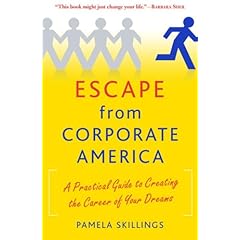
Review: Escape from Corporate America


When Alex sent me his wife's first book, I took a lot of time to get down to reading it. It was the early proof and the cover wasn't what you see on the left side.

Then I wished I hadn't kept it off for so long.

Escape from Corporate America written by Pam Skillings is ,first and foremost, a joy to read. More often than not, business related books are absolutely boring to read, even if the content is quite interesting.

Pam however is a writer who knows her mettle. And she knows what she's talking about. As someone who wanted to be a journalist and ended up working in corporate America to earn her paycheck her book's message is a simple one : "If you are doing something that you are hating just because you think there is no other option, you need to treat yourself better"

Doing so she looks at the people who have left corporate roles behind and started alternate careers, from people like Dilbert creator Scott Adams and Hollywood gossip blogger Perez Hilton.

Skillings is right when she says that most people on most days don't find meaning and engagement in what they do. They spend majority of their waking hours and they don't know how they are getting through it. Most employers are not known for being generous employers and except for a handful it translates that a majority of employers are 'bad places' to work.

She tells the story of an investment banker who became a chef, for example. And she addresses the doubts and risks that all of us have before going so.

This book is not for the entrepreneur to be, or how to make up business plans for venture capital and PE firms. It is a steady nudge showing a mirror on us asking us are you truly happy at your work?

Of course, there are lucky few who get, well, lucky. The learning for us HR types is how we can make that a reality for others too. Pam has a questionnaire that Bob Sutton blogged about here.

Of course as a HR professional I wish Pam had included concepts like Career Anchors and Job Sculpting but I'm not complaining. With these numbers of disillusioned or disengaged employees why are HR groups not doing something to change that statistic.

The chapter that resonated with me most was solopreneurship. Probably because I had done it. I just wish I had this book to read before I took the plunge, maybe things might have been a lot smoother. Pam offers a lot of very practical advice on how to get solopreneurship to work for you.

But as Seth Godin says, sometimes not taking a risk is the biggest risk of all.

Am not sure if the book is available in India (it just launched on 13th May) but you should read it. Even if you are very happy in a corporate job. It makes you look clearly and with humor on what you are giving up on. And that's always good to know :-)

P.S. You might want to read the excepts at Forbes.com

If children or other family members rely on you financially, it's important to make sure that they will be taken care of during the transition. Making an educated financial plan will be a top priority, and you will have to put more money aside to ensure that all essential costs are covered.

Still, while such preparations may take longer, the benefits can more than compensate. You may have more time to spend with your family as a result of your career change. You will definitely be more fun to hang around with once you're working in a career that energizes you.

Many of the successful corporate escapees I interviewed had families to support, and quite a few were the primary breadwinners. They approached their career changes a bit more cautiously than others, but they didn't settle for career drudgery just because they had responsibilities.

Jan 22, 2008

Book Review: 101 ways to Get Wild About Work

Curt Rosengren, blogger turned author has written a book called "101 ways to Get Wild About Work"

As Curt says:

The book was actually born in the blogosphere, as many of the ideas were inspired by posts in my old blog, The Occupational Adventure.Written with the busy professional in mind, the book is designed to allow the reader to work through it one small, manageable piece at a time. It will be available both in paper form (via lulu.com) and as an e-book.


The book contains bite sized pieces of advice that most of us instinctively know, but fail to act upon. Ideas that you are the expert who actually has answers to your queries about work (and not bloggers like me ;-) ) Which is why when people mail me and ask me "What should I do about my career?" they are disappointed with my response which is usually on the lines of "What do you want/like/dream of doing?"

Yes there are really 101 chapters on various aspects of work and being passionate about it. The chapters are divided into topics like Self-Exploration, Getting Unstuck, Overcoming Obstacles, Internal Assets, Support, Creativity/Intuition, Awareness, Change, Taking Action andStaying Energized.

The writing is upbeat, and the message is written straight from the heart. If you are looking at charts and data, you might be better off looking at another place. These chapters are a couple of pages long with inspirational quotes by diverse achievers like Da Vinci to Elvis. There is a strong bias towards tools to help yourself too. People who like to focus on "so what" from a book, would gets lots of techniques to deploy it.

In that way, it's a book for the dreamer and the detail-minded. I think the message from Curt's book is that to be passionate about work you have to be both.

You can find more info and purchase the book at http://www.passioncatalyst.com/101ways .

Jan 14, 2008

Strategy and the Fat Smoker - Book Review


There are only two words I have to describe this book - "Amazingly Insightful"

David Maister blogger and author of such masterpieces like Managing the Professional Services Firm, The Trusted Advisor and First Among Equals, takes a look at why individuals and organizations cannot do what they know should be done.

I was kicked when David's people contacted me to review the book, and when the book arrived in the mail last week, I was engrossed and read it from cover to cover taking small breaks to ruminate and think about it over the weekend.

The metaphor of the "Fat Smoker" is the organization, that needs to change, knows what should be done to change and yet does not change. In a simple, conversational style David Maister brings his key insights to tell us why change in professional services firm is so hard and what needs to be done to make it happen.

That's because, David tells us, that the objective of strategic planning should not be analysis, but resolve. Too many times, in too many organizations - and this holds true not just in professional services firms but in others too - strategy is about saying "this is what we will do" and "these are things we will not do"

The "we will not do" things are tough to imagine and organizations keep losing their focus on it. As an independent consultant I was myself a victim to this thinking. I wondered if I could do blogging consulting, as well as training in traditional HR and Leadership areas and I guess that's where I failed.

Building distinction and differentiation needs to be translated into both the statements. And as David reminds us, it is the leaders of the firms that need to be setting directions by their actions. Any ambiguity is perceived as a negative mark.

He also reminds us that people are of two types, those whose goals are short term and those who prefer a long term view. Then there are people who like to work alone and there are others who prefer to collaborate. Implementing a strategy through a diverse group of such individuals and their different needs can be a huge challenge.

Apart from Strategy, David also covers Client Relationships and Managing and how to tie them up all together.

There are so many gems in this book, that I can't recommend it enough. The part that really resonates with me is chapter 10, why (most) training is useless. I found myself nodding throughout as I read it :-)

If you are a manager, HR and Change leader or corporate Executive who is leading change and wondering why change is so difficult, then read this book. It will tell you what to do - and it can be painful truth. As one of the chapters says: It's not how good you are, it's how much you want it!

Now you can even get the book as a printable ebook. More reviews about the book here and there's a podcast too.

Oct 31, 2007

The Global Brain - Network Centric Innovation

Satish Nambisan and Mohan Sawhney have come out with a new book on harnessing external sources of Innovation called The Global Brain.

In their search for innovative ideas and technologies, companies are realizing the importance of reaching out to a diverse set of external innovation partners. This includes customers, suppliers, amateur or independent inventors, academic researchers, scientists, as well as different types of innovation intermediaries who facilitate the innovation process (for example, idea scouts, invention capitalist, and innovation capitalist). The authors refer to this vast creative potential that lies beyond the boundaries of the firm as the Global Brain.

The term ‘Global Brain’ signifies two things. First, the external innovation partners are diverse in terms of not only their industry expertise or creative input but also in their geographical location. Second, the innovation partners form the nodes on a network – i.e. the innovation network – and it is through their continued interactions that the innovation would emerge. In sum, the global brain reflects both the global scope and the inter-connectedness of a company’s external innovation partners.


I'm looking forward to getting my hands on a copy of the book, specially since I'm very interested in innovation driven by consumers and other partners and secondly because Nambisan is an alumnus from XLRI ;-). I wonder if he'll send me a copy to review?

I wonder how the principles are different from Prahalad's views on Co-Creating Value or John Seely Brown and John Hagel's views on innovation across enterprises.

Jul 1, 2007

Currently reading: Made to Stick

As someone who often gets into anxious mode because the 'best ideas' don't always gain currency, this book is an eye opener. It features what are the characteristics that make ideas 'stick' (yes, I know the word sounds like something from the dot com boom, but it's very apt)

Chip and Dan Heath show that ideas that stick have six characteristic

  1. Simple
  2. Unexpected
  3. Concrete
  4. Credible
  5. Emotional
  6. Story
That's SUCCES :-))


Here is the blog too.

Jun 27, 2007

On business fads

Why is having a blog such a great thing? One can respond quickly to questions by readers. Consulting thought leader and author David Maister responds to a question by one of his readers about Phil Rosenzweig’s book The Halo Effect . As David agrees:

My book, Practice What You Preach, is not covered by Rosenzweig (it wasn’t a best-seller) but I have no doubt he would make a similar critique of my methodology. I surveyed people in 139 businesses on 74 questions and explored the statistical relationships between that opinion data (on what was and wasn’t going on in their office) and the financial performance of those businesses.

I think I would argue two relative strengths of my study: By allowing the statistics to tell me which of the 74 questions had explanatory power, I allowed the data to be discriminating between which aspects of office culture was correlated and which wasn’t.

If you were nit-picking, you COULD argue that all I discovered is which characteristics have a high halo effect (i.e. are given high ratings by employees when things are going well) and those that have a low halo effect. But that’s a pretty complicated argument.

Secondly, I did use a statistical methodology (structured equation modeling) – used by none of the authors Rosenzweig examines – which allows you to test for causality (and the direction of causality) not just correlation. (Which is one of his big concerns.)

So, net, net, net – I think he’s written a terrific book to remind all managers to beware of quick fad conclusions, and to remind all researchers and consultants that many (if not most) relationships in business that we think we know for sure actually don’t have much of a solid research backing to them.

Hmm... Rosenzweig’s book is on my reading list (thanks to the blog hunt prize) and I intend reading it soon. For people interested in more such "fact based business research" you can follow management professor Bob Sutton's (co-author of Hard Facts, Dangerous Half-Truths and Total Nonsense) blog here and the related website here.

Jun 4, 2007

Déjà vu-Reflections on a Visionary co.

Post contributed by frequent conributor R Karthik

The first time i learnt of this word was years ago and i then thought there possibly can't be any such feeling which one gets and intuitively leads him to think he has been through a similar experience or situation earlier. And years later in June '06 when i read Jim Collins' 'Built to Last' there was Déjà vu. It occured to me and i believed that there could be Déjà vu indeed!


'Built to Last' is about successful habits of visionary co.s (so easy to spell that out huh!-the authors & their team took 5 years to complete the ground research and lay the foundations for the work to be written). Not intending to review that book here anyway!
Scores of co.s have been researched and classified into 2 distinct sets.
Visionary co.s according to authors are those which could withstand and grow amidst the ever-transient dynamics of marketplace, industry, CEO transitions, stock market, economic cycles, technology obsolence and so on. Comparision co.s on the other hand are those businesses that did not stand the test of time, got budged from their position, fell down and got eroded by any one of the above factors.

Having defined visionary co.s that way, the authors have established with empirical evidence what it takes to build such businesses and organizations.Some of the key attributes they argue, of visionary organizations are as below

-Big, Hairy, Audacious Goals (BHAG): way of goal-setting
-Cult-like culture: only fit flourishes and a misfit perishes almost immediately
-Home-grown management: a committed approach to nurturing and grooming leaders from within as opposed to head-hunting talent from outside
-Guided & driven by a set of core values always


While i was engrossed in reading this work, with every chapter this feeling grew within me that i have experienced and observed such culture and practices...almost every aspect of visionary co.s that the authors were explaining. All my experiences were directly relating to the organization i was then part of. As a matter of fact...the book i was reading was borrowed out of the office library and i immersed myself into the book when on one of those recruitment tours for them. My understanding of that organization was indisputable and so any concept dealt in the book-i could accurately relate to similar concepts that which existed within that organization. Also as a HR professional i knew the DNA of the organization; i knew the thought and the underlying philosophy for all its moves.

As i completed the book i felt an increasing urge in me to go and discuss this with the VP-HR.
But I resigned saying to myself "i will definitely tell them sometime but not immediately", lest it is miscontrued to be some form of flattery or an exaggeration even.
Months ago, i was checking their website (i do it from time to time as i want to stay abreast of all changes that have happened with them ever since i left-new product launches, press releases and so on) and i found a new link was up on their site. It read BHAG #1....
I chuckled to myself and said "someone from the top team has read the book; the co. has found a reflection of itself in what is being talked about in the book...and now they are internalizing the learnings from 'Built to Last'.
It was heartening to learn that they began thinking the same way i thought much before then and my feeling was again of Déjà vu :)

I wrote to the VP-HR immediately saying these thoughts were on my mind too and expressed happiness about the coincidental matching of thoughts.( It would be presumptous to have called it like-mindedness even though it actually is:))
Such feelings are too hard to resist! Well...anyone buys whaI i have said above?


The most CT jobs await you on the
AllCountyJobs.com regional job board network.

May 24, 2007

6 Books to read

Well the Army Institute of Management, Kolkata had organized a Blog contest which this blog won and now the winning prize has arrived... or I should say, have arrived. Six of the books that I yearned to read arrived in the post and they are:

  1. The Halo Effect: and the Eight Other Business Delusions That Deceive Managers by Phil Rosenzweig
  2. Made to Stick: Why Some Ideas Survive and Others Die by Chip Heath
  3. Resonant Leadership: Renewing Yourself and Connecting with Others Through Mindfulness, Hope, and Compassion by Richard E. Boyatzis and Annie McKee
  4. Hard Facts, Dangerous Half-Truths And Total Nonsense: Profiting From Evidence-Based Management by Jeffrey Pfeffer and Robert I. Sutton
  5. The Long Tail: Why the Future of Business Is Selling Less of More by Chris Anderson
  6. Every Business is a Growth Business: How Your Company Can Prosper Year After Year by Ram Charan and Noel Tichy

So look out for a series of book reviews in the near future as I go through these books. But currently I am busy reading Rushdie's "Shalimar the Clown". So these books would have to wait :-)

Apr 9, 2007

Innovation and Connection

How Innovators Connect - A book review

This is the first book I am reviewing that I received because I'm a blogger here :-) I got an email asking me if I'd like a copy, and since innovation is a BIG interest area for me, I readily agreed.

Rohit Agarwal, CEO of the social networking site for techies called techTribe, has written this book which focusses on the importance of connections for innovations. And the connections he talks about in the book (that he co-authored with Patricia Brown) is not just with other people, but to connecting with self, an idea, the environment, timing, the team, partners, money, customers, humility, failure and spirituality.

It might seem strange to how a person connects to self and what implication it has for innovation. Or even other abstract concepts like humility, but Agarwal and Brown bring excellent examples (though, primarily from Silicon Valley) to bring alive the ideas of the book. Therefore, this book is about innovation at various levels.

At one level it focuses on the nuts and bolts, from how collaboration is a life-line of innovation (why should a larger firm partner with a smaller firm?) to what's a good time to raise capital to how timing can make or mar a breakthrough idea.

On the other side, it also explores the inner mind of the innovator, how failure impacts, how to deal with your ego to how faith and equanimity impacts your innovativeness.

Therefore, this is a book filled to the brim with ideas and examples, and yet the ideas are not joined in a simplistic "how-to-innovate" framework. While that can be challenge for the casual reader, the innovator who wants to bring out his ideas into reality will walk away with learnings from others that are relevant to him or her.

It also has a great collection of stories, from the more well known recent stories like YouTube's success to the habits of successful innovators like Steve Jobs.

The book has been based on a series of 40 interviews that the authors had with people like Guy Kawasaki, Gururaj Deshpande, Jan Baan, Kiran Karnik.

The focus for the book has been technology innovations, with the exception of Sula Wines, which is the only non-technology firm covered in some detail.

The other drawback of the book is that the focus seems to be Silicon Valley innovation, and while that is a great aspirational view to have, there have been quite a few domestic technology innovation and apart from Quintant that later was acquired by iGate, none of the Indian technology innovations are covered in much detail.

In fact, the richest story in the book is how Rohit brought about techTribe to fruition. It's a personal story, and blends in some of the various "connections" that an innovator needs to make to bring an idea to reality. I only wish that the story could have been been a little longer :-)

I think the book delivers on its promise, though at Rs. 950 it seems to be little overpriced.

Sep 20, 2006

Execution by Ram Charan and Larry Bossidy

Overall thought: If you have only enough money saved to buy only one book on business, whether you are a CEO or middle manager or even a management trainee selling soap, then buy this book.

It's one of the best business books that I have read in a long long time !

The book is targeted mainly at CEOs and divisional business leaders of large organizations that are global in nature, yet has enough learnings for everyone connected to organizations, so there are a lot of "a-ha!" moments.

The central premise of the book is that it is the CEOs job to make things happen in an organization and that only vision is useless without execution. Bossidy and Charan take you through what are the reasons why companies cannot execute and what they need to do.

Answer: The CEO has to link up the three functional areas and plans of strategy, people and operations.

The book also talks about the cultural aspects of a business that will help the above to happen. As the authors call it "robust dialogue" must take place without fear for the truth to emerge in each of these areas.

They also talk of the attibutes of a leader, and link "emotional fortitude" on the part of the leader to actually confront reality and take decisions that might be unpopular or heartbreaking.

So if you aspire to rise up the corporate ladder, go get yourself a copy of "Execution"

The TOC is available on this blog post

May 16, 2006

Managers turn authors - Anu Kumar and Ajay MK

After Abhijit Bhaduri it's the turn of two more management people to turn writers.

Ajay MK, a close personal friend is bringing out his short story book "A drizzle of yesteryears" and has even started a blog around it. Ajay works in the HR function of a MNC in Malaysia.

Anu Kumar is having a book release function for her book "Letters for Paul" in Mumbai on the 26th at the Kemps' Corner Crossword flagship store, where filmmaker Shyam Benegal will help launch the novel. Dolly Thakore will alsoread from the book.

May 7, 2006

My favorite books on HR, KM and Innovation

Someone asked me if I could suggest them my favorite books on HR, KM and Innovation.

I thought I'd share it with you too !

Flawless Consulting: A Guide to Getting Your Expertise Used - Amazingly down to earth and step by step guide to anyone who wants to influence without using authority. Peter Block is amazing. Read the latest edition and the added chapter on "The Shadow side of Consulting". Highly recommended for internal support groups within organizations too !

The Headhunter's Edge - Jeff Christian's book will tell you how a headhunter thinks and how you can thereby ensure that your people cannot be hired away by them. Amazing insights into recruitment as well as retention. He fully endorses counteroffers, by the way!

Harvard Business Review on Breakthrough Thinking - If you are in an exploratory mood to read up various viewpoints of organizational creativity then do pick up this book. But if, you are working in an organization, and what to know what to do to take it through the whole end-to-end innovation journey then this book is only an appetizer. You'll have to catch someone else to serve you the meal.

Enabling Knowledge Creation : How to Unlock the Mystery of Tacit Knowledge and Release the Power of Innovation by Kroeg and Nonaka. this book is likely to disturb people who have read and formed ideas about KM by reading works of the American thought leaders. Their premises of Knowledge Enabling and Creation are that Knowledge is justified true belief, individual and social, tacit and explicit, Knowledge depends on your perspective and that Knowledge Creation is a craft , not a science.

Intellectual Capital: The New Wealth of Organizations - Tom Stewart demonstrates how the traditional accounting system and management processes do not take into account the most important things in the company, human capital, structural capital and customer capital.

The Living Company by Arie de Geus talks about the evolving notion of the organization as a living being, instead of just an "economic entity" whose main purpose of existence is to survive, fulfill its potential, and to become great.

Maverick : The Success Story Behind the World's Most Unusual Workplace by Ricardo Semler. In my view this is the organization that most organizations should aspire to become. The holy grail of HR - no HR departments :-)

Self Designing Organizations: Learning How to Create High Performance (Organizational Development Series) by Susan Albers Mohrman.

The book contains a lot of case studies that seek to clarify and demystify the practical delineation of what it takes for an organization to self-design. It also looks at the components of the design process: gaining knowledge, determining values and diagnosing the organization. It also touches on the "zero-sum" designing in which the design team starts with a blank slate rather than with an already existing organisation. The book also describes the action learning sequence of implementing, assessing and iterating. This reiterates the need for hedging against uncertainity and stresses innovation.

An important part of the book refers to what transition roles and structures are necessary. One chapter is devoted to the special challenge of self-design that entails large-scale change.

Designing Organizations for High Performance by David P. Hanna. The book focusses on how to implement various theories to get better results, and therefore is more of a 'how-to' book rather than being comprehensive in treatment of concepts. The how-tos concern two aspects of design , (1) the rational part, including identifying the desired organisational model, structuring the various design elements to produce the required results, and assessing one's progress at any point of time and (2) the emotional part including educating membersabout organisational alternatives to the bureaucratic model, developing their commitment and support for the model actually chosen , changing habits and practices to fit with the "model system", maintaining commitment "when the going gets tough", and renewing the model when circumstances require it.

Of course, there are a lot other great books in the above areas. What are yours?

Nov 23, 2005

Book Review: They Just Don't Get it

First, the disclaimer: I got a mail from Leslie Yerkes' assistant, Stephen, asking me if I would be interested in reviewing a book on Change and Communication. I said that I would, and that's how a copy of They Just Don't Get It! came into my hands.

The book is written in the newly popular style of "business fable" (with lots of pictures) and would last a fast reader less than 30 minutes.

The premise of the book is simple: Sometimes when you are trying to influence people with your views, and they don't seem to get it, maybe the problem is not with them, maybe the issue is with you.

Positioned A-type personalities, who have little time with theory Leslie Yerkes and Randy Martin make a story of an advertising executive who learns to loosen up and get her team's inputs into ideas to make it a richer idea.

No rocket science here, just one concept that's focussed on here.

People who are a little more conceptual and theoretical (like me) would be disappointed, but I guess business executives these days seem to prefer books like these.

Aug 30, 2005

Booming market for HR books in India

The HBS Press honcho says

"HR (human resource) books are very popular in India and are in great demand," said Mark Bloomfield, the associate publisher and world marketing in charge of Harvard Business School Press (HBSP).

"Blue Ocean Strategy", co-authored by W. Chan Kim and Renee Mauborgne, continued to "sell like crazy", Bloomfield said. It has had 29 translations worldwide and 140,000 copies of the English version have sold so far.Another HBSP title that has sold well in India, according to Bloomfield, is "The New Leader", which is the British edition of "Primal Leader", the original US version.He said HBSP was bringing out a new book by Richard Boyatzis and Anne McKee, titled "Resonant Leadership". The company was also getting ready for a November release in India of "The Heart of Change Field Guide", a tools and tactics manual for organisational change.Bloomfield said the largest number of buyers for HBSP editions in India were in Bangalore.Among the Indian authors on HBSP list are Nirmalya Kumar, Sumantra Ghoshal and C.K. Prahalad.

Whew ! I never realised that. Should I start writing a HR book now? Hey how about making this blog into a book. Would you pay to read my rants?

Aug 17, 2005

Semler on Innovation

One example of an organization that has constantly surprised me (ever since I read Maverick) is Semco, the Brazilian company that lets it's employees set their own hours, wages, even choose their own IT. The result: increased productivity, long-term loyalty and phenomenal growth.

Speaking to CIO Ricardo Semler talks about innovation. Some nuggets:

I think what we've done is being emulated because of the amount of dissatisfaction that is rampant among workers, but also among stakeholders. Basically, most career opportunities are fraudulent. The idea that I will hire you, I will train you, I will want to know where you want to be in five years, and then I will give you that better job is totally out of the question. And the other things [besides offering job security] corporations are supposed to do well like innovation, or customer service, they don't do those well, either.

The first anxiety executives have about workers setting their own hours is that people are going to suggest that they come in as late as possible, leave as early as possible, make as much as possible—end of story. And in 25 years we've never heard that. I don't think [that sort of behavior] comes to people as naturally as the anxiety about it comes to the [manager] who's thinking about it. [At Semco,] we always assume that we're dealing with responsible adults, which we are. And when you start treating employees like adolescents by saying that you can't come late, you can't use this bathroom—that's when you start to bring out the adolescent in people.

Jul 27, 2005

Book review of "Mediocre But Arrogant"

As a category the MBA seems under threat, with even the likes of Henry Mintzberg (who gets quoted by all the MBAs) training his guns on them. In India, we are subjected to conjecture and envy when the MBA salaries come out in Feb-Dec. No wonder that the common man questions "Who are these guys?"

Abhijit Bhaduri in his book "Mediocre But Arrogant" tries to answer that question in a humanistic way.

Mediocre But Arrogant is the story of Abbey an unambitious drifter who was good in extra-curricular activities during his BA (Eco) days because he needed the cash from inter-collegiate festivals to pay for cigarettes and coffee. He has clueless about what he wants to do after his graduation and serendipitously lands up for a course in HR from the Management Institute of Jamshedpur.

The book is how Abbey navigates his way through the two years of MBA in Jamshedpur, the girls he falls in love with, the friends he makes, and his journey from a youngster without any clue, to a person who doesn't mind flouting the rules to survive and towards the end of the book, the signs are evident that he's becoming more self-aware and possibly more responsible...?

But the book is more than just about Abbey, it's also about his interaction with systems (like Delhi University and MIJ) and people (from Profs like the respected by all Haathi and feared by all Chatto ) and classmates (from the slimy Gopher, the know-it-all Rusty, the "brains" Sethu). Abbey of course has a major soft spot for the women, and they have a profound impact on him, giving rise to some of his most introspective moments. There is the 'girl back hom' Priya, Ayesha 'the coquette' and Keya 'the lovely'. In each one of them Abbey discovers a human being beyond just the bracket they get slotted in by the boys.

What Mediocre But Arrogant does is that it humanizes the MBA from the analytical left brained creatures of popular media to normal youngsters who have their own set of dreams and insecurities.

While the book is based in the 1980s the world of MBAs have changed, but there are deeper roots that run through. For example, Bannerjee Babu, who does student's assignments and projects for a fee and is the repository of all papers churned out in the past is a human figure of cyberspace which today's MBAs rely so much more on.

What I would have liked in the book is more stories about Abbey's classmates. While the book is written in the first person by Abbey who is quite self-centred stories/episodes about fellow classmates and professors would have made the book much more engrossing.

The humor is always spot on, and anyone who's lived in a hostel with weird people will surely be able to identify with the book. Of course, I think the people who should really read the book are the ones who aspire to do an MBA. The book shatters a lot of myths around MBAs and yet does not demonize them. The cartoons are really good...I loved the ones on the MIJ anthem, OB notes and the Strategic Planning notes. Go ahead, check them out!

Abhijit tells me that the second book will be about how Abbey copes with corporate life. I can't wait for it now ! I want to see what Rusty, Gur, Gopher, Abbey, Ayesha, Sethu will turn into in five years...(you know the campus interviewer's always-in-fashion question..."where do you see yourself in five years?" Will Fundu become an NGO worker? Will Rusty actually move towards consulting? Will the 'jugaadu' guys do better than the ones who studied hard? I would love to know all these... How will they deal with strikes in the workplace? With firing people? With subordinates...?