Aug 4, 2025

Biggest HR Challenges Across Indian Sectors and Innovative Responses


Below is a sector-wise overview of the top challenges HR heads face in India, paired with real-world examples of organizations that have pioneered creative solutions.


Sector-Wise Challenges and Innovations

Sector Key Challenges Innovative Response Organization
Manufacturing Skill gaps on shop floors; compliance with evolving safety norms Augmented-reality training modules for upskilling line workers in real time Tata Motors
IT & BPO Sky-high attrition; need for continuous learning; hybrid work AI-driven learning platform with predictive attrition analytics Infosys
Retail High seasonal turnover; inconsistent service standards Mobile microlearning app with gamified onboarding and performance badges Shoppers Stop
Healthcare Talent shortage; staff burnout; regulatory compliance Holistic well-being platform and on-demand telehealth services for staff Fortis Healthcare
Public Sector Bureaucratic hiring; outdated appraisal systems; multigenerational workforce AI-enabled recruitment portal and 360° feedback dashboards India Post (Department of Posts)

In-Depth: Examples of HR Innovation

  • Tata Motors introduced AR-powered trainers on its assembly lines. New hires don wearable headsets that overlay step-by-step instructions onto their real environment. This cut on-boarding time by 40% and drove compliance with new safety protocols.

  • Infosys rolled out “Lex,” an AI-driven learning companion that curates courses based on career aspirations and flags early attrition risks. By predicting who may leave within three months, HR teams could preemptively redesign roles and incentives.

  • Shoppers Stop launched a mobile-first microlearning app. Rather than classroom sessions, frontline staff complete three- to five-minute gamified modules during downtime. Points unlock instant rewards—driving engagement and reducing first-quarter attrition by 25%.

  • Fortis Healthcare deployed a digital well-being platform offering mental-health counselling, fitness challenges, sleep coaching, and 24/7 teleconsultations for employees. Combined with “no-meeting Fridays,” this has measurably improved staff morale and reduced absenteeism.

  • Facing slow, paper-based hiring, India Post built an AI-based recruitment portal. It automates CV screening, standardizes assessments across regions, and provides managers with interactive performance dashboards—modernizing a 150-year-old system.


Emerging Trends for HR Leaders to Explore

  1. People Analytics maturity
    • Use data to move beyond gut calls—measure engagement drivers, forecast workforce needs, and tailor retention strategies.

  2. Gig-economy integration
    • Extend your talent pool by onboarding project-based professionals onto secure digital platforms.

  3. Diversity, Equity & Inclusion (DEI)
    • Implement bias-free screening, track pay-parity metrics, and launch employee-resource groups.

  4. Hybrid & Remote-First Culture
    • Rethink performance metrics, experiment with “virtual watercoolers,” and redefine the office as a collaboration hub.

  5. Wellness Beyond Physical Health
    • Blend financial coaching, mental-health offerings, and family-support programs into your benefits mix.

By mapping these strategies to your organizational context, you can not only tackle today’s pressing HR challenges but also position your company as an employer of choice in India’s fiercely competitive talent landscape.

Jul 31, 2025

Questions to ask a HRMS vendor when looking to change systems

I’d focus on effectiveness, scalability, integration, compliance, support, and ROI. Here are the key questions I would ask the vendor:


⚙️ Product Capabilities

  1. What HR functions does your platform support?
    (e.g., payroll, leave, attendance, performance management, recruitment, onboarding, learning, compliance, offboarding)

  2. Is your HRMS modular or all-in-one? Can I pick and choose modules?

  3. Can you walk me through the employee lifecycle experience on your system?


🧩 Integration & Compatibility

  1. Does your system integrate with our existing tools?
    (e.g., payroll, ERP, Slack, Outlook, biometric systems, background checks)

  2. Do you offer APIs or connectors for custom integrations?

  3. How do you handle data migration from our current HRMS? Is this included in onboarding?


📈 Scalability & Customization

  1. Can your platform scale as we grow — say to 5000 employees in the next few years?

  2. How customizable is the platform to our HR policies and workflows?

  3. Do you support multi-location, multi-country setups with local compliance needs?


🔒 Security, Compliance & Data Privacy

  1. Where is our employee data stored? Are you compliant with data protection laws (e.g., GDPR, India DPDP Act)?

  2. What security protocols are in place (encryption, access control, audit logs)?

  3. Do you offer role-based access and audit trails for sensitive data?


👩‍💼 Employee & Manager Experience

  1. What does the employee self-service portal look like? Can we see a demo?

  2. How intuitive is the mobile experience for employees and managers?

  3. How do you improve employee adoption and reduce resistance to change?


🤝 Implementation & Support

  1. What is the typical implementation timeline for a 1000-employee company?

  2. Will we get a dedicated customer success manager or implementation partner?

  3. What kind of training and onboarding support do you provide for HR teams and employees?

  4. What’s your SLA for support requests? Do you offer 24x7 support?


💰 Pricing & ROI

  1. What is your pricing model — per employee per month, tiered, or flat fee?

  2. What’s included in the base pricing vs add-ons? Are there hidden costs (e.g., implementation, customization, data storage)?

  3. Can you share customer case studies or metrics showing cost savings or efficiency gains?


🧾 References & Credibility

  1. Who are your other customers in our industry and size range?

  2. Can you share 2–3 references for us to speak with?

  3. How often do you release product updates or new features? Can you share your roadmap?


Would you like me to also help draft a scoring matrix or RFP template to compare multiple vendors?

Jul 30, 2025

Steps for Transitioning to a Skills-Based Organization

In various HR conferences we keep hearing the buzzword - "skills not degrees" - but what does moving from a traditional organization to a "skills based" organization actually mean? 

Steps for Transitioning to a Skills-Based Organization

1. Define the Vision and Rationale

  • Clarify the business case and desired outcomes for becoming skills-based.

  • Communicate how this shift aligns with organizational strategy and culture.

2. Assess Current State and Readiness

  • Conduct a skills audit to identify existing skills, gaps, and needs across the organization.

  • Review current job architectures, organizational structures, and talent processes.

3. Build Leadership Buy-In and Capability

  • Engage executive sponsors and leaders to champion the transformation.

  • Provide leadership training on skills-based principles, metrics, and management practices.

4. Redesign Work Around Skills Instead of Roles

  • Break down traditional job descriptions into discrete skill sets.

  • Map critical tasks and projects to the required skills, not just job titles.

5. Implement Skills Taxonomy and Technology

  • Develop or adopt a skills taxonomy relevant to your industry and business.

  • Invest in digital platforms that allow for skills mapping, tracking, and visibility.

6. Realign Talent Practices

  • Shift recruitment, learning & development, performance management, and career progression to focus on individual skills and growth.

  • Implement internal gig marketplaces or project-based work assignments to match people to opportunities based on skills.

7. Foster a Culture of Skills Agility and Continuous Learning

  • Encourage employees to upskill and reskill through targeted training and access to resources.

  • Recognize and reward skill acquisition, versatility, and knowledge sharing.

8. Adjust Reward and Recognition Systems

  • Evolve compensation and reward structures to reflect skills proficiency and contribution rather than tenure or fixed roles.

9. Pilot and Scale

  • Start with pilot projects in specific departments or talent segments to test and refine the approach.

  • Use data and feedback from pilots to inform broader implementation and continuous improvement.

10. Monitor, Evaluate, and Adapt

  • Establish clear KPIs to measure progress, such as skills coverage, mobility, engagement, and productivity.

  • Continuously adapt the framework to changing business needs and workforce trends.

Shifting to a skills-based organization is a strategic, multi-phase process that requires leadership commitment, robust technology, and a culture of ongoing learning and adaptability.

How AI Is Changing Corporate Learning

Personalized and Adaptive Learning

  • Custom Training Paths: AI tailors learning programs to individual employees, analyzing skill gaps, learning habits, job roles, and performance to provide the right content at the right time. This means employees focus on areas where they need improvement and can skip topics they’ve already mastered, making learning much more efficient and effective123.

  • Real-Time Adaptation: As employees progress, AI-powered platforms adjust the difficulty and recommend new materials based on performance data, ensuring continual growth and engagement24.

Enhanced Engagement and Interactivity

  • Gamification and Interactive Elements: AI enables training experiences that include dynamic simulations, gamified modules, leaderboards, and real-time feedback to boost employee motivation and knowledge retention567.

  • AI Teaching Assistants: Virtual assistants provide 24/7 support, instantly answering questions, clarifying complex materials, and giving personalized feedback, helping learners overcome obstacles without waiting for human intervention16.

Data-Driven Insights and Analytics

  • Learning Analytics: AI tracks employee progress and behavior, providing managers with actionable insights on performance, engagement, and future learning needs. This allows organizations to continuously refine training strategies to maximize ROI and impact574.

  • Skill Gap Identification: AI analyzes industry trends, job requirements, and internal workforce data to identify emerging skill gaps and recommend targeted reskilling and upskilling paths54.

Improved Efficiency and Scalability

  • Automated Content Creation: AI streamlines the process of developing and updating training materials by generating content that remains current and relevant for different job roles and regions12.

  • Administrative Automation: Routine tasks like scheduling training sessions, tracking completions, and managing certifications are automated, freeing up L&D teams to focus on strategic work8.

Hyper-Personalization and Career Development

  • Personalized Career Mapping: AI compares individual employee competencies against industry benchmarks and suggests personalized learning programs to accelerate career growth and mobility24.

  • Reduced Bias: Automated systems can help decrease unconscious human bias in learning and promotion recommendations, making development opportunities more equitable2.

Addressing Corporate Learning Challenges

  • Scalable Solutions: With AI, companies can provide consistent, high-quality training to globally distributed teams, ensuring all employees receive relevant and timely learning experiences without logistical bottlenecks7.

  • Continuous Reskilling: As technology and industries evolve rapidly, AI-driven learning platforms help organizations keep pace by identifying skills that will be in demand and preparing the workforce accordingly59.

TrendWhat’s Changing
PersonalizationTailored learning journeys replace one-size-fits-all127
Real-Time FeedbackInstant, adaptive support and assessments57
GamificationLearning becomes interactive, fun, and engaging56
Virtual AssistantsOn-demand help for learners any time16
Data-Driven StrategyAnalytics drive continuous improvement574
Automated AdministrationL&D teams automate repetitive tasks8

AI is fundamentally transforming corporate learning—making it more personal, data-driven, scalable, and engaging than ever before. Employees can now learn what matters most to their careers with just-in-time support, while organizations benefit from actionable insights and more effective workforce development152.

  1. https://trainingindustry.com/articles/artificial-intelligence/how-ai-is-shaping-the-future-of-corporate-training-in-2025/
  2. https://www.brighteyevc.com/post/ai-for-training-the-evolution-of-corporate-training
  3. https://www.linkedin.com/pulse/how-ai-revolutionizing-corporate-training-game-changer-workforce-8qmwf
  4. https://www.madcapsoftware.com/blog/the-impact-of-ai-in-learning-and-development/
  5. https://disprz.ai/blog/ai-in-corporate-training
  6. https://blog.commlabindia.com/elearning-design/ai-corporate-training-trends
  7. https://elearningindustry.com/benefits-and-limitations-of-ai-in-corporate-learning-a-comprehensive-overview
  8. https://www.linkedin.com/pulse/how-ai-revolutionizing-corporate-training-dr-reggie-padin-ivtne
  9. https://datasociety.com/the-future-of-ai-driven-corporate-training-what-to-expect-in-2025/
  10. https://joshbersin.com/2023/12/ai-is-transforming-corporate-learning-even-faster-than-i-expected/
  11. https://globalfocusmagazine.com/the-role-of-ai-in-corporate-learning/
  12. https://becominghuman.ai/ai-and-the-future-of-corporate-learning-76820deed77?gi=cc7d0198892e
  13. https://www.gyrus.com/blogs/how-ai-is-revolutionizing-corporate-learning/
  14. https://www.commlabindia.com/blog/ai-corporate-training-opportunities
  15. https://groovetechnology.com/blog/software-development/ai-for-training-and-development/
  16. https://www.forbes.com/sites/bernardmarr/2024/10/25/the-future-of-corporate-learning-and-employee-engagement-why-traditional-training-is-dead/
  17. https://disprz.ai/blog/how-ai-shapes-corporate-learning
  18. https://www.edstellar.com/blog/ai-in-corporate-training
  19. https://www.mckinsey.com/capabilities/mckinsey-digital/our-insights/superagency-in-the-workplace-empowering-people-to-unlock-ais-full-potential-at-work
  20. https://joshbersin.com/podcast/how-ai-is-blowing-up-the-corporate-learning-market-the-whole-story/


Sep 23, 2024

Your HR team is facing performance gaps. How can you bridge the divide between team members?

My answer to the question on LinkedIn:


To start, the HR leader needs to diagnose the root cause of "performance gaps". There could be various reasons:

1. Gap in setting goals. Are various HR leaders and managers clear about what they need from their employees. 2. Gap in communicating goals. Do employees know what are high-priority goals, and if there is any change in the period are they communicated it in a timely manner 3. Skill vs Will issue. Do all your HR leaders know each employees strengths on the job as well as their motivation level. As a HR leader do you understand which HR managers are having frequent check-ins with their people? 4. Business Feedback. What do business leaders say about each HR person they have direct contact with. HR exists to serve the business

May 23, 2024

Why you should get your HR team a corporate membership of GHRC

 As some of you may know I recently started consulting as Brand Ambassador and Community Manager of the Global HR Community

If you're in HR here are the reasons why you should get a corporate membership of GHRC

  1. All benefits of premium membership for multiple employees within the organization: Every employee covered under the corporate membership can enjoy the perks of premium membership.
  2. Customized solutions tailored to the organization's needs: GHRC provides tailored solutions such as group training sessions or consulting services to meet the specific needs of the organization.
  3. Dedicated account management and support for the organization's HR team: The organization's HR team receives dedicated support and account management services from GHRC.
  4. Brand visibility and recognition as a corporate member: The organization gains brand visibility and recognition as a corporate member of GHRC, enhancing its reputation in the HR community.
  5. Priority registration and discounts for GHRC events, conferences, and training programs: Corporate members receive priority registration and discounts for various GHRC events and programs.
  6. Access to premium webinars, workshops, and masterclasses: Employees can participate in premium webinars, workshops, and masterclasses led by industry experts to enhance their skills and knowledge.
  7. Enhanced networking opportunities: Corporate members can benefit from enhanced networking opportunities, such as VIP networking events or member directories, facilitating valuable connections within the HR community.
  8. Additional resources such as toolkits, templates, and best practice guides: Access to resources like toolkits, templates, and best practice guides to streamline HR processes and tasks.
  9. Personalized support and assistance from GHRC's membership team: The organization receives personalized support and assistance from GHRC's membership team to address any queries or needs.
  10. Opportunities for leadership roles, committee involvement, or speaking engagements: Corporate members have the chance to take on leadership roles, participate in committees, or engage in speaking opportunities within the GHRC community.                                                                                                                                                                                                                      


Nov 22, 2023

Gamifying HR; AI and Organizational Communications

I was recently interviewed by Yashika Begwani who hosts the Voice of Achievers podcast 

Mar 23, 2023

Event Report - Cornerstone Connect Live at Mumbai


On February 15th, Cornerstone's Connect Live event was held in Mumbai, India, where CEO Himanshu Palsule emphasized the critical skills gap in the country and the need for learning to address it. He highlighted that not only does the skills gap impact individual employability, but it also affects the growth and productivity of the Indian economy. Cornerstone, with EdCast, SumTotal, and Saba, have become the largest learning platform company globally, serving 7,000 customers and over 100 million end-users.


He further stressed upon the democratization of talent and how employees expect their organizations to take initiatives in skilling them. He warned that companies that fail to invest in employee development risk losing out to competitors who do and urged organizations to act. Himanshu also expressed his belief that technology plays a significant role in addressing this issue and presented the vision of the Cornerstone Talent Experience Platform. 

In the keynote, Yashwant Mahadik, the Global CHRO of Lupin, shared his experience and discussed the complexity of a global LMS rollout. He highlighted the challenges that leaders will face in the future and predicted that immersive learning using virtual and augmented reality will be the next big thing. Mahadik emphasized the need for leaders to be in tune with technology to remain relevant in the future. 

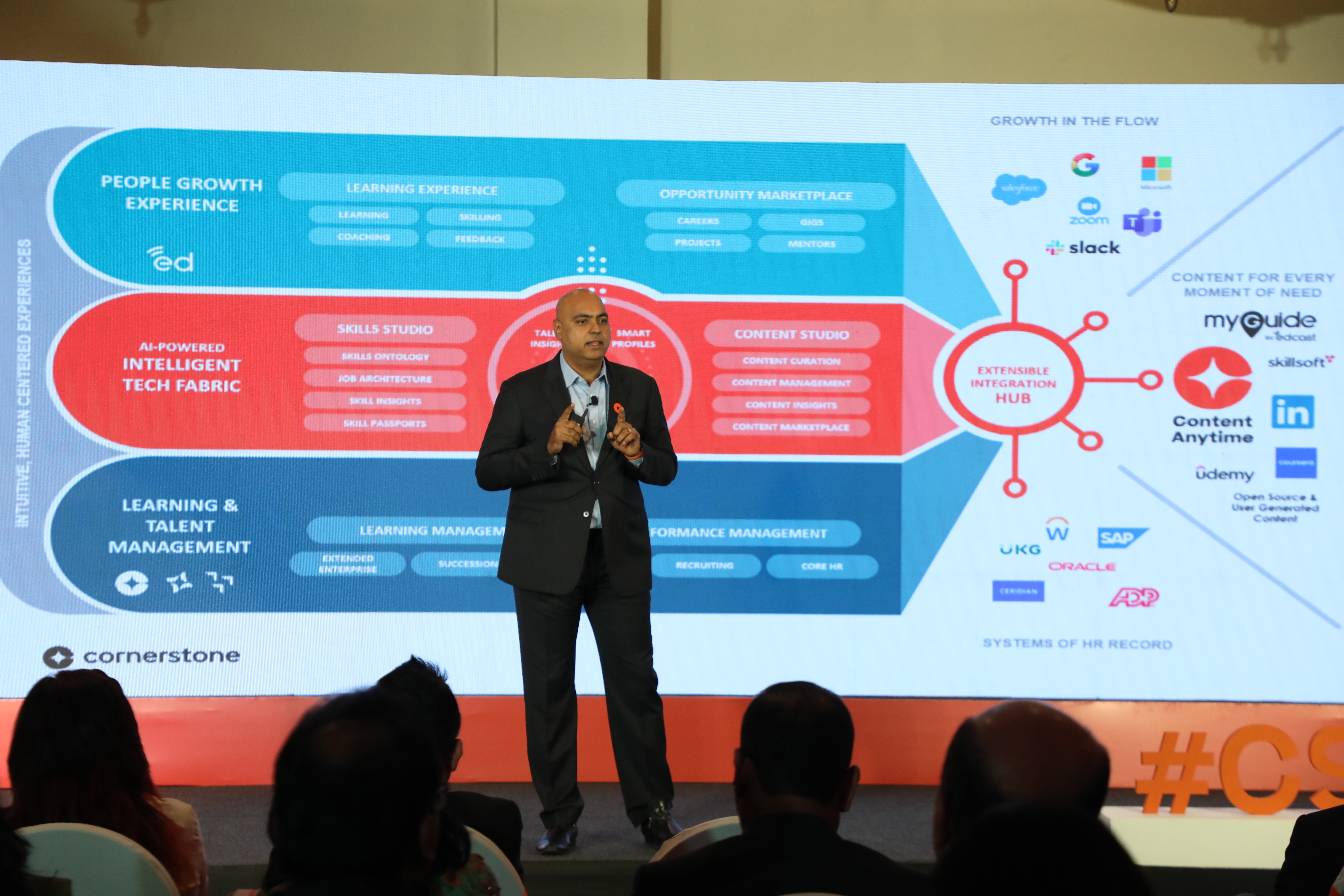
In the product deep-dive session, Cornerstone’s Chief Product Officer, Kartik Suri unveiled Cornerstone's Talent Experience Platform, where the best-in-class learning, performance and talent management capabilities are married to holistic, highly engaging, personalized people growth experiences, interconnected by intelligent tech-fabric with AI-powered skills, highly context-aware content, both of them fed through a people-intelligence data layer, all built on an open ecosystem with an extensible integration hub.

In the CXO panel discussion, Nishchae Suri, MD at Cornerstone India, began by sharing insights from the Learning Health Index survey, which revealed that corporate India operates at only two-thirds of its potential, despite 82% of employees expressing a desire to take ownership of their learning. The panel discussed the need to bring enterprise technology up to par with consumer technology, with Mohit Kapoor, CTO at Mahindra Group highlighting how his team tracks Employee Waiting Time, a metric that measures the time it takes for a request to be approved from the time it was raised.

Carmistha Mitra, CLO at Axis Bank emphasized the importance of technology providing hyper-personalized data to both employees and the business while making supervisors accountable for their team's learning. Animesh Kumar, President - HR and Transformation at Zee stressed the crucial role of managers in facilitating learning and development, describing them as the linchpin for success in this area. Abhilash Misra, CEO of NSE Academy spoke about the importance of investing in one's own learning through a Systematic Learning Plan (SLP). 

In the Customer Success Story session, Prateek Mehta, head of Mahindra leadership University shared insights into how Mahindra Group re-imagined learning using EdCast by Cornerstone’s Learning Experience Platform. In a refreshingly candid presentation, Prateek discussed the mistakes made and the lessons learned along the way, ultimately resulting in an impressive adoption rate of 80% and a Net Promoter Score (NPS) of 66. 

The event concluded with an inspirational talk by Ashish Vidyarthi, an actor turned speaker, who shared his personal journey of finding his voice by remaining open to learning, regardless of where he found himself in life. He emphasized how technology has simplified life and provided opportunities for individuals to reinvent themselves, provided they possess a curiosity and willingness to learn. His talk left the audience feeling inspired and motivated to embrace continuous learning in their personal and professional lives. 

Looking into the future, with the potential to be a game-changer in the future of learning, talent, and work, Cornerstone's Talent Experience Platform (TXP) could revolutionize the way individuals approach personal and professional development while equipping businesses with the necessary tools to thrive in an ever-changing landscape.

To learn more about Cornerstone’s Talent Experience Platform, visit www.csod.com