May 30, 2011

Social Intranets catch on

Interesting findings from a recent survey:
Social media tools on the corporate intranet (intranet 2.0) became mainstream nearly two years ago.  Preliminary results from The Social Intranet Survey (open now, prepared by Prescient Digital Media and sponsored by IABC) show that about two-thirds of organizations have at least one social media tool on their intranet. Shockingly, there are some pundits that still think social media is still a fad. In fact, they couldn’t be more wrong.
But wait, the social intranet phenomena is bigger than you think: of those that have social media on their intranet, 59% claim to have a “social intranet” (preliminary data, 400 respondents, The Social Intranet Survey.

Here's an easy way to make Microsoft SharePoint social, if that's what you're looking for!

May 27, 2011

Workshop on Social Business and Employee Engagement for HR

I would be taking a workshop along with the National HRD Network on Using Social tools to build Employee Engagement, in Delhi on 24th June. You can take a look at the event here and register by sending an email to the email address mentioned on the site

What will the workshop cover?

  • Importance of social media and its impact on society and businesses
( Looking at how the larger trends of how social technologies are impacting society, media, politics and businesses. Focusing on how businesses are using social networks to market, support and co-create with customers)
  •     The Millenial generation and their expectations from organizations
(The new generation which is entering the workplace is the first which has exposure to social applications before they join organizations. How does that impact their expectations about sharing and connecting in organizations?)
  •     The imperatives for Organizations to embrace Open Collaborative nature
(We shape our tools, and then our tools also shape us. It was true in the prehistoric age and it is true in today’s age. How does the new workplace and social tools impact organizational culture)
  •     Use of Social Technologies by HR
(How social technologies can be used by HR to : increase employee communication, better employee communication , build innovation and learning)


Who should attend :
The program is open to HR Practitioners with any level of work experience. Managers from any other function would also benefit from this workshop.

So will I see you there?

Is Mobile Learning the future?

Well, I have always been sceptical of the term mobile learning. As someone who's had a grounding in traditional learning and development, I have seen how e-learning failed to live up to its hype. People started talking about "mobile learning" some 5 years ago, based on text messages.. and with the proliferation of apps and smartphones I think it is coming back, as a study by ASTD/i4cp survey respondents seem to be bullish about it:

· 57% said within the next three years, companies will design training programs to be accessed by mobile devices

· 55% have the internal expertise to design training systems accessible by mobile devices

· 47% will make use of smart phone apps for the purposes of learning

If that is the case, I would make a case for not content to be ported to mobile, but the ability to connect and share with fellow learners before and after the classroom event, that would be more valuable. And while this data may be for the US, I wonder how it would translate to the Asian markets where feature phones still rule, and smart phones are used only by corporate leaders.

What do you think?

May 24, 2011

What's Your Cause?

I attended a meet of HR professionals last week, and the topic being discussed there was attracting and retaining talented employees.

One of the speakers started sharing how difficult it was to retain and promote employees into leadership positions when they don't have "life experiences to lead"

I felt I had to interject then - "That's a fallacy, I think. In the armed forces we have 23 year olds leading large groups in a life and death situation. They don't need 'life experiences' to succeed in leadership roles."

Another speaker then said "But the army is a very hierarchical structure with strict discipline and tradition of following orders without question. That's the reason why, maybe..."

Then I added "Then take examples of activist organizations, like Non Governmental Organizations - people take leadership roles at a young age, do more with less and don't need hierarchical structures to do that"

What was common to both the examples I shared?

Both types of organizations have a larger cause that is always inspiring to the people in it. For the armed forces its a desire to save the country, the regiment, or the pride of the platoon. For the NGO it could be the fight to remove poverty, disease, illiteracy.

Why don't most organizations have inspiring causes?

Having an inspiring cause is IMHO one of the key components of employee engagement - and also customer engagement

Does your company articulate its vision in the form of a cause? Can you share it in the comments below?

May 23, 2011

Social Business and Employee Communications

Got these questions from a journalist about how technology is changing employee communications - and my answers


  • How important is it to communicate with an employee in an organisation?
    • Employee communication is often the most ignored aspect of HR initiatives without too much thought or resources being dedicated to it. HR people often forget that communication is a two way process. In my view it is critically important to listen to what employees are saying, and that is an aspect that is usually not done in organizations on a regular basis, apart from an annual or semi annual satisfaction surveys. Communication is the bedrock on which the success of change initiatives hinge.

  • What kind of methods do you use to communicate with your employees?
    • In Qontext our employees are constantly communicating their ideas about our product and strategy and interesting content they come across – with all of us on the employee social network internally. It helps each of us to know what people are feeling, doing and sharing on a regular basis. The social intranet also allows us to share corporate news – which employees can connect on and “like” – and goes viral , helping people engage with the item in a much better way, than say, an email communication. The employee newsletter is ,for example, a crowd-sourced initiative.

  • How do you inculcate technology in your communication? How have you benefited?
    • We are a technology company, with a young workforce so our internal employee social network (which we also deploy for clients) is the core aspect of how we connect employees to each other and the employees to the organization. By doing so, we have reduced our dependence on one way broadcast emails for communication. People share ideas and knowledge on the communities and groups on the network, adding to everyone’s knowledge and reducing rework.

  • How do you plan to stay ahead of the curve with a comprehensive employee communication strategy?
    • We are constantly looking at adding functionalities to the employee social network, making it a default place for people to do their work. We realize that employee to employee communication is as critical to build an engaged workforce.

  • How do you leverage employee communication to build organizational effectiveness, trust and understanding?
    • There are three factors of building an engaged workforce – how an employee feels about work and immediate team, whether the employee has friends at work and how does the employee feel about the organization. The Second and Third factors are increased and reinforced by using the Qontext employee social networking tool. Just by deploying this tool, we (and our client organizations) showcase an open and trusting culture. It shows that the organization cares for the views of the employees on a daily basis and. It enables employees to make connections with other employees in other business units and locations that they might never have connected with – if such a tool was not available.

  • What are the changing trends in employee communication?
    • More and more listening to employees. I foresee large organizations large organizations will soon start analyzing data on which employees are thought leaders, experts and influential amongst the workforce (like marketing does for external customers) and try and build them as employee advocates.
    • As more and more younger workforce enter organizations, their expectations shaped by consumer social applications like facebook, twitter and blogging, they would want access to similar tools within the workforce
    • The next step would be mobile. For example Qontext is already available as a mobile app. This would be a key aspect for organizations with a large sales force who are
    • Communication would lead to collaboration – as more and more employees connect and communicate with each other, they would change work processes itself, making things work faster better and changing processes. Organizations have to continue being open and continue the trusting processes earlier.

    Looking for partners and resellers

    I'll try to keep Qontext posts to a minimum on this blog :-) But I think this is a must for Independent Software Vendors and Resellers who are interested in Qontext, check out this site or contact:
    partners at qontext dot com
    Software VendorsIndependent software vendors can not only instantly social-enable their applications, but they also join a growing community of application providers. Because Qontext enables social collaboration to be tied across applications, by integrating with Qontext, you can immediately offer value to customers of our other ISV partners. For example, customers using Qontext with a CRM system can now link collaborations in CRM to orders in your order entry system. Or a HRIS system can pin "conversations" on performance discussions and applicant tracking systems
    Integrating Qontext can literally social-enable your application within days instead of years to build comparable features.

    Resellers
    Qontext is owned by the global enterprise software company, Pramati Technologies. It is built to handle enterprise scale without compromising on simplicity. Qontext’s social capabilities plus universal toolset and the cloud-hosted or on-premises options are applicable to companies small and large.
    Some example service opportunities for resellers and VARs include:
    1. Best Practices & Community Customization: Assist customers with implementation, community setup, customized policies and procedures
    1. Application Integration: Help customers integrate Qontext with existing off-the-shelf and/or custom or legacy applications.
    1. Custom Extensions: Leverage Qontext’s comprehensive APIs and UI widget architecture to extend Qontext to new uses or devices.

    May 20, 2011

    Implementing Social Business Software

    I just got off the phone - after a conversation with some students of Singapore Management University who are working with a large hi tech firm in China - doing a project on how social media internal deployment can help the organization innovate and increase productivity.

    Some of the questions they asked and my answers

    1. How can businesses measure the success of a social business deployment

    Each business must be clear for the reason they are leveraging social technologies in the workplace. Metrics can be adjudged and measured against the objectives. Sure, every social technology implementation will have other benefits and consequences - however the primary reason needs to be measured.

    2. What role does HR play in social media within organizations?

    Ideally HR has to be involved (along with Quality, IT, Communications, KM) when an initiative like this takes place. That's because it impacts people, their work, information and what they share. It is great when it is championed by the leadership - as then it makes the most impact. While there are tools where you can sign up for free and use it under the radar of traditional systems, to really make an impact these initiatives have to be embraced by the whole organization and connect with ways people are already working.

    3. What makes such a deployment a success?

    Community facilitation. And content for people to engage with. Both of these need to be designed and set up well to ensure employees form communities.

    So what do you want to know about how to make your workplace "social"

    Social Collaboration and Knowledge

    My colleagues, Jay Pullur, CEO of Qontext, and Samir Ghosh (blog, twitter) VP of Strategy recently wrote a white paper for KMWorld. You can download the full paper (in pdf form) from here

    Here are some excerpts

    Social collaboration includes a bundle of key advantages for knowledge management. Following are some examples:
    Personal information cloud: Social, for the first time, is helping to move information from personal silos like email inboxes into a centralized cloud where it can be captured, analyzed and discovered by others;
    Social bookmarking: As the amount of content on the Web explodes, sites like delicious.com, stumbleupon.com and digg.com have demonstrated the value of democratized content recommendations;
    Media abundance: The eruption of mobile devices has flooded us with multimedia, including photos, audio and video.
    Social collaboration leverages familiar interfaces (from sites like facebook.com, flickr.com) for submitting and organizing media on varied devices;
    Crowdsourcing: By breaking problem discussions out of email into a controlled, more transparent forum with self-subscription capabilities, larger, more diverse groups can be leveraged for faster and better problem solving;
    Consumer-driven: Portals and internal solutions are only useful if they deliver what users want and expect—currency, relevance, interaction;
    Engagement: Social engages users. One out of every eight minutes online is on facebook.com ; and
    Discussions: Not all important knowledge ends up in documents. In fact, the average person sends and receives about 200 emails per day
    Email is (currently) where knowledge goes to die.
    Instead, social collaboration captures this knowledge for easy future recall and discovery.

    Information workers need fewer, not more, collaboration destinations. The productivity losses of email interruptions alone are 30%
    The context switching that users experience when, for example, attempting to resolve an exception in an order-entry system, creates friction in the business process. This friction can result in process delays and other inefficiencies. The answer is to build the collaboration service directly into the business process. Linking the collaboration content to the associated business objects then enables contextual recall, improving overall knowledge management

    Social applications like Facebook, while social in purpose, also include social collaboration tools that can be utilized inside of business organizations for knowledge management and productivity gains. To Maximize these benefits, consistent social collaboration tools should be integrated across the business applications used every day.

    May 19, 2011

    Connecting, Sharing and Collaborating

    What causes people to connect with each other? The answer is elusive and yet critical for us to understand the processes that lead from connecting to sharing and finally to collaborating.


    • Connection - happen often serendipitously around common interests, passions, practices. Over the last several years of blogging I have connected with people from the areas of HR, Recruiting, KM, Consulting - things I have blogged about and have read on their blogs - identified with their passion that gets articulated from their writing and ultimately leading on to making a connecting - either by linking to them, leaving a comment (most of the time both of them !) Ever wondered why the umpteen people you meet in conferences do not get to build those relationships? That's because (in my opinion) the "visibility" of the common interests are not two-way. Let me explain - when I am at a industry meeting/conference I have had lots of people come up to me and say they read my blog/like it etc. However, what I don't know is their interests, their passion about the subjects, hence coming in the way of building a connection. 
    • Sharing - This is the second step of the relationship - and builds trust to a large extent. Again, blogging has made sharing a one sided process, personal bloggers share their vulnerabilities and professional bloggers about their low phases. Sharing information reinforces the connection too. When the sharing is both or multi-sided, they can eventually get round to working in the next step
    • Collaboration - Collaboration is when two or more people work together towards an outcome. When a group works together the processes they follow is summarised by Tuckman's model. Using social technologies the forming stage is by self selection based on connection and storming and norming is facilitated by sharing - which gets round to performing as a collaborative group. 
    All these three stages are rooted in the "social object" of the community formed by the above steps. The strength in each of these steps enables the community to reach the next step and reinforces the previous one too. So it's not really a step like the visual shows but more like a spiral growth.

    Your thoughts?

    May 11, 2011

    Personal Brands as Influencers - The New Role

    Yesterday there were a couple of interesting articles by Rawn Shah and Paul Greenberg.


    Rawn wrote about the Social Business Jam that IBM organized (and I participated in) and asked whether the role of Personal Brands raise questions for HR

    He quoted some comments from the jam (and I think I made one of those, but can't be sure for now :-)) and asks the questions:what t

    • How should personal brand value relate to compensation?
    • Should this compensation financial, non-financial recognition, or counted as special award criteria for long-term development?
    • Should compensation be based on outcomes from specific events, or should it be based more of a general quality of a person not specific to a particular event?
    • Should there be set targets and goals appropriate for their level of skill in being social?
    • Is the value of a particular outcome itself measurable on a business level? Who can measure it vouch for its value?
    • Is this expected for this level of employee or is it a degree of influence unusual and above the level they are expected to perform?

    Personally I think these are new kind of roles - and need to be tracked and compensated for, not as addition to - but as roles in themselves. Such as the "vendor influencers" list that Paul Greenberg compiled (that includes my friend Prem)

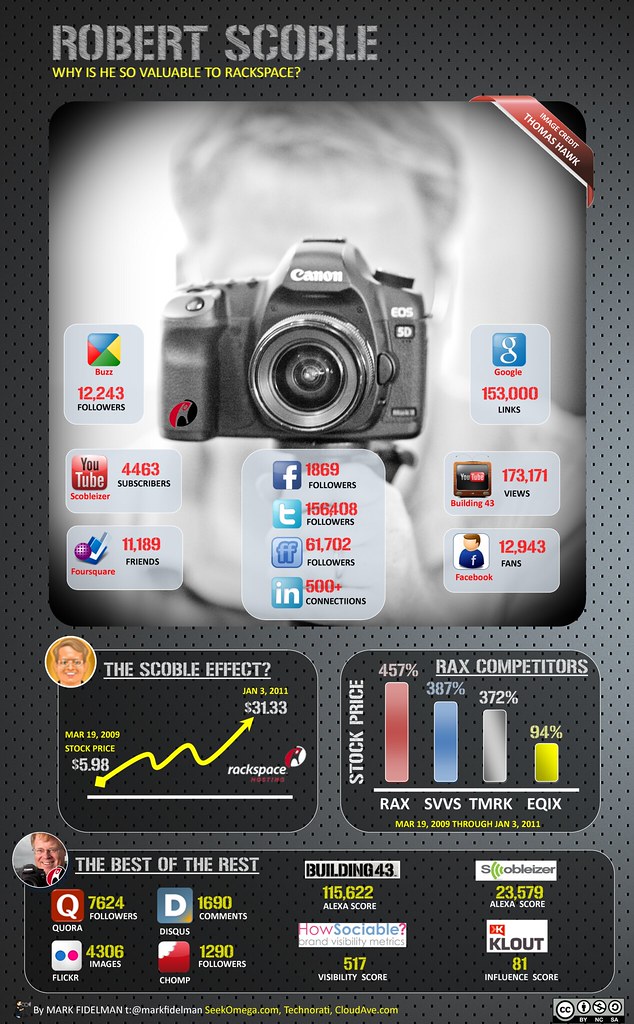
    Organizations that want to leverage the credibility of their "social ambassadors" in their respective fields need to carve out a role that connects with their passion and interest (in fact using Waldroop and Butler's Job Scultping model this applies to all employees!) and arrive at a consensus of what these would be. (Take Mark Fidelman's post on the Scoble Effect, and decide whether you need to hire a Robert Scoble)


    So what do you think?

    For brands marketing in the age of social media, is the brand evangelist/ community manager / product evangelist (ahem!) a critical role? How would you evaluate them?

    Two must read articles : Ray Wang on the Trends and Influencers using a variety of vehicles and Michael Wu's series of posts on Influencing and Influencers.

    Next Step for Social Business - Making ERP social and collaborative

    I have always believed that "social" in the social business has to contribute to the business aspect of the firm - in addition to connecting employees to employees and employees to customers.

    One key aspect of Social "contextual collaboration" is that it often creates silos - ironically. Discussions happen in the "systems of engagement" (social intranet/ enterprise 2.0 apps) whereas it is not reflected in the "systems of records" (business applications, documents etc)

    This dichotomy is what we at Qontext want to bridge. And for which Gartner recently awarded Qontext the "cool vendor" for 2011 for context aware computing :)

    To quote:

    A key finding in the report, available from Gartner, states “Organizations need to understand the principles of context-aware computing to properly filter the increasing amount of sensor, search, analytics, location, presence and social information they can use to enhance applications and user experiences.”
    While the benefits of using internal social software is gaining widespread acceptance among enterprises, most employees and departments would like to see immediate and sustained benefits. Tangible benefits are realized when social collaboration is integrated within the applications used every day, by preventing loss of productivity due to context switching and aiding knowledge capture and reuse. Qontext does this by providing immediate access to contextually relevant communications and documents right inside and across business applications.

    Yesterday, we took a huge step forward in that direction when we partnered with NetSuite (the #1 Cloud ERP / Financials Software Suite) - to enable contextual collaboration within NetSuite's applications.


    You can see this slide deck on how Qontext integrates with applications in NetSuite
    Klint Finley wrote on the ReadWriteWeb Enterprise blog

    NetSuite already supports enterprise social collaboration through Qontext. Qontext enables customers to add microblogs and activity streams directly into applications so that users don't need to leave their primary application to participate in discussions.

    May 9, 2011

    Case for Enterprise Social Networking in Organizations

    I contributed an article to the Citeman portal, which is one of India's leading management portals.

    You can read it here Case for Corporate Social Networking, in short for employee engagement, communication, learning and building an open culture.

    Comments welcome, here or there :)

    May 5, 2011

    Culture and its impact on Social Business

    Interesting case study by Dinesh Tantri on his blog how Thoughtworks' culture was critical in making its Enterprise Social Network a success

    ThoughtWorks is a “positive deviant” in many ways – Over the past 17 years we have experimented with and evolved a number of organizational and people practices that are fundamental to building a collaborative work culture. These practices and beliefs form the corner stone of what we call our “Global Social Infrastructure” :

    Our belief that culture is the long term advantage not business models
    Small Offices – We limit the number of people in each office to 150. People get to know each other better, there is better trust and deeper knowledge sharing
    Open workspaces act as change agents – None of our offices have cubicles – None in leadership team have a private cabin.
    Loose Hierarchies – our organizational structure resembles a fishnet with “temporary centralization based on purpose and need.“
    Smart Incentives –Peer recognition and intrinsic motivation drive collaborative behavior
    Informal Communities – We have always had thriving communities & fantastic conversations. None of them are “official” per-se. Most of them are self-assembled groups of passionate people – Irrespective of the platforms we have used in the past [ Mailman, Google Groups etc., ], we have always had intense conversations and debates in these communities. This is a side effect of the kind of people we hire and the traits we look for. Face to face community meetings are another key aspect of the culture. Every region has its own style and rhythm – Friday Pubs, Lunch and Learn sessions etc.,
    Transparency and trust – This is a key part of our culture – Giving people on the ground access to resources they need and letting them make decisions is a major way of engendering trust. The rule of thumb on the transparency is “as much as people can tolerate “.

    An open and transparent organizational culture will take to social networking like a fish to water, however it should be remembered that it is not a "necessary ingredient". If traditional organizations have the intent, they can also move towards creating an open and collaborative organization using social networking tools if they follow the process :-)

    May 4, 2011

    All the Enterprise Social Media blogs on Alltop

    Now there's a resource for people interesting in Enterprise 2.0, Social Business, Enterprise Social Software. The folks at Alltop have put together a list of all blogs around the subject - and this blog is listed there too (ahem!)

    Some of my favorite blogs are listed there, for example The Social Workplace blog (props to Elizabeth Lupfer who worked to Alltop to create the list), Oscar Berg's The Content Economy , The Dachis Group's Collaboratory, and Dan Pontefract (who like me comes to this field from a training background)

    This is the fourth Alltop list this blog is listed on. Others being the HR, India and Career list on Alltop.


    May 3, 2011

    How Qontext works as a Social Intranet

    I thought it would be a great idea to show how we use social features in Qontext, for business to employee communication as well as employee to employee communication.

    So when I log into my account this is what I see

    At the very top are the places that shows new alerts meant for me (in this screen grab nothing for me, else that small icon would be red)

    On the top are the stories spotlighted by the organization. These could be news items, information, quizzers, surveys or other media. Those are highlighted by the red rectangle in the picture above.

    Under that in the blue rectangle is the quick posting area - where I can post a status updates (like Twitter - with 140 character), a message (like an email), a blog post, a wiki page (so that others can edit and add to it) One can also upload documents, presentations, videos, polls

    When I post these I can specify that these are only to groups I am a part of (red rectangle on the left sidebar) or whether they are public or private to certain employees (who would get it as an alert when they login)


    See the screen capture below for more


    The green rectangle shows the activity feed (postings of the people I am following or in the groups I am a part of). And I can toggle to see public timeline (see postings by everyone who posts publicly)

    I have almost given up using email (I use it only for external emails) and share information with my colleagues using the blogs/wikis/status messages/bookmarks

    When my colleagues "like" my updates it gives my engagement a boost too :-)

    Looking through the public timeline I am able to discover people who share my interests and have conversations with them. And because the "connections" I make are like twitter (one way, following people) there are no awkward conversations like "why didn't you accept my request to connect?" :-)

    When I get alerts (which is when someone alerts me with a post, or when someone leaves a comment on my post) this is the screen I see.

    What I like about this is that it reminds me of the user experience of MS Outlook and when you click on an item it opens like an email does in MS Outlook. Which makes it comfortable for people to use, as it reminds them of a familiar interface.

    You can see more of the features here

    Of course there are lots of more features in Qontext, like integration with business applications like HRMS, CRM, SCM and ERP systems

    By the way, there's an app for the iPhone by Qontext too

    This is how the how the phone screens look


    May 2, 2011

    Two lists of Thought Leaders I am listed in

    I thought I won't blog about these, because I don't think it's very modest to tell people when others consider you a "thought leader".

    However, I realised that since you folks notice what I post, maybe you could leave a comment here saying I shouldn't deserve to be on these lists ;-)

    First is the list of Social Intranet, Enterprise 2.0, Collaboration, Engagement, and HR Technology Experts compiled at the Social Workplace blog.
     Then yesterday, blogger from Australia, KerrieAnne Christian put me in exalted company in company of today's thought leaders like Seth Godin, Malcolm Gladwell, Clay Shirky, David Gurteen and others.
    I was really embarrassed and flattered to be considered by KerrieAnne to be considered in the same league as these others, but I really don't think I deserve to be on this list.

    What do you think?

    The Facebook page crosses 1000 likes

    Today's a red letter day for me :-)

    My blog's Facebook page has crossed a 1000 "likes"
    What happens on the Facebook page? Well, I share the posts I make on the blog, as well as some interesting links I come across.

    Hoping to share more content in it.

    Oh, by the way, I also added the Facebook "Send" button on the top of the blog. Now you can use it to share the blog with specific people and groups on facebook.

    Enterprise Social Software Qontext chosen as a Cool Vendor of 2011 by Gartner


    We got this awesome news - and I couldn't resist sharing this with all of you :-)Recognition by an analyst firm like Gartner is a huge boost for the young team at Qontext Inc., and a reminder that we are on the right way - making collaboration and corporate social networking contextual.
    Amplifyd from www.qontext.com
    A key finding in the report, available from Gartner, states “Organizations need to understand the principles of context-aware computing to properly filter the increasing amount of sensor, search, analytics, location, presence and social information they can use to enhance applications and user experiences.”
    While the benefits of using internal social software is gaining widespread acceptance among enterprises, most employees and departments would like to see immediate and sustained benefits. Tangible benefits are realized when social collaboration is integrated within the applications used every day, by preventing loss of productivity due to context switching and aiding knowledge capture and reuse. Qontext does this by providing immediate access to contextually relevant communications and documents right inside and across business applications.
    “Social contextual collaboration delivers true ROI and sustained adoption to an enterprise by augmenting existing business processes,” said Jay Pullur, CEO of Qontext Inc. “We consider our inclusion in the Cool Vendor report by Gartner as confirmation of our mission to enable customers to unlock the power of social collaboration.”
    About the Cool Vendor Selection Process
    Gartner’s listing does not constitute an exhaustive list of vendors in any given technology area, but rather is designed to highlight interesting, new and innovative vendors, products and services. Gartner disclaims all warranties, expressed or implied, with respect to this research, including any warranties of merchantability or fitness of a particular purpose. Gartner defines a cool vendor as a company that offers technologies or solutions that are: Innovative, enable users to do things they couldn’t do before; Impactful, have, or will have, business impact (not just technology for the sake of technology); Intriguing, have caught Gartner’s interest or curiosity in approximately the past six months.
    Read more at www.qontext.com