Jan 26, 2012

The Future of the Resume

Social-network
Image via Wikipedia
I tweeted this WSJ article "No More Résumés, Say Some Firms" and got some interesting responses from folks. Yes for some jobs your "web presence" is becoming more and more important. And others require you to do online quizzes and solve problems before you can apply (therefore weeding out people who don't meet some requirement for the job)

One recruitment consultant replied that two of her clients ask her to send candidates' social network URLs to them. And one of them, a startup IT firm, insists that all the candidates should have tech blogs. (this is in India!)

However, the death of the resume is greatly exaggerated.For one, such roles and organizations are miniscule. The processes and systems of traditional organizations with its armies of sourcers and recruiters and technology like Applicant Tracking Systems understands the resume better. And while you might be fortunate to get interviewed by a company that can make a decision about your expertise using your social web presence -that will continue to be in the edge as that method is not scalable yet for large to medium organizations where the number of applicants per job vacancy go from 10 to 25.
 
 However, for key skills in certain roles focusing on social web presence is critical as external people often trust a regular employee over a financial or technical analyst and the CEO according to the Edelman Trust Barometer for 2012. So we will continue to see services like re.vu (you can find mine here) who aim to turn your resume into a visual story too. Looks kinda pretty, doesn't it? Then there's About.me (mine) and Flavors.me (mine) who all try to get to unify your social web presence.

Not to forget the 800 pound gorillas fighting to own your digital identity - Google (my Google profile is now Google+) and Facebook and Twitter (which adds a rel="me" tag to the URL you add to your website there)

So the moral of the story, keep your resume polished and keep the same information in the big profile pages too. And start writing a blog (specially if you're in technology!)
Enhanced by Zemanta

Jan 21, 2012

The Best Companies to work for - social media wise!

Fortune put out its list of 100 best companies to work for. But it also put up another list on which of the top 100 are leveraging social media and networks both externally and internally. I loved the list and thought I'd share some examples here:

Marriott : The longtime face of Marriott International, Bill Marriott, has operated a blog since 2007, and the company uses mainstream social media such as Facebook and Twitter extensively. the company ventures into new ground with its My Marriott Hotel social game. The game allows users to manage different elements of a Marriott hotel. Even with languages such as Arabic and Mandarin supported, it might come as a surprise that the city with the most players is Cairo, according to the company. Associates can post ideas for corporate changes to the "Did You Think of This" internal website, and several hundred entered a video contest submission through Marriott's jobs and careers pages on Facebook. The company also periodically has its officers hold question and answers sessions online, such as a human resources executive providing insight into the job search.

Google: Social media used: Twitter, LinkedIn, Facebook, YouTube, Google , Google+, Google Groups, Magnet (internal tool), internal and external blog
Google also uses social media heavily in its recruiting operation. In addition to a Google students page, the company posts live streams of Google+ Hangouts on Google provide applicants with feedback on the hiring process, such as what code languages to know at interviews.

SAS Institute: SAS offers substantial training in social media for its employees: its new education program, "Social Studies," provides workshops and training modules, while an optional responsible-use course had several thousand participants last year.

Intuit: Internally, Intuit has a news portal, SNAP, within its proprietary intranet. Employees can share news stories, discuss them, and even send pieces to friends and family. Internal blogs and Yammer also keep Intuit workers connected, through Yammer groups such as one for members of a "high potential" leadership program to connect outside their hands-on training.

Jan 19, 2012

Executive Search Firms and Social Media

come work with us!
Image by Esthr via Flickr
An interesting meeting I remember with an executive search firm was "We don't need to go social. Our ability to charge a higher search fee is based on senior exec people not being available"

Another exec search firm (one of the biggest in the world) has asked me to address their "researchers" in their Knowledge center.

So what do you think? Is the Exec Search firm a fundamentally different one that they inhabit?

If yes, how does it impact the profitability ?
Enhanced by Zemanta

Jan 18, 2012

The Talent Series event report

From left: Lucian Tarnowski, Madan Padaki, Pratik Kumar and Krishna Prasad


As you know we had planned a gathering of business and HR folks in Bangalore on 6th January to have a conversation about Talent and Technology and specifically about the Future of Talent in India.

There were some fascinating points and experiences shared about what employability means, the future of training and teaching and how technology is transforming organizations.

Read the full report here
Members of the audience
Photos via Dheeraj Prasad

Enhanced by Zemanta

Jan 17, 2012

HR should act as an enabler for Social Business

Social Media Cafe
Image by Cristiano Betta via Flickr
On the social business news blog Michael Brito posted about the SHRM survey that finds that HR would play an increasingly important role in Social Business.

However the crux of that involvement focuses on "creating and enforcing a social media policy"

To me that sounds like policing - not acting as the enabler and empowering the energy of the employees to be the organizations' advocates on social media.

To do that the focus has to be on building an empowering and trusting culture within the organization and then following that with education and training on the dos and donts of social media. Governance, while it is critical,  cannot be purely on the basis of publishing a policy.

A company cannot be asocial inside and social outside.

HR has to evolve to catch up with the rest of the organization to embrace social.
Enhanced by Zemanta

Jan 12, 2012

Culture is the Employment Brand

No the employment brand does not exist in advertisements or what you tell your marketing agency.

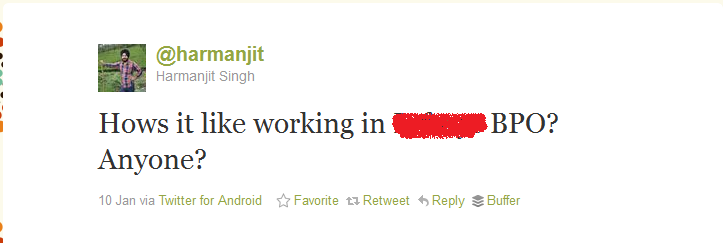
Your company's employment brand is shaped by conversations that are triggered by questions like this on social web these days.
Your employment brand is built and shaped now by such conversations. It is what your employees say to their friends and what their friends reply to questions like the above.

In short, if you want to really impact the employment brand - start with the culture of your organization. Because that is the brand that people actually care about.

Start with being authentic. Open. Upfront. Both externally and inside. Listen. Talk less. Do more.

If you are authentic about the kind of culture your organization has - conservative, experimental, edgy or whatever it is - you will attract people who would be comfortable with that culture.

Sure culture is a messy thing. Not usually articulated easily. It is not the "values espoused" but demonstrated by the "values in action" and hence open to perception and biases.

Culture is also defined in various contexts. If you're a bank then you have a certain kind of culture, right. Not really. Because if you're the bank's BPO or IT center in India then the culture would be either subtly or radically different. If you're in another country the national culture would also shape it.

So how do you showcase your myriad cultures to the myriad applicants who apply to you or the people you want to hire?

Do share what has worked for you.

Online Influencers in Recruiting

The HRExaminer brought out its version 5 of the Online Influencers in Recruiting - this time moving away from Traackr to using HRMarketer's SocialEars to "assess influence"

Surprisingly I am number 6 on the Recruiting list with high scores in the areas of "Social Recruiting" "Recruiting" "Staffing" and "Recruitment Advertising" (strangely, I don't remember having posted/shared anything about Recruitment advertising)

You can see the full list here, and how they scored

Jan 2, 2012

Musing on Identity and community

Ancient Times, Hither Asia
Image via Wikipedia
Communities have always existed and people have given them different names for it. In ancient times the community was about a place. Every village was a community. Every tribe a different community.

As civilisation took root, the ideas of a community became more and more complex. We had communities based on regions, nations (all based on place) , communities based on professionas (what we do - which was taken to an extreme in India - with caste)

The interesting thing to note is that one's community becomes one's network - you get access to a certain world view, specialised skills and knowledge - and are better equipped to deal with certain opportunities.

Then came modern education and training and it lowered the barriers to access but not substantially so. If you could afford it you could be anything.

And then came the online world - which lowered the access to resources and therefore skills.

You could have been a Chartered Accountant's child, or a Doctor's but you could become a writer, artist, photographer, programmer.

Now with ubiquitous access to the net and cheap access devices like the Akash tablet we are bound to see the barriers come crashing down even more, with anyone who wants to getting access to the best teachers and resources to learn skills one wants to learn.

The online world also has communities. Communities of people learning something (skill or talent communities), communities of people interested in solving problems (activist communities, support communities) or communities of interests (lifestyle communities, brand communities).

Earlier communities were the source of your identity.

Now, you can choose your identity and join your community.

So will you choose your identity based on who you are or who you want to be?
Enhanced by Zemanta