Jun 29, 2010

Leaving 2020 Social and Available for Hire

2020 Social SalonImage by Gauravonomics via Flickr
30th June is my last day as an employee at 2020 Social. It's been a short tenure - of eight months - and I have enjoyed being here and learning and adding some value to the Talent and Employee Communities practice.

However, we realised over the course of the last 8 months that the market in India is really not ready to embrace the consulting services that we were offering - namely internal employee communities within the Enterprise and Talent Communities to help in Recruiting and Employer Branding.

Yes, we kept getting inquiries still about it - but not enough to justify having two people @ksarda and me working on it. However, if you need an employee/talent community built - @2020social can still do it - Kaushal Sarda had earlier built a startup in the Enterprise Collaboration space.

Personally I think I learnt a lot - thinking and blogging about Building Open Organizations leveraging social technologies. Leadership, Organizational Culture and Structure, Employee Roles and on motivating them, Use Cases of Talent Communities and a more Social HR and a Social Media Workshop for CXOs were some of the areas I worked on, and I think I even coined a new term "Social Employee Relationship Management" :-)

However, in the end, it's not what I have learnt that will matter- but the great folks I worked with, Gaurav Mishra or as he's better known @gauravonomics and @evansdave - Two thought leaders and I have learnt a lot from both of them. @abha_arora worked with me on this practice and is a perso I hope to work with again sometime in my career. Fellow cartoonists @kgopal and @ksarda. Then there were @ankursuri1 @hardeepkrai @divyauttam and @mohitverma @upasanataku and @freddie_b who made the office a joy to be in.

So I'm looking for my next gig - it might be consulting, might be line HR, might be something in the Social space. Here's my Linkedin profile, let me know if you have a job for me :-)
Enhanced by Zemanta

Jun 25, 2010

Revisiting Connectivism and Enterprise 2.0

Most of the language around Enterprise 2.0 has the tone and tenor of software implement - totally expected as most of the evangelising is done by the tool vendors.

They talk about steps to "adoption" and getting buy-in and showing ROI. While I am not saying the approach is not right - the approach is rooted in the mechanistic way of thinking - the metaphors are drowned in "organizations as machines" as Gareth Morgan called it.

Michael at Socialtext points out the positive way of looking at Enterprise 2.0 through that lens - of a set of tools that people use to improve their way of working - improving business processes. Even before I joined 2020 Social I agreed with Gaurav's POV that "in the flow systems" help people incorporate tools better.

Changing one's way of doing things - in the flow- requires a new way of learning - which communities of practice like open source developers use - focusing on learning not a "packaged good" but a process too. George Siemens calls it Connectivism and I really think Enterprise 2.0 and the new way to learn should be seen from this lens.

Image on Flickr by dvidal.lorente


How do you set up an initiative to be self-organizing without leaving it to "chance and prayers"?


Why Organizations 2.0 after all?

I realised that I had written a lot of posts related to Organizations 2.0 - covering details, how tos and cases.

However what is the need for Organizations to reorient this way?

If you had to tell your business leader, HR head, CEO to embrace the 2.0 way, what is the short simple messahe you would leave them with?

So I tried putting the argument in the old Organizational 1.0 way - in a powerpoint (because you gotta talk to people in the language they speak :-) and this is what I came up with.

What do you think?

Feedback? Comments?
Enhanced by Zemanta

Jun 24, 2010

Businesses Need to Build Two Skills

Clay Shirky in his book "Here comes everybody" talks about how social tools are changing people and society. In it he makes the point that business will have to become media houses - as people will expect to see content from them. If businesses don't create content that is relevant and engaging for their audience (employees, stakeholders, customers) then they risk being left behind.

Creating content is never a businesses' core competence - hence traditionally it has been outsourced to PR agencies who interface and "pitch" story ideas to journalists. If you have interacted with either/all of them you know the amount of angst that is embedded in these networks.

However as "media" (the term comes from the word meaning "in-between") evaporates (slowly, ever so slowly) there will come a time when content will be created and shared in the space between businesses and their stakeholders.

But why should businesses bother?

One main reason - and we go back to the basic fundamentals - the purpose of the firm is to create customers (marketing) and to produce goods and services to meet their needs (innovation and production) as articulated by Peter Drucker.

Producing content - and managing a community of stakeholders - to co-create innovation will be what tomorrows' businesses will do to innovate and create customers.

Both are not skills that current organizations have.

So here is my short manifesto for businesses who want to remain relevant to how things are changing:

Learn and become good at:
  1. Identifying and creating content relevant to their stakeholder
  2. Building a community of people interested in content and willing to create content to the larger purpose of the organization.

Also do go through Gaurav's post on the new 360 degree marketing.

Thoughts? Comments? Share in the comments below.


Jun 23, 2010

Empowering Employees to be HEROes

One of the most useful books for businesses to become Organizations 2.0 - by leveraging online communities is Groundswell by Charlene Li and Josh Bernoff of Forrester. Charlene has moved on and co-founded consulting firm Altimeter Group and has written a book called Open Leadership while Josh is still with Forrester and has written a book called Empowered with Ted Schadler.

I haven't read either of the books (you got a review copy for me?) but was excited to read the principles of Empowered in a HBR article (which is free to view for a month!)

The interesting part for me is that the article gets to the main issue when it comes to empowering employees to solve customer problems using social technologies.

The authors coin the term HERO - an acronym for “highly empowered and resourceful operative” for such people. As they say in the article:

HEROes exist because technologies like Twitter, online communities, cloud computing, and online video are so easy to master and so cheap to set up. Employees, especially in marketing, sales, and customer service, see customers’ problems and use these technologies to solve them. Moving forward with their solutions creates challenges for three groups: the HEROes themselves, management, and IT.


In most companies, cultural resistance to empowering employees to use technology is systemwide. Keeping technology locked down and under the IT department’s control seems like the safe thing to do. It limits risk and prevents chaos. This traditional approach would be fine if not for the actions of all those empowered customers. Companies have to respond to customers’ escalating power. Their employees are ready to do so. The challenge is to encourage HERO-driven innovation without generating chaos.

To make it work there are three principles authors spell out:

  1. HEROes agree to innovate within a safe framework.


  2. Managers agree to encourage innovation and manage risk.


  3. IT agrees to support and scale up HERO projects.

Read the full article at HBR here.

You could contact Charlene on Twitter at @charleneli and Josh at @jbernoff
Enhanced by Zemanta

Jun 22, 2010

The Noble Profession - 8 career guidelines for Consultants

Guest post by Sunit Sinha. Sunit is a Consulting Leader with one of the large management consulting firms. He recently posted this as a note on Facebook, and I asked him for his permission to share it with all of you.

It was with some trepidation and even a lingering skepticism that I decided to write this note – just imagine writing a gyaan article for a group of consultants. Then I thought; well all I could do is just share some pearls of wise counsel I have gleaned from my limited experience, a bit of reading and also what one learns from all the brilliant and wonderful people one gets to work with – both fellow consulting professionals and clients. Lest I may sound presumptuous and ingratiating – let me clarify that in no measure does this list of “sunitspeak” purport to be absolutely original or something I woke up to one morning and lo and behold – saw the light!!

I hope they bring you some perspective and be like the North Star that they have become for me in what is a truly challenging but at times a hard and lonely profession – management consulting.

  1. A job is what you make it. If you look at your function as only a job (show up, fill a desk, answer a phone, pass on a report), that’s what it will be. But if you recognize the time you spend in your early, entry or junior position as a process of career building, then that’s what you will have: a career. Always play your role with dignity, looking for ways to learn from it.
  2. The real keys to success are not smarts or qualifications or belonging to a brand-name firm. Rather, success is derived from courage, drive, energy, passion, ambition, enthusiasm, excitement, initiative, discipline, a dream and enough self-confidence to keep trying.
  3. Don’t be intimidated by senior people. Remember, they also started somewhere, and if they are purposely intimidating you, they can’t be very secure themselves. Don’t, however, confuse intimidation with respect. Even if you don’t agree with a senior person, they have earned and deserve their due for what they have achieved in the organization.
  4. When you feel underappreciated (or undercompensated) take a deep breath. Even if you are doing better work and have more responsibility than someone earning more or being treated better, show some patience. It’s the long term that counts!!
  5. Broken promises are remembered more than kept promises. Do what you say you are going to do. It’s better to have the guts to say up front, “I’m not sure I can get that done,” than to accept a task that you can’t deliver on.
  6. It is important to , listen to the assignment and carry out what has been asked. Again, remember that you are the directee, not the director, at this point in your career. You may not like the assignment, but do it with the same enthusiasm that you show for those projects you do like. Pencils must be sharpened, and everyone (even the CEO) has taken his turn.
  7. Remember that success is not spontaneous combustion; you have to set yourself on fire.
  8. Last but not the least – remember who actually pays for your salary – the client. Never lose your connect with clients, and always put them at the centre of what you do.

TLNT.com Launches

ERE Media has launched a new network focused on HR content called TLNT.com - and has got thought leader John Hollon (who was editor of Workforce mag) on board, and Lance Haun, the ERE Community Manager is also involved in it.

As Lance emailed some of us "It is aimed directly at Human Resource professionals with a newsy + opiniony feel to the whole thing" - and the byline is "The business of HR" That sounds good!

If you want to contribute HR articles/ opinions to the site, let John know at john@TLNT.com

There are some articles that I found to be topical and thought provoking - like this one which talks about China Gorman leaving SHRM and the challenges her successor will face with regards to SHRM's international programs and initiatives. Also this interesting one (for me at least) on how HR can capitalize on complexity.

So if you're a HR professional, TLNT.com is a new source of content you should add to your daily reading.
Enhanced by Zemanta

Infosys enters the Enterprise 2.0 space with iEngage

This is big news. Indian IT services giant Infosys has launched iEngage, a way for its clients to engage with the digital consumer using social media.

What is much more interesting for the readers of this blog is that this engagement has a enterprise 2.0 component - within the organization - with Employee Engagement being a service being offered.

As it says:

Social media unleashes possibilities to collaborate and enhance your company's pool of knowledge, facilitate ideation and problem-solving among employees, and engage with external stakeholders.

Infosys iEngage™ employee engagement platform helps accelerate knowledge discovery, improve workforce productivity, deepen employee engagement and foster innovation. Our platform can be leveraged for employee engagement initiatives such as employee on-boarding, knowledge networks, new product development, sales collaboration, and alumni networks.

Yep, I agree. I think larger enterprise 2.0 consultants like @Headshift @SovosGroup @AltimeterGroup should evaluate iEngage. What would differentiate it against IBM's or Cisco's Enterprise 2.0 offering should be the cost, and whether the solution can be customised in India giving it further price advantage.

Exciting time, folks :-)

Jun 21, 2010

Railway Recruitment under Scanner again

Forget Indian private sector employees going for high salaries - that news is dependent on economic cycles. However if there is one sector that is immune to such recruiting woes - and where people routine riot and cheat to get into - it has to be the public sector jobs. Check the latest railway recruitment scam unfolding in the country

The railways have deferred the recruitment examinations scheduled across India on June 27 after the CBI’s revelation yesterday of a question-leak racket involving two senior officials and their families.

Railway sources said the affected exams of June 6 and 13 too could be cancelled and fresh tests held since 780 to 1,000 candidates were suspected to have known the questions.

New dates will soon be announced for the June 27 exam, meant to recruit enquiry-and-reservation clerks and goods guards, a Railway Board official said.

Sources said the CBI had found sealed question papers of the June 27 exam at the Railway Recruitment Board office on Calcutta’s R.G. Kar Road during their countrywide raids on Thursday that busted the racket and netted eight people.

Group C and Group D jobs are roles that are apparently not very skill oriented - like this ad for the Railway asks for sportsmen to apply and there are other quotas like "cultural" quotas.

When an unskilled job comes with an almost-lifetime employment guarantee, and perks that most private sector employees never get, and no incentive to increase performance levels it's no wonder that it's a den of corruption.

Jun 18, 2010

Dell launches India Blog

It's exciting to note that Dell has launched its India Blog this week. It's a mix of content focusing on varied consumer groups. Looking forward to more initiatives by the Dell India team in embracing social business like it has done worldwide. In fact, there's the Take Your Own Path India community where people can share their entrepreneurial stories and it also has a business forum.

When it comes to embracing social technologies for business - Dell is an organization that is always a case study for the various communities it has created. Starting with almost a negative brand - Dell has leveraged conversations, community and collective intelligence using its properties like Idea Storm (a platform where anyone can submit ideas - and they are voted on by the community - and then chosen ideas are implemented)
Dell also has a vibrant support community - where users solve other users queries about Dell products. Then there's a vertical community for Small and Medium Business Owners, where SMB owners get advice from other entrepreneurs on running their business.

Then of course, there are the "social outposts" on Twitter like the DellOutlet which has helped Dell USA earn millions of dollars in revenue, and the SMB page on Facebook.

Check out Dell's slideshows that explain how Dell engages with the tools and listens and reaches out social media, blogging and responding.

Disclaimer: I am a Dell Alumni - having worked there as a HR generalist in 2005. In addition, my current employer 2020 Social works with Dell on their social media initiatives, like Dell Go Green - although I am not part of the team working with Dell. 

Jun 16, 2010

McKinsey and Nielsen form JV for Social Business Consulting

The industry of Social Business Consulting just became a little more interesting. McKinsey - the big daddy of the traditional Strategy consulting firms and Nielsen - the maker of the Nielsen Buzzmetrics, social media analytics and listening tool (which helps in listening and responding as explained in this blog post), announced a Joint Venture to help clients leverage the social media data being gathered.

Here's Clickz's news report:

Nielsen has formed a new social media consulting company through a partnership with McKinsey & Company. The firm, called NM Incite, includes executives from both Nielsen and McKinsey, and is intended to help brands act on social media research and analysis provided through Nielsen-owned BuzzMetrics offerings.

Over the years, Nielsen has served some of the same clients as McKinsey, a global strategic consulting firm with consultants based in more than 50 countries. The new venture brings the companies together formally in order to serve senior level executives. While Nielsen monitors social media to isolate brand strengths and weaknesses and consumer insights, the combined NM Incite will help clients apply that intelligence on a more strategic business level.

"Our clients have been asking many questions with regard to social media...as to how to use it to their advantage," said NM Incite's president of media products and advertiser solutions, Steve Hasker, who spent 12 years with McKinsey before moving to Nielsen and helping to get the joint venture off the ground.

Hasker said Nielsen's traditional clients in CPG, retail, and media have shown an interest in the new company's services, in addition to pharma and financial services. "The large clients will be a focus here," he added.

"There's a big area around product development," he said. NM Incite will focus on "how brands can leverage social media to harness consumer insights to develop better products and optimize the launch of those products," he said.
I personally think McKinsey's entrance into this space brings a larger sense of credibility to the social business consulting world - and along with folks like Dachis Group, Altimeter Group in the US, and 2020 Social in India, will be growing and maturing the market. I expect to see other large consulting firms like Booz & Co., BCG, Accenture and Bain to also actively look to enter the space via the JV, acquisition or "building a practice" route.

Check out NM Incite's blog posts here.


Yes, exciting times ahead.

Jun 14, 2010

What does Social CRM, Enterprise 2.0 mean for HR and Work

Over the last few months as I have delved and tried to understand the new emerging world of the Social Business (i.e. how businesses are being shaped by emerging technologies that make us all want to be creators rather than consumers) - one area is emerging as the arrowhead of change in organizations.

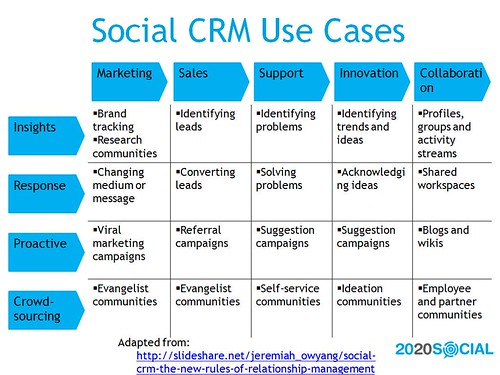
Take a look at this list of use cases that the folks at Altimeter Group came up with

Most organizations who are looking at becoming social businesses - are looking at getting insights in the areas of marketing, sales, innovation and support and responding to them. There are lots of tools - from basic to complex to help organizations do that.

Social CRM sets the stage (or assumes) that HR, Sales and Marketing are now everyone's job. However, social CRM when built with workflows - needs organizational structures and processes to enable it. And I am not merely talking about policy. The questions that need to be answered are:


  1. If I am not in Marketing and Sales, but I come across a tweet/facebook posting/Blog which either praises my organization/product or disses it - how do I respond? Should I respond?
  2. Someone on my friend's list is looking for a product. I think we could build our existing product to what he wishes for. Should I connect him with someone in the R&D team?
  3. How do people within the company connect and collaborate with each other to solve customer issues? How do they acknowledge the issue, and respond to the person externally to share what's being done.
  4. Within the organization when someone is working on an issue how do co-workers know about it - and add their perspectives?
  5. Is there a way for point 4 to be expanded so that customers externally who have ideas are also able to contribute?
When organizations will end up answering these questions - they will understand that the way they recruit, motivate, assess, reward and promote people needs to change. This is because

  • Achievement in this organization is not the same as in today's organization
  • Collaboration is both external and internal. How do you encourage it.
  • We're talking about discretionary effort driving the organization - so forget employee engagement - the question HR needs to ask is "How do I convert my employees to be my evangelists - who view their job in not just making my product/service but as creating more evangelists?"
Do take a list of my related other posts here.


What do you think? How will HR need to evolve - and keep up as the customer facing parts of the business start building, managing communities and "get social" ?

Jun 11, 2010

Hating HR? Lessons from Tony Hsieh of @zappos

Remember there was this article some years back in the Fast Company called "why we Hate HR?"

There's now a follow up post at the HBR Blogs title Why We (shouldn't) Hate HR.

And I have often blogged about it - if business leaders were as demanding of HR as they are of Marketing and Finance, then they'd ask their HR people to do a lot more.

I was again reminded of this when over the last few days I read the book "Delivering Happiness" by online retailer @zappos CEO Tony Hsieh. The book is a mix of a personal story and is also tied in with how his experiences led him to build the culture at Zappos.


When I was reading the book, I was reminded of a book I read more than a decade ago - Maverick by Ricardo Semlar.

Tony is as much of a maverick as Ricardo, taking decisions that puts the culture of the organization, openness and transparency at the centre of the structure, and then challenging the norms of the industry.

Tony's belief is that the culture of the organization is the biggest brand it has, and that value drives the way Zappos treats its people and lets them take decisions. The culture is tied to the core competence of the organization which is Customer Service. Zappos knows that both the core value and core competence need to be invested in, and while it has twice faced tough economic times it didn't compromise on them. Long term needs to be balanced with short term. It is not an either-or option, unlike what most senior executives believe

But most importantly Tony's belief is that an organization's larger goal is not profits, or even passion but a purpose - and for Zappos that purpose is to Deliver Happiness - to its customers, partners and the world at large. I personally think that Zappos is the archetype of the Organization 2.0 I keep blogging about.

The HR processes support such thinking within Zappos. For example they have a culture book, which is a collection of how each of their employees experience the culture at Zappos - and now anybody can read that book.

During interviews HR people can reject a perfectly technically suitable candidate if they don't meet the "culture fit" of the organization.

After a person is recruited, they are taken through a few weeks of training - where every employee has to experience the core competence of the organization - customer service - by manning the contact centre phones. Doesn't matter if your job is in Finance or Legal or HR. You have to man the phones for some time.

After training - each employee is offered $ 2000 to quit, if they want to. That's a lot of money, and Zappos believes that people who are not touched by the purpose of the organization will take that option and leave. About 1% do.

If you are aspiring to build the 21st century's next enduring business, you should read Tony's book.

Here's a slideshow put together by Tony which captures the salient points of the book. Check it out

Jun 7, 2010

Good managers believe a dozen things

I often link to Prof Bob Sutton's blog posts here. By the way, if you're on twitter you should follow him @work_matters .

On the HBR blogs he wrote a great post on 12 things good bosses believe.

I think most people should know it, so am doing my bit to spread the word. Won't you do the same?


  1. I have a flawed and incomplete understanding of what it feels like to work for me.
  2. My success — and that of my people — depends largely on being the master of obvious and mundane things, not on magical, obscure, or breakthrough ideas or methods.
  3. Having ambitious and well-defined goals is important, but it is useless to think about them much. My job is to focus on the small wins that enable my people to make a little progress every day.
  4. One of the most important, and most difficult, parts of my job is to strike the delicate balance between being too assertive and not assertive enough.
  5. My job is to serve as a human shield, to protect my people from external intrusions, distractions, and idiocy of every stripe — and to avoid imposing my own idiocy on them as well.
  6. I strive to be confident enough to convince people that I am in charge, but humble enough to realize that I am often going to be wrong.
  7. I aim to fight as if I am right, and listen as if I am wrong — and to teach my people to do the same thing.
  8. One of the best tests of my leadership — and my organization — is "what happens after people make a mistake?"
  9. Innovation is crucial to every team and organization. So my job is to encourage my people to generate and test all kinds of new ideas. But it is also my job to help them kill off all the bad ideas we generate, and most of the good ideas, too.
  10. Bad is stronger than good. It is more important to eliminate the negative than to accentuate the positive.
  11. How I do things is as important as what I do.
  12. Because I wield power over others, I am at great risk of acting like an insensitive jerk — and not realizing it.


Reblog this post [with Zemanta]

Jun 3, 2010

Does your organization have a Social Media Policy?

My colleague @evansdave has a great article on how critical it is for businesses to set up social computing policies.

I quote:

Current social computing and social media policies range from an outright prohibition of employee participation on the social Web, including at home (yes, some firms do this), to the more open - and very much informed - use of social media by Zappos, Dell, and IBM. Zappos encourages employees to participate. Dell builds disclosure into the social media handles of employees: "@StefanieAtDell" runs @DellOutlet. IBM's policies clarify that employees using social media should refrain from using "we" and instead use "I" when publishing posts or comments that might relate to the workplace. At SAS Institute, employees using Twitter include a statement to the effect "these views are (mine) and not those of SAS" in their profile.

These are all solid examples of how to smartly approach social media and its use by employees. It's essential that your employees understand the rules, ahead of time. Situations involving employees and social media will arise. If you don't have social computing policies in place now, consider making this a priority.

Where do you start? First, visit IBM's page on social computing policies. Social computing policies are not a "one size fits all" proposition, but reviewing IBM's and other firms in your own industry is a great place to start. Then, go meet your legal team: show them the policies of other firms like yours and the best practices of firms like IBM's and ask them to draft a set. Champion this effort and sell it in through HR.

Not only will you do yourself a lot of good - in the process, you will become the organization-wide go-to person for smart decisions involving social media - but you'll also set in place a larger team of people within your organization that understands how social media can be responsibly brought into the business. That's a huge win, and it sets you and your team up for further advances as you push from social media-based marketing to a more holistic social business.

With your policies in place, the next hurdle you'll likely face is what to do about employee social media in places like Facebook, where individual pages or pages of their friends may or may not reflect the kinds of activities that you want your customers seeing. I'm not saying...I'm just saying, as the expression goes.

In a recent workshop in Toronto, we talked about this very issue. Up, Inc.'s Catherine Sturm suggested connecting the business social Web presence to employees' LinkedIn pages, and then specifically connecting the "About Us" or a similar social page on the corporate site - where holiday party pictures might be posted, for example - to the Facebook pages. This provides the flexibility employees and employers need, and sets the correct expectations for what one might find - as a client, for example - when visiting these larger, related social postings.

Finally, think about an oversight policy. For example, use your listening tools to monitor mentions of the brand. When you find them, affirm that any postings by employees are appropriately within your policies. If not, work with employees constructively to address any issues. Should you choose to go down this path, disclose this to your employees.

Read the full article. It's well worth your time!

And also check this list of social media policies courtesy the Altimeter Group.

Reblog this post [with Zemanta]