Jun 30, 2006

Employment Brands being shaped by social software


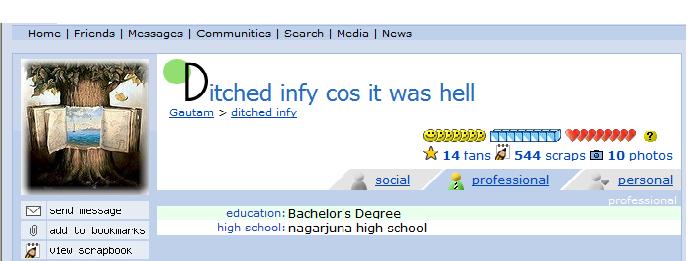
It's not only blogging that is changing and moulding employer branding and perception. Social software like Orkut are also inexorably making their mark on employees sharing their perception with prospective employees.

Check out the above graphic.

What are you doing as an employer to counter such perceptions?

Are you getting confrontational or are you joining the conversation?

Jobster doesn't go to SHRM, the Ladders does !

Jason Goldberg's reason for Jobster not advertising at the SHRM meet this year (as quoted by the cheezhead): "Too big. We went last year. Waste of money."

But that didn't stop the other niche innovator from the recruitment industry TheLadders.com to be there in full force. Check CEO Marc Cenedella's blog for the pictures !

While on the SHRM meet check the Cheezhead's posts on it here
Also check Dennis Smith's pictures and posts here

This is what I love about blogging...I don't have to go to SHRM to experience it in a way !

Jun 29, 2006

So many jobs...

...and not enough people ! So Mukesh Ambani has plans for training and education too !

from the Business Standard (can't write BS for it ;-))


As Reliance gets closer to the deadline for the roll out of its first retail outlet, the action is also hotting up on the people front.

According to HR consultants, the attrition levels in the sector have sky rocketed in the last few months, especially in the corporate and back office functions where Reliance has been steadily hiring.

The company's retail team is already 2,000 people strong. Over the next few years,
the group has committed to spending Rs 25,000 crore on its retail rollout , which is expected to create at least 1 million jobs both directly and indirectly. And this is just retail.

Refining, the company's other major initiative, is also likely to spawn a number of openings, predominantly for engineers and management staff.


Ambani said that in addition to the 10,000 professionals that they would be hiring for the retail venture, the company would also take on board 500,000 customer care executives.

These would be youngsters, either students or those who are fresh out of college, who would be trained by the company across a variety of disciplines.

These would include behavioural traits, customer service, product knowledge and the technology aspects, all of which would serve them well as the frontline staff for the retail stores.

"Our plan is to provide training and education opportunities on a distributed learning platform through classroom e-learning and and personalised coaching in a 'earn while you learn' framework," said Ambani.

The company is said to be working in collaboration with a foreign partner to develop an appropriate training module for the frontline staff.

In addition to this, Mukesh Ambani is said to be finalising plans to set up a university in Gujarat which would produce 10,000 graduates a year.

While the university would offer courses across various disciplines, it is believed that most of these students would be absorbed by the different Reliance group firms. The university is also likely to tie up with a few international universities.

Barriers to Innovation: Standards and Supports

Very often, organizational innovation is looked at as a process within the organization only.

So processes and policies are built and brainstormed to open up creative juices and mind-blocks within the organization. Silos are broken down, breakthough ideas are dreamt of, and cynics told to shut up or else...

But still organizational innovation either in the process mode, or product mode, often fails.

That's because, when innovating people seem to ignore the external standards and supports that often have a pivotal role in making innovation work.

Suddenly the product that people have designed does not really fit the retail shelf, or blends in too easily with other me-too products. Or the product and packaging is not helpful to store or transport by the logistics people.

Sometimes it all depends on luck. Between the GSM and CDMA standards which will emerge victorious?

So what do you factor in your plans when you innovate?

Indian on the JobsBlog

Priya joins Jenna, Jim, Julia, Janelle, Elizabeth and Eric at the iconic MS JobsBlog.

Jun 25, 2006

Some viewpoints on Indian Innovation

From the Businessworld issue on Indian innovation (regd. required)

Vijay Govindarajan, argues that Indians are innovative; even villagers are used to doing more with less. But Indian companies lack the will to innovate.

Indian companies are prone to imitate practices from their western counterparts. Says Arun Maira, chairman, Boston Consulting Group (BCG), India and member, Innovation for India-Marico Foundation: “These may not be the right practices for our context, so we may not get the result.”

R.A. Mashelkar, director general, CSIR has long argued, society is reasonably ambivalent to the need for innovation in India. In an interview to BW in 2002 (see ‘Think Differently!’, 4 February 2002) he had said: “What we need is to get the entire society on board — administrators, educationists, ordinary people. We need to launch a national innovation movement.”

Nirmalya Kumar, professor of marketing at the London Business School, says “One must remember that while manufacturing is often in low-cost countries, innovation is kept closer to home by developed countries as it is considered their competitive advantage,” he says. In other words, if India has ambitions of becoming an economic superpower, it needs to match, if not beat the developed nations at the innovation game.

Madhukar Shukla, professor at XLRI, says not much is being done to address this segment of the market: “There is a vast market at the bottom of the pyramid. It also makes business sense.” One derivative of the bottom-of-the-pyramid mindset is the emphasis most Indian companies have begun paying to thrift. And that, in turn, have made many of them globally competitive, especially in manufacturing. XLRI’s Shukla, argues that even if India were to create an iPod, lack of marketing muscle would not allow it to exploit the global market. “The XP launch cost Microsoft close to $800 million. Can any Indian company match that?” he says.

Jun 24, 2006

A 77% pay increase....

is what increased trust in your employer, a greater variety of projects, a position that requires skill and enough time is equal to....

So says the the Sightline Institute here .

Hat Tip: Dennis Smith

Why Talent Management or "HR" doesn't capture the essence !

Names often are windows of how we make sense of our jobs.

That's why I have a problem with both names: Human "Resources" or "Talent" Management !

The first, views people as equivalent to any other resource, like money or material.

The latter, seeks to reduce people to how they are useful to organizations, i.e. to their talents...and tries not to look at the emotional aspects of the person.

Both names also look at only the employee-employer relationship and do not factor in the behavior and skills of teams and groups in the organization.

What would be a better name for a group that seeks to attract, retain, develop and energize people to an organization?

The problem with Leadership Development

One of the critical issues that HR can impact businesses is by building the leadership pipeline and developing them to take on further roles within the organization.

However, very often HR groups fail to effectively partner with business leaders to make this a reality.

What are the reasons?

First and foremost, the way HR is structured ensures that it approaches the critical issue in a functional silo mode. Very often Leadership Development is seen as "only" a learning issue and handed over to the training department.

However, to actually make it a success, assessing leaders should be handled by recruitment, development in the classroom by training, and business HR should help translate that learning into the job.

HR also needs to monitor the kind of assignments these future leaders are getting by the business and whether senior leader is actively mentoring them to make the transition from functional to business leadership.

The HR job of the year

...would have to be this !

And I'll be very envious of the person who finally gets the job !

Jun 23, 2006

Jobster CEO up for Entrepreneur award

Jason Goldberg has been nominated for the 2006 Ernst & Young Entrepreneur of the Year.

Wow !

I can tell my grandchildren now that I sent him some emails and even got a reply back ;-)) !!


Hiring companies rely on BIS for performing background
checks
on candidates globally.

Jun 22, 2006

Career advice from Seth Godin

when he told his friend that it was Time to quit

Our parents and grandparents believed you should stay at a job for five years, 10 years or even your whole life. But in a world where companies come and go -- where they grow from nothing to the Fortune 500 and then disappear, all in a few years -- that's just not possible.
Here's the deal, and here's what I told Doug: The time to look for a new job is when you don't need one. The time to switch jobs is before it feels comfortable. Go. Switch. Challenge yourself; get yourself a raise and a promotion. You owe it to your career and your skills.

Jun 21, 2006

The Leaders' biggest problems

The biggest mistakes business leaders make are not communicating, failing to provide feedback and just not listening to their workforce, new research has suggested.

(Source: Management-Issues : News )

Why don't they do these? And how do they become leaders if they never did these in the past?

The answer I believe is the difference between being a great manager and being a great leader.

As Marcus Buckingham notes, great management is finding what is unique about your team members and playing to their strengths. So for a consistently great manager the discipline he or she builds is one of focussing on the individuals.

The competency however fails when the manager becomes the leader, because from focussing on uniqueness, the leader has to focus on the universal. The common thread that energizes and takes along evrybody.

Jun 20, 2006

Copy paste a full blog?

This is very strange.

I saw a link from technorati from a blog called "Human Resources in Iran"...curiosity piqued, I hopped over to the blog, excited that there was a English language blog on HR from Iran and which would give some insight on what's happening there.

However, when I went there I discovered that it was a mirror image of my own blog- Go ahead check it yourself !!


I really don't know if I should be offended or be flattered.

Oh, by the way, I am adding Joel's CheezAds to my posts. Let me know if you feel they are obstrusive in any way !


You'll find entry level jobs at College Recruiter.

Jun 16, 2006

On HR Metrics

This post is owes its genesis in a conversation I had with a friend who works as a HR consultant.

She had called me up and was trying to understand the metrics that are usually reported by the training and development group within organizations and how they might make more sense.

Then it struck me that training metrics are symptomatic of HR metrics not being aligned to business value and therefore wasting individual's energies.

The power of metrics is frankly underrated, and that is where the disconnect between stated objective and achieved reality often starts.

Take the example of training and learning metrics.

The stated objective of the training group is to increase individual and team performance to meet the strategic needs of an organization. That is the outcome expected from this group.
But the metrics that are tracked focus more on inputs, like

1. are all employees getting the promised x hours of training?
2. Do most of the training get ranked "very good" by majority of the participants?

The metrics focussing on output linked to performance however, are done few and far between. One of the reason is that organizational systems and processes are not designed to catch this information and extra manpower is used for doing so.

And this is the reality for metrics that are tracked for Recruitment, Compensation and Generalist roles too.

HR is trapped in tracking efficiency metrics, while business needs metrics that focus on effectiveness.

More posts on how HR can make this transitions coming up.

Jun 15, 2006

An old HR saying...

A players hire other A players

B players hire C players

C players should never be hiring...

So are your best people also hiring?

Gretchen feels that's the reason for Google's job search ... and why their recruiting works !

Going Solo

Uber-blogger and tech journalist Om Malik is going solo.

Are we actually starting to see the Free Agent Nation coming into its own?

The answer in my opinion, is yes and no.

Sure there are people who are using blogs and related technologies to build their brands and deciding that the security of large companies are not needed any more. In other words, they can carve their dreams into reality.

Most of us however, have only a vague idea of our dreams and within a large organization end up making it in a different form and shape. This, more than any other fact, is the biggest reason why people feel suffocated within organizations and yearn for the day that they can open their own 'dukaan'

Update: Some people however, just move on to bigger and better dreams. (hat tip: Heather)

V Kartikeyan, who is currently Texas Instruments' head of Human Resources in India is also going solo from next month. Kartik (or Kaka, as he is also known) will be a freelance consultant in the areas of Organizations, OD and Leadership Development. Here's an interview he gave to the Hindu in 2001.

Kiruba to interview Scoble: It's a podcast !

Want to ask a question for Scoble? Leave it as a comment here. Kiruba Shankar will be podcasting his interview with Scoble tomorrow.

as Scoble says in his blog post:

One thing I've learned is that the most interesting stuff (and the most interesting stories) are being done by people you don't know, or who you think are unimportant.

Networking at US B Schools

I'm sure that companies will try out these tactics to influence their rankings from day two to day zero imposed by premier Indian B Schools on campuses.

With the constant pressures of career planning, socializing is hard work for B-school students. "Among students, socializing and networking is basically the same thing," says 2006 University of Virginia Darden graduate Trevor Brown. Even tailgate parties at weekend football games are sponsored by major recruiters. Business and pleasure also get blurred when companies sponsor social events off-campus, such as bowling parties or fancy dinners. It's in this non-academic atmosphere that jobs are often secured, according to Darden student Caroline Rosenberg.


In my days (damn, that makes me sound so old !) the highlight was HLL's pre-placement talk.

We got free ice-creams.

Alas, UB or De Beers did not come to campus !

Jun 11, 2006

Robert Scoble resigns? What should Microsoft's HR do?

TechCrunch has the scoop on Scoble resigning.

This is the test for Microsoft's HR. They've lost their recruiters, that was the bad part. Now they are even losing their star blogger who is a role model who's been called the Chief Humanizing Officer of MS !

This is the time for HR to act proactively and make all out efforts to retain Robert. I cannot think on why any business (specially MS) would let him go. Of course, I am assuming his work on the corporate image building is his performance goal. There he's clearly exceeded expectations I assume !

If Microsoft succeeds it'll reflect very positively on it as a place which clearly values its better people. Even if it doesn't succeed, the effort will be noticed by others in the blogosphere.

P.S. Robert has his views here. He says:
Sixth, how do you know that the company didn't move heaven and hell to keep me happy? They did. I have the best job in the tech world. Bar none. I got to meet and interview and influence the best people in the world. Career decisions are personal and opportunity and growth require thinking about a lot of different things, not just one or two. I've turned down quite a few offers for more money than I'm now making.

Jun 8, 2006

Why Lefkow is in the wrong zone.

Dave Lefkow in ERE makes a case if Recruiting should leave HR for good. I don't know where Dave is coming from, but I disagree with the argument totally.

Sure HR is a despised function. Along with Transport, Facilities and the office canteen. The reason is simple, when a support function has an impact on the personal needs of an individual, the function almost always loses. In trying to average out the needs of the individuals it ends pleasing nobody.

That's why very few people like the cafeteria food consistently. That's why everybody has an opinion on HR issues.

Most people when asked "Do you feel you are paid commensurate with your performance?" would say "No". Ironically, the ones who underestimate themselves are the people who are the high performers!

Dave postulates that since HR is universally hated, Recruiting has to secede from HR to be respected and taken as a strategic function.

I agree that the benefits of Recruitment is more immediate to see compared with other HR functions. Take a look at Anuradha's post explaining the behavioral aspects behind it.
In my book, any business that ranks certain HR functions over the others is one which aims at short term efforts and therefore is not a sustainable business.

Sure, recruitment can get you the great talent, but if can't ensure that performance management is fair and rewards are linked to performance then it won't take that long to lose the superstars you hired, and for you to lose the sheen on your employment brand.

Sure, HR Outsourcing is going to hit a lot of HR departments, and that is when Sanjay's advice will come in handy.

For all of HR, including recruitment !

Jun 7, 2006

Which is the best Indian blog?

Dump your nominations here.

Dear Headhunter...

A Google sotware engineer's guide to recruiters on what kind of emails to write to excite prospective candidates...

Google spreadsheets

I managed to get an invite to try out Google spreadsheets.

First impressions:

1. It will take time to catch up in India given the abysmally slow internet speeds that most of us at home. Microsoft doesn't really have to worry in the short term.

2. A lot of formulas are built in but I didn't discover too much information as to how to use them.

3. The common basic arithmetic formulas however are easy and intuitive.

4. For people used to doing excel calculations with the mouse, would have to start getting used to using the keyboard a lot more. No right click functionality here :-)

5. I could only see "freeze rows", couldn't find "freeze columns" anywhere.

6. The sharing option should have gmail address book built into it.

Breaking news...Jobster buys Recruiting.com

Jobster acquires Recruiting.com !

Read all about it here !

I guess the synergy started with the name. No, I don't mean the name "recruiting.com", I mean the name "Jason" ;-) !

Just struck me, since I am a (very) occasional contributor at Recruiting.com does that mean I'm now an employee of Jobster ;-) ?

An ex-colleague on Reservations

A former colleague from HP, Bruce left a comment on my other blog on reservation. I thought it was an important viewpoint to be noted on this blog, as it has implications for organizations and people working in them.

I'm an American, and a former co-worker of Gautam's. I've never visited India, and yet...

The quotas in Indian universities have been getting a fairly large amount of attention in Silicon Valley. I don't pretend to understand the issue in full, but it certainly reminds me of the period of the early 1960's in the US when laws were passed to ensure that employers and schools took "affirmative action" to remedy decades of prior discrimination against black Americans.

Powerful voices said then "Isn't a level playing field enough? Must we actually FAVOR the previously discriminated against? Must today's young white people give up their places at the head of the line in order to redress the discrimination that benefited their parents' generation?"

Four decades of experience has convinced me that Affirmative Action is just, and that it will probably need to be in place in the US for 3 generations (60-80 years) before we achieve a color-blind society where "a level playing field" actually exists for people of all races.I expect that India will find the process will take a similar length of time to play out.

Yes, there will be thousands of talented individuals from privileged backgrounds who will face challenges because of the changes.

There will be injustices -- but over time, Indian society will benefit, as American society has, by becoming more inclusive.

Bruce

Jun 6, 2006

What is Organization Development (OD)?

After I posted about HR yesterday, I got some emails from some readers asking where OD fitted in HR and if I could write more about it.

Organization (or Organizational Development) is the discipline of viewing organizations and groups as systems and designing systems and processes to improve their productivity, effectiveness and output. Unlike HR where often the unit of analysis is the individual OD looks at the systemic and process issues much more deeply.

OD however as a 'function' does not fit very easily into typical organizational structures. This is because the effectiveness of a OD person is by being an outsider and questioning processes and practices that are done 'ritualistically' by organization. Internal OD people however are handicapped by either losing that perspective or being buried under organizational politics.

Internal OD resources however exist within HR and sometimes in Corporate Planning or Strategic Management groups. These people become saddled with the task of 'thinking'/designing corporate policies/training programs and increasingly become disconnected with reality.

A firm needs to take a call whether it needs OD in-house or chooses to call an external consultant whenever it needs one. It depends on the context, age, time, size and complexity of the organization and the level of maturity of its HR processes.

Most internal OD jobs have a big "Learning/Training" dimension built into them. But OD more than any other HR area can be tracked by "outcome metrics" rather than "input metrics" and some meatier OD jobs have performance management systems, competency mapping, key talent development, leadership development also on its agenda.

By the way, an interesting list of skills for the OD Consultant

Also read how Terrence became an OD guy

The 100 most influential HR people

Apart from the consultants and gurus who are overwhelmingly American the list of practitioners is very British, as the story has been published by the UK based HR Magazine.

Want to earn money from blogging?

Watch and learn from the master !

Jun 5, 2006

Competition to Jobster and H3.com ?

Distributed social referral networks?

How employees view HR mailers

From the All Seeing Spy the CNN IBN HR email

Hilarious, and I mean the blogger's comments in the brackets :-)

Human Resource Management as a career choice

Get to know HR

I often have been posting about things related to HR and OD and related topics, when it suddenly dawned on me that some of my readers are still students and might not know what it's like in a HR department, what skills you need and what are the different kind of jobs are available.

So here's my lowdown for those of you considering a career in HR.

What is HR?

Human Resources is the discipline of study of human behavior within organizations. The field comprises study of individual behavior, group behavior and organizational behavior. As a field of study, OB is the backbone of Human Resource Management.

So it's not common sense?

Unfortunately, while everyone seems to think HR is common sense, in reality it is not. HR people without any knowledge of human motivation, perception, identity and behavior are doing great harm to their organizations and fellow employees.

Seriously, in lay terms, what do you guys do?

In lay terms, HR people are responsible for attracting, retaining and developing people to their organizations.

The people who attract people to organizations are known as recruiters, and they are HR people with the jobs that are very 'sales and marketing' in nature. They scour your resumes, your job sites and these days, even your blogs to find those great people that are needed to make their company successful.

However, they just can't offer you any salary. The people who set salary and salary bands within the organization based on the job families within the organization and ensuring industry parity are the compensation & benefits experts. These HR guys love working with numbers and crunch data on excel sheets and talk in their jargon that has a lot of "percentile, median, etc" words thrown in them.

After an employee comes on board, they come under the ambit of the HR Generalist (also called Business partner, Employee Relations, Unit HR, etc.). The job is fairly simple, they solve your day to day queries reagrding policies and processes. They also are the guys you run to for your goal setting, performance management issues. Their primary client happens to be the business and they analyse a lot of employee data and advise the management on business unit specific HR issues.

The development of the employees is spearheaded by the Training or Learning function within HR. This team also comprises a lot of technical and business trainers sometimes in certain industries. In other industries or companies it might be outsourced to a large extent. The training group's job is to track the skills of various employees, do the training needs identification for them (if a competency model is in place in the organization) and ensure that training is delivered that is useful for the business and work with the management to follow up and check if behavioral impact of high cost training at least is there.

So do you want to be a HR professional? Which role described above excites you most?

Do you have any additional questions?
Apple unplugs Bangalore Technical Support

Haven't been able to find the story online, but have heard enough word of mouth to give you all the scoop.

Apple Computers which had planned to set up its offshore support facility in Bangalore (see earlier post here) has scrapped its plans and has handed the pink slip to the 28 or so management people hired so far.

Apple had hired ex-Dell VP Mohan Kharbanda to head the centre. Another ex-Dell HR person Batis Brent was heading HR for Apple's offshore centre at Bangalore. And the Recruiter was from HP.

Update:

Indian Blogger points out to an online article at http://www.itwire.com.au/content/view/4515/945/

So what is the message that Apple is trying to convey?

We wanted to copy Dell's model of India support, so we hired Mohan Kharbanda to grow our centre the "Dell way".

Oops, we suddenly noticed that Dell's stock is headed south.

So we'll cut back our plans and ensure that you continue to recieve tech support through our third party centre in Mumbai and Bangalore.

Duh !

CEO turnover

Global CEO turnover reached a record peak in 2005, write Chuck Lucier, Paul Kocourek and Rolf W. Habbel in strategy + business. According to Booz Allen Hamilton’s annual study of CEO churn, over 1 in 7 of the world’s largest 2,500 public companies changed leaders in 2005, versus just 1 in 11 a decade previously. Outright dismissals of top CEOs also increased fourfold compared to 1995 fuelled by mergers and acquisitions, note the authors. [Hat Tip: Egon Zehnder Executive News Service]

Phew ! 1 in 7 ! That's gotta be the toughest jobs. But not here in India though. Boards here continue to be rubber stamps and promoters and their family members continue to be in the CEO's position no matter how much value they destroy !

Jun 2, 2006

India, Ideas and Gurus

The ideas men of India - an interesting post from the Business Innovation insider blog. It linkes to this article. On a related note here's a comment I made on Dave Lefkow's blog:

I believe that the way Indian firms deploy and develop talent is fundamentally different in the way US firms deploy and develop their talent.
The reason is the cultural difference to knowledge and competence in the two cultures.
To put it more plainly, Indian firms are better at "guruism", having their exceptional individuals maintain their knowledge and tacit knowledge to a much higher extent than a US firm.
A US based organization structures work so that it becomes broken down and can be replicated easily.


My earlier posts on related themes:

Web 2.0 organizations - Innovative or wannabe?

I've already profiled http://www.pixrat.com (the Indian innovation that remixes Flickr and Del.icio.us :-) on this blog earlier.

Now I've decided that any further requests to profile any other Web 2.0 sites would be done on my personal blog only. So here are two: OLX.com (for online exchange) and uLinkx.com (doing to Videos what Pixrat is doing to pictures!)

Jun 1, 2006

Google Notepad

Google Notepad seems like a great tool for people like me who want to pick up snippets of information when browsing and want to retrieve it later. I don't use Google Desktop Search, because of security concerns that my IT folks told me about, so the notebook is a great idea, specially when I am travelling without my notebook PC (is that why they named it the notebook?)

It would be great if the notebook/notepad is integrated along with Blogger, it can be a great tool for blogging !

Have you noticed that Blogger is one of the acquired tools that Google has not tried to integrate too much into the google accounts?

Is that a good thing or bad?