Jan 31, 2007

The boss relationship

Over the last couple of days I have been talking to some friends who have one common issue these days: Boss problems.

It's a difficult relationship, this one, and finding the perfect boss is a function of many factors. The biggest of course, is your own personality.

Reflecting back on my own career, I've had the opportunity to work with some great bosses, like the three Balajis in Satyam, Rick and Asha at HP and Aniruddha at Dell.

Whether remote or co-located, great bosses do some things better than not-so-great bosses.

  1. Their focus is always on your needs. A great boss understands that a great employee has needs that have to be fulfilled, and that it sometimes has to come before the client or customer needs for long term success. Once a boss establishes a trust that your need is paramount to him/her, then you trust that boss with all your heart.
  2. A boss admits when he can't help you. Great bosses are direct and upfront with their plans. When I talked to one of my bosses that I wanted to move to another division as the work they were doing in L&D was much superior to what I was doing, he told me "I know that you might want to go there, but right now I need you in this role, as we are getting the basics in place here" . I could take that because I knew that he had point 1 on his mind too.
  3. A boss always communicates. A great boss always takes time to spend time to share what's on his/her mind, the issues he/she is up against as well as what you are going through in the office. I believe when a boss shares his/her vulnerabilities you end up making the relationship much more richer. It would be a great idea to also share ideas and bounce off ideas that the boss could use. This could be during a performance related meeting or additionally.
  4. A boss gives you credit. In my first job, when we were trying to realign our business unit I helped get a lot of business folks into a primarily technology company. During the unit's annual review offsite, the MD of the firm walked into the review and my VP told him that we had been able to hire some really great people without any additional expenses, and then he told him "All because of that guy." he pointed to me sitting in the last row,"Gautam was instrumental in getting them due to his internet networks". Remember, this was the time when I was two years into the job and the VP was 6 levels above me in rank. By sharing it with the MD and putting the focus on me, he ensured that I always put in more than 100% in my work after that too :-)
  5. A great boss is not insecure of your abilities. A great boss never shies away from hiring people who have skills that complement his own. Most people get scared of hiring a subordinate who gets a functional skill that they have little or no knowledge about. Working with a great boss who has no such insecurities is an amazing feeling, have you experienced it?

For the most on recruiting information, checkout ERE.net.

Jan 30, 2007

Center of gravity shifting

The Accenture CEO announces in Bangalore that Accenture India will soon overtake the US as the place with the largest employee headcount.

Does this mean that the center of gravity is actually shifting to the east?

In certain matters, yes. The centralised HR policies and processes of large MNC firms that have a huge delivery population in India (like IBM, HP, Oracle, Microsoft) would need to be either changed or aligned to geographical considerations.

The big difference is that the Indian headcount of these firms are not spread out over a large number of cities, as in the case of US, but concentrated in four/five cities like Bangalore, Chennai, Hyderabad, Delhi.

That is a key difference. So while a delivery centre in India might support 3-4 different business divisions for the mother firm, the collaboration possible between these units is something lacking in the US. That's because even junior level employees converse with each other even when they work in separate divisions, because they either travel in the same transport or eat in the same cafeteria.

I foresee the actual center of innovation shifting to India in these firms, as these collaborative relationships come to fruition in the future.

Jan 28, 2007

Stories as diagnostic tools

As OD professionals and consultants, the most important critical skill that we can develop is the skill of diagnosis.

Diagnosis, though, is not just to figure out what is wrong but to get an overall sense of the client organization. Sense of reality is a tricky business. What is visible and stated is sometimes only a part of the whole reality. Organizational realities exist at various levels.

There is the level of reality that is in stated documents and mission statements. These unfortunately is the 'espoused cause and value' that is stated. For example an organization might state that its primary goal is to add value to the lives of the customer, but in reality its primary goal is to garner a high marketshare. Sometimes these two realities, the 'espoused' and the 'actual' might be in accordance, and that is when organizational magic happens. However in most organizations these are divergent and give rise to customer and employee cynicism.

As an OD consultant, there are many tools one can employ to diagnose the reality at work in an organization.

One can do a survey of attitude and behavior in an organization, but we always need to realise as Prasad says that an act of measurement in a complex human system is also an act of intervention.

One can interview stakeholders and client members to find out what is working and what is hindering people and teams to be effective.

One can also observe groups as they work together to observe the processes of decision making, negotiation and conflict management to come to a conclusion if effectiveness can be increased.

One of the most interesting ways to know the 'unexpressed reality' of organizations is to listen to the myths and stories of the organization. Stories and myths are richer, full of emotion and convey an idea better to people than written reports. Listening to what the myth or story conveys and what it also does not say is an important element to determine what is the reality of organizational life at that point of time and space. Shawn has some great examples here.

See the ways and processes to do organizational diagnosis here.

Key Result Areas for writers

It's not every day that India's premier literary and movie blogger blogs about something as mundane as Human Resources, but when Jai Arjun Singh reaches Delhi back after the Jaipur fest he discovers:
The features department in office is abuzz with talk about a grand new concept called "Key Result Area" (KRA), conceived by the human resources team as a way of measuring employee performance. It sounds very promising, but a senior editor tells me the acronym makes much more sense when you add the letter "P" to it. Another sniffs, "How can you quantify a writer's work or reduce it to cold figures?" It feels like I'm back at the lit-fest.
Hmm, I wonder what we HR bloggers can suggest how to quantify a writer's work? Any ideas, readers?

Resume Doctor

A friend of mine who works as a diversity training in the management development group of a large MNC sent me her resume to see if I could help her improve the document.

Due to reasons of confidentiality, I can't share her before and after resumes. However, these were the things I asked her to incorporate:

  • Don't mention your work email on your resume/CV. This friend has spent more than 4 years in her present organization. Her work email is the one she accesses most, however, whatever the reason, do not give your organizational email on your resume. It appears really unprofessional to the recruiter. (for more suggestions about email ids read this earlier post)
  • Next thing I suggested to her was either to customise her "professional objectives" to each position that she would apply for or, simpler, get rid of it altogether. Usually it sounds vague and does nothing to grab the attention of a recruiter.
  • She had described her work in the various roles that she had done as "achievements and responsibilities" and as another friend of hers remarked, "The resume is not a combination of your year end performance appraisal and job descriptions". I asked her to cut out her 'responsibilities'. Focus on what one achieved in the role, and if you have a choice, choose the most high-impact achievements. Write something that will make the recruiter or hiring manager ask you a question (and of course, that you can answer to the best of your ability :-))
  • I asked her to cut the resume length as much as she could into a two page resume. For that I was ruthless on her work experience earlier to the current organization. She had spent very less time (<>
  • The other changes I suggested were more in the kinds of word to use (action oriented and an active voice)
  • When one works for an organization, one often uses jargon that is understood within the organization. Be careful not to use words like that in your resume. If your organization calls the six sigma certification a "hexa-S" certification, then mention it as "six sigma" on the resume. And no. That's not misrepresentation.
Ultimately, a resume is a brochure, and it's purpose is to get the recuiter pick up the phone and call you for an interview. It is not a document for you to make philosophical or political statements (use your blog for that :-) or for telling people what sports you had played in middle school.

Read more on what AK Menon, who is a professional executive search consultant in India feels about what makes a good resume.

Jan 27, 2007

Skills education and India at Davos

A couple of days ago I received an email from Jim Rosenberg (via blogstreet) that stated:

The World Bank has prepared a special section online with useful information about India related to the World Economic Forum in Davos, underway this week. The theme of Davos this year is "The Shifting Power Equation." We have organized our resources around the subthemes of the meeting:

  • Economics: New drivers
  • Geopolitics: The Need for Fresh Mandates
  • Technology and Society: Identity, Community and Networks
  • Business: Leading in a Connected World
The page is located at http://www.worldbank.org/indiadavos

We hope it is useful to you, and we welcome your feedback.

Today, I finally got to check out the link and I think it's a great way to involve us, the common citizen into the hi-powered world of the WEF at Davos.

I thought this article in particular is pretty significant:

A fifth of all those born between now and 2030 will be Indian – a full 320 million people. They will live in the world’s most populous country, a prosperous one no doubt, but also one marked by inequalities. By 2030, without intervening government policies, India may experience an increase in inequality because of the skill-intensive nature of its growth path. Much of this can be attributed to new technology, the rising demand for skilled workers, and a disinclination to employ unskilled people.

I fervently hope that tomorrow's growth does not give rise to inequity. To succeed in that endeavour education, both in the primary, secondary and higher section needs to be really overhauled to help us meet the challenges of the future.

Today I met some of my ex-colleagues for an informal lunch. There were a couple of PhDs from business schools who have ended up the corporate sector, who admitted that teaching and research is always their first love, but there is very little original research happening in the economic and business areas in India and the lack of talented conceptualisers in the business world has pulled them into the corporate world.

There was talk of how the western model of management and doing business is essentially "de-skilling" of talents...where one focusses on narrow specializations that leave people with little or no larger connect with the context. While we see that it is also being replicated in India, there was no consensus whether it was a good thing or not for talent levels in the country.

More jobs than CEOs

According to Hannah Clark in Forbes.com

A recent survey by the Association of Executive Search Consultants revealed that 66% of recruitment experts predict a surge in demand for executive talent. Banking and financial services are expected to experience the strongest demand, followed by information technology, health care and the pharma industry, writes the author.

Several trends are driving the boom, explain recruitment professionals. In North America and Europe the first C-level baby boomers are reaching retirement age and proving tough to replace. In the U.S. this trend is exacerbated by the strong economy, which is fostering expansion in all sectors and draining the leadership talent pool, notes the author. In the fast-growing economies of India and China, rising entrepreneurial activity and privatizations should create a host of new executive positions, she adds. Unfortunately, there aren’t enough experienced managers to fill these posts, warn experts. Training fresh C-level talent will take a whole generation, they add. In the meantime, the war for CEO talent looks set to intensify, concludes the author

Looks like another trend of CEO pay increases will be on the rise, specially as Indian firms get more and more globalised and compete with US and European MNCs on their own terms.

How are you charting your career to be a CEO? Remember now it is not only the CFO who is ahead in running to be the CEO, Marketing, Sales, Technology and even HR functional heads have a great chance to be CEOs. However they will need to get out of their functional silos and get a more strategic perspective.

If you are a CEO how are you building succession for yourself?

Jan 26, 2007

International recruiting a challenge for US recruiters

Reports Workforce.com:
"The most talented employees worldwide are increasingly unwilling to tolerate the long waits and uncertainty entailed in immigrating to the United States. Instead, they are going to Europe, Canada, Australia and other countries where knowledge workers face fewer immigration difficulties.

Despite the arduous requirements for labor applications and the time-consuming recruitment and documentation process required, employers looking for top talent in hard-to-fill positions need to integrate permanent-residence immigration into their recruiting process to create a solid pipeline of foreign candidates."

So competing for knowledge workers is getting a little tougher for US firms. However, most of the cutting edge R&D and Innovation still happens in the USA. Knowledge workers who really want to work on cutting edge stuff I guess will be prepared to wait for the US entry.

What do you think?


Get the blog via email:
Subscribe to Gautam Ghosh - Management Consultant by Email

Confidence or over in an interview

Heather talks about insecurity and treading the fine line between jerkiness and confidence in the interview: "I can't tell you how often I see people crash and burn in the interview due to over-confidence. There's a real skill in self-awareness, especially when you can determine your interviewer's opinion of you and match your hot-shotness to their perception. Frankly, I could do without the hot-shotness (I'm a big fan of substance over flashiness and I have the wardrobe to prove it) in the first place but if you can pull it off, good luck to you."

Confidence is always nice to see and experience. In an interview it tells an interviewer that the person knows what he/she is talking about, is honest and trustworthy. Confidence cannot be an act or be put-on. You can't fake it in front of an experienced person.

Over-confidence however is a different kettle of fish altogether. It makes one come across as a boor, or a person who might end up rubbing people the wrong way. And unless you are applying for a job with very limited people interaction, or have the skills that only a handful of people have in the world, over-confidence would normally lead to an interview being unsuccessful. 99 times out of 100.

Rather, make it 999 times out of 1000.

Get the blog via email:
Subscribe to Gautam Ghosh - Management Consultant by Email

No need for specialists

Prasad muses on the future of 'Specialist' roles in internal HR:
"What I have noticed is that the number of these positions are reducing. There could be many factors influencing this. Many organizations feel that these kind of deep specialist skills are not required on a continuous basis as they come into play mainly in special initiatives (or even only in particular phases of special initiatives) that happen once in a while. Thus this could lead to underutilization these costly expert talent which does not make sense either for the organization or for the specialists involved."

While I agree with him, I also feel that the future of specialist roles in MNCs in India is poised to grow further. The assumption being, once these firms cross a certain critical number of employees who are based in India (the number's criticality would depend on the nature of work being done by the India employees) there would be a business case for specialists to be based out of India.

Where I do agree with Prasad is the future of OD as a practice. He is spot on when he describes the 'distributed model' of OD within organizations. That however does not hold true for other specialist functions like compensation and benefits or HRIS.

Get the blog via email:
Subscribe to Gautam Ghosh - Management Consultant by Email

Jan 25, 2007

Shilpa Shetty and consulting


Mick ponders over the recent row over Shilpa Shetty in the UK reality show Celebrity Big Brother to explore the attitudes that define India in the eyes of Britain and British consulting firms.

From Top-Consultant.com:
"consultancies have led the pack in establishing business links and subsidiaries in India and China. But the tendency has been to portray this side of the business as “resources”, brawn to back up the consulting brains.

Naturally, firms with Indian roots don’t necessarily conceptualise things this way. The challenge as they see it is not to grow a delivery side to deliver the downstream promise for a consultancy front end. Rather it’s to add consultancy to a pre-existing delivery capability in a way that allows it to be deployed more intelligently. I’ve been lucky enough to meet with a number of Indian firms and their growing consultancy arms over the last year or so. They’re definitely poised to be super-competitors, but only if clients are going to be receptive. As the Indian economy continues to grow, so will the scale and complexity of infrastructure and enterprise projects. That expertise and experience can flow back into the UK—or we can ignore it and let others take advantage. What a shame if the burgeoning Indian consultancy industry decided to bypass Europe and concentrate its efforts in the States. "
Interesting read. All said and done, I think Indian firms feel US firms interact more at a partner level with Indian firms than European and UK firms whose perspective of India and Indian firms might be shaped by history more than they might realise.

Jan 24, 2007

Jobs on Blogs

Remember I had posted about jobs becoming the new revenue growth driver for bloggers?

Today SimplyHired took that proposition to a different level by introducing "Job-a-matic (www.simplyhired.com/publishers), a service that connects the audiences of blogs and Web sites with the job boards, employers and recruiters that are eager to reach them."
And in an impressive coup has lined up A listers like the following to launch Job-a-matic. The press release states the following names:

Check the FAQs for more details. Best of luck to Gautam Godhwani and the rest of the SH team for pulling this through. As the Cheezhead states the most impressive part of the deal is that SH is partnering with SixApart and Feedburner too.

Power Influence and Politics

There must be some invisible meme in the blogosphere. Some weeks ago Astha posted about power, Anu then linked to Penelope Trunk's post and then articulated her thoughts on politics and now David Maister posts his thoughts on politics in organizations.

Here's the news dear readers in your first jobs or who are not yet working: Power, Politics and Influence are a reality of organizational life. They are a reality because these are human behaviors in groups and communities, which is true of firms too.

Even if there was no resource shortage in organizations, even then politics would be rife.

Some people think politics is bad and any organization that has politics would not be a good place to work.

So long as the politics does not become the 'purpose' of the employees to the deterrent of customers and services and products, it is the output of group dynamics, the result of different worldviews and the desire to influence others to one's own worldview.

Power takes many forms, like expertise power, power due to hierarchy, referral power (you have power because you are close to someone powerful) and coercive power (you can punish people who do not listen to your cause), power due to passion and charisma.

Any behavioral change involves the application of influence by the change maker and therefore many levers of power are pulled. Any change has also people who have stakes in the status quo, and who don't want things to change, coercive power is usually used on these stakeholders.

Influence is a skill that one has to build in today's organizational world, and the use of coercive power is only the last resort. Work places today are more about distributed teams, cross functional groups, working with clients and partners. Influence is the only way you can get work done. Influence is the ability to ideate and showcase your expertise. Influence is also the ability to articulate a middle path between two opposing views and to show them why working together is a better idea than working at cross-purposes.

How do you plan to build your influencing skills?

Jan 23, 2007

David Maister hosts the latest CotC

After a long time I participated again in the Carnival of the Capitalists, and it's hosted by consulting and professional services guru David Maister's blog.

David has classified the postings in a simple way to aid navigation. I have already added one blog to my feedreader after reading the posts, and that is Shawn Callahan whose firm (in Australia) provides advice on how to use stories and anecdotes to make things happen. Sounds like organizational storytelling, an aspect that has always interested me from my KM days.

Jan 22, 2007

Indian organizations in the Most Admired Knowledge Enterprises

My ex-colleague from HP, Stan Garfield points out the European and Asian winners of the MAKE award at his blog Line56.com: KM Blog: and the Indian firms that make it to the list in 2006 are:

"4. Infosys Technologies (India) - Information technology services
10. Satyam Computer Services (India) - Information technology services
12. Tata Consultancy Services (India) - Information technology services
13. Tata Steel (India) - Metal fabrication
16. Wipro Technologies (India) - Information technology services"


The MAKE award is given to the organizations that most effectively capture, manage and reuse knowledge for competitive advantage. Toyota is the overall Global MAKE Winner for the second year in a row.

According to the 2006 Global MAKE Report, European knowledge-driven organizations are failing to keep pace with their Asian and North American counterparts, and more organizations are relying on innovation for the competitive advantage. More at Jack Vinson's blog.

Great to see Tata Steel amongst the Indian winners amongst the IT services firms. It makes it amply clear that every business is becoming a knowledge based business and unless every organization knows what it knows and then, knows what it does not know, it will find it difficult to survive !

Putting Customers before Profits

How can newspapers succeed?
"In Mr. Buckmaster's (CEO of Craigslist) view, newspapers would be better off being a little more Craigslist-like: Go private, eschew Wall Street's demands for continually 'goosing profitability' and give your readers what they want. Much trouble in the world comes, in Mr. Buckmaster's view, from losing sight of that essential goal."


From another article on when Buckmaster met Wall Street folks:
Craigslist charges money for job listings, but only in seven of the cities it serves ($75 in San Francisco; $25 in the others). And it charges for apartment listings in New York ($10 a pop). But that is just to pay expenses.

Mr. Schachter still did not seem to understand. How about running AdSense ads from Google? Craigslist has considered that, Mr. Buckmaster said. They even crunched the numbers, which were “quite staggering.” But users haven’t expressed an interest in seeing ads, so it is not going to happen.

Following the meeting, Mr. Schachter wrote a research note, flagged by Tech Trader Daily, which suggests that he still doesn’t quite get the concept of serving customers first, and worrying about revenues later, if at all (and nevermind profits). Craigslist, the analyst wrote, “does not fully monetize its traffic or services.”


Both links thanks to Thejo


Search internships at CollegeRecruiter.com.

Jan 21, 2007

Private Equity new dream jobs for MBA

BusinessWeek reports that the latest jobs that MBAs in the US are lusting for is the chance to earn $450,000 in private equity firms !
As always, MBAs chase the money. And nowhere are the pay packages more regal than in the land of private equity. First-year compensation of $300,000 for top-tier talent at a Wall Street investment bank doesn't seem too shabby--until you consider that thoroughbred MBAs joining the largest private equity shops command base salaries and bonuses as high as $450,000. Add to that, of course, the real payoff: the equity. "More equity is flowing downtream to these new hires," says Brian Korb, a partner at New York executive search firm Glocap Search, co-publisher of the 2007 Private Equity Compensation Report. "Especially for the all-stars. It's just like in sports."

There's just one hitch: There aren't as many private equity jobs out there as you might think. While many of the biggest funds will hire about 20% more B-school grads this year, says Korb, demand for such jobs outstrips supply by a factor of about five to one. And the positions typically go to those with prior experience. A taste of just how cloistered this world is: The mighty Carlyle Group sent co-founder David M. Rubenstein (BW--Jan. 15) to Harvard Business School in October to woo finance stars over dinner at a gourmet restaurant. But Carlyle's 50% jump in hiring? It amounted to a mere seven spots, says human resources manager Annie Paydar.
Hmm, anybody have any idea what private equity firms exist in India, if any? (added later: found a list here)

Two Indian hot shot professionals who did head for private equity firms are ex-Wipro CEO Vivek Paul (who joined Texas Pacific) and ex-Microsoft India head Rajiv Kaul who joined Actis.

Jan 20, 2007

Workshops

Sometimes the best way to help clients get insights is not to train them on something or not to hand them a thick report full of charts and figures.

Both the above approaches are effective in a limited way...that's because they only engage the cognitive part of the brain.

As all of you who may have worked might have realised that the cognitive part of the brain is not responsible for all the work that happens :-) A lot of decisions that get taken in organizations are due to emotive reasons too.

The way consultants can help clients recognise the emotive nature of work and organizations is by use of facilitating a certain kind of workshop. Workshops typically refer to an unstructured intervention in the client system when some or all of the stakeholders or decision makers are invited by the consultant.

Steve Shu describes some workshops that business consultants can use.

The workshop needs to have specific goals in order to be effective. In some cases, the workshop may be a first step to get the client thinking about where they think priorities should be for their business. In other cases, the desired outcome of the workshop may be for the consultant to help the client with two to three focus areas that become evident during the workshop. Other outcomes might include performing financial analysis of different business scenarios/ideas generated during the workshop.


On the other end of the spectrum a workshop can also focus on helping the management and leadership team build trust and work effectively together, as OD consultant Kartik describes a recent one on his blog:

Was facilitating a retreat for the top management team of an MNC in the semiconductor space in Bangalore. Day One of two - we struggled through looking at the issues of team effectiveness, blockages and so on. When we ended the day, I was personally left feeling somewhat adrift and sort of clueless as to where to take the group next. We had ended the day stating that we would do some feedback to each other the next day

Jan 19, 2007

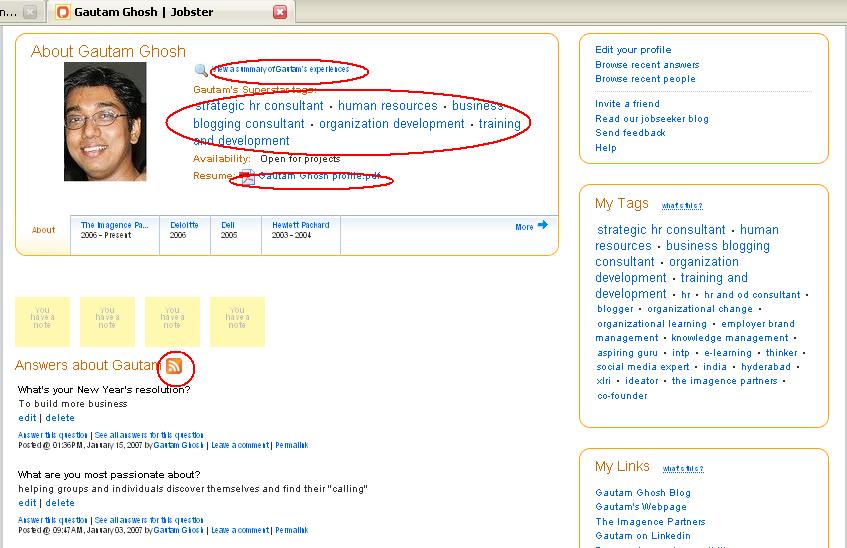
Comparing Linkedin and Jobster profiles

Yesterday, Jason Goldberg announced some new features Jobster rolled out. The most exciting (for me) is the ability to have a personalised URL. So I got my choice URL http://www.jobster.com/people/gautam

Personalised URLs have been around for a long time at Linkedin and my profile there is available at http://www.linkedin.com/in/gautam

So I thought that comparing the jobster public profile with the linkedin public profile would be a useful exercise in case you have your profile in only one place or in none of them :-)

Both the comparisons are of the visible bit of the profile over the fold.

Of course, the focus of the two profiles are different. Jobster profiles are useful for job hunting or being hunted, whereas Linkedin profiles are meant for broader range of business networking (however, head hunting is becoming the most used activity on Linkedin, IMHO)

Exhibit 1:

My Linkedin Profile
Where Linkedin scores is:
  • Highlighting Education - enabling alumni members and past classmates to contact and find you
  • Highlighting the number of endorsements - Shows that people who have worked or interacted with you consider you reliable and have said something publicly.
  • The usefulness of clarifying multiple current roles possible.
  • The ability to showcase an industry, in my case it's "management consulting"
  • The location is quite visible under the name and designation.
Exhibit 2:
My Jobster Profile
  • Jobster enables people to view your "superstar tags" to quickly understand your core skills. The fact that these are restricted to 5 means you have to choose the most important ones.
  • You can upload a profile/resume (either a word doc or a pdf document) for people to download and read.
  • You can subscribe to a person's answers to "questions" by a RSS feed.
  • Pictures can be uploaded on to your profile. While some disagree that pictures have any place on a business related profile, I think the presence does not hamper it in any way.
  • People can leave you messages or 'notes' and that is much better than attempting to contact people through connections in common as in Linkedin.
The big downer for me is that Jobster profiles are US specific and locations like India don't get updated. I guess Linkedin is much ahead than Jobster in globalising. Linkedin also uses the endorsements in a much better way.

However, Jobster gives higher visibility to a person's employment status (for example, mine says, "Open for projects") from "Hire Me" to "Happily Employed" to "My group is hiring". You can also see the job history in a glance by clicking on the "View a summary of Gautam's experiences" while Linkedin helps you articulate what you did in a particular role much better.

So if you want to network and don't have the patience to maintain a blog, put in little effort and open profiles on both Linkedin and Jobster.

Be found.

Internal customers within HR

Anuradha posts about how she is adding the evaluation of the HR generalist in her own performance evaluation as a specialist.

They need to be actively involved in the input process - be it training need identification, specification gathering or new system implementation.

Just as a Business Head makes a contribution to the performance review of his / her HR generalists, a specialists' performance evaluation should have one component that comprises Business HR feedback.

Having worked in both sides of the HR divide (corporate and generalist) I had come to the conclusion that the difference of the worldview of both these groups is due to the nature of work they perform.

A HR generalist (or Business unit/partner/HR manager) manages exceptions. A new leave policy is being rolled out? A good HR generalist will let you know what the 20% employees will be unhappy with it.

A specialist on the other hand, needs to focus on the 80% of the people who will be OK with the new policy.

This is where the dichotomy of viewpoints happen.

I am not sure if incorporating a change in performance evalution as Anuradha is trying will work or not. If anything, then it cannot merely be one way. A specialist must also evaluate a HR generalist on how promptly the feedback was given to change the first draft of any new proposal.

My advice for most HR professionals is that adding more metrics/evaluation might make this much more muddier and confusing. It has chances of succeeding in a much mature HR group.

What does need to change is the adversarial positions of these key HR roles and various HR functions need to do so according to their own cultures and methods.

Downsides of being independent

Yesterday was a rotten day.

I had to postpone and then ultimately cancel a meeting with a potential client because of personal issues.

Then it struck me that once you are independent and have no bosses or subordinates, you can't really send someone else in your place.

I'm feeling pretty down because of not being able to meet my commitment. The person was visiting Hyderabad for a couple of days and therefore it's not like we can meet immediately now.

That's one of the reasons, I bet, why independents and microfirm consultants are slowly forming relationships with other consultants. Consultants News reports:

It has begun to dawn on consultants that the way to build trusted relationships with other consultants is the same way they’ve been building successful relationship with clients. That is, first realizing that it takes time to find out if the relationship will work.

For independent consultants and microfirms, every one of these trusted relationships goes through a series of stages each of which must be completed to move onto the next stage. During each stage, participants learn more about the business philosophies of potential partners and how realistic and flexible the potential partner is. The progress through the stages is how basic business acquaintances turn into trusted partners.

Typically, the smaller the organization, the greater the scrutiny by potential partners. Before attempting to start a partnership, experienced indepen-dent consultants take the time to become very clear about how they do business, what they hope to achieve from the partnership, and how best to articulate that information to potential partners.

Another trend by independent consultants is to slow down and pay more attention to personal needs on a daily basis, as opposed to ‘when I get a chance.’

“If you think that you can only make a first impression once, think harder because chances are you’ve already made that first impression,” said one consultant. Experienced consultants know that you’re not only always on stage; even more important is that your reputation precedes you.


In my own case I have started conversations with independent and small consulting firms in Delhi and Bangalore to refer clients to each other if they can't afford consultants from other cities. Even a larger consulting firm which has no presence in Hyderabad is open to having affiliates like me in cities so that if I do get leads of large engagements that I may not be able to deliver I can call them. They get the ability to build business which would not have been possible and I get to work on a client engagement which I might not have got.

Oh well, tomorrow is a new day.

Jan 17, 2007

After advertising now jobs

Seems like A list blogs are slowly morphing into online versions of trade journals or newsletters.

First they make money through advertising and then they launch classifieds sections, specifically around jobs.

So after Om Malik's GigaOM job board, CrunchBoard by Techcrunch, Problogger's job board and Joel on Software have their own job boads now.

After the tech crowd, looks like other A listers are also joining in the party.

Yesterday I received a mail from Piers Fawkes of trend hunting blog psfk, that they are launching a jobsite too. Although the job site is international, the focus is on London, New York, LA, Berlin, Tokyo, Shanghai & Sydney.

So I mailed Piers if readers from India and nearby regions would also have relevant jobs, and he replied that right now the focus on India is not there.

Julian has an interview with Piers also.

I came across an interesting post at Moustache that rues the fact there are too many such niche job-boards. Will the existence of similar targeted such job boards help or hinder job searchers and recruiters?

Imagine one is a specialist in credit card marketing in Mumbai. And imagine that there are different blogs with job boards on the subjects of finance, credit cards, marketing, retailing, Mumbai. Your dream job could exist in any one of them.

The promise of the large job boards was aggregation, but with micro audiences coming, there exists the danger of splintering of the content too.

If such a thing happens then recruiters and job hunters are in for a tough time in the future.

Blogging's value

One of my ex-bosses, Rick (who himself blogged for therapy, after he escaped the tsunami in Phuket) once asked me "Gautam, what is the value blogging has added to you?"

That got me thinking as to why exactly I blog, and because Rick is not just an occasional blogger. He's also the hyperactive head of learning in one of the divisions of a fortune 100 company.

So today when I received the following email from a B School student from western India, it makes the value of blogging apparent to me.

This mail is to express my heart felt gratitude and regards to you and of course your extremely useful blog that have enabled me crack 5 companies on day 0 itself . Finally I've decided to take up ITC .
May I have the audacity to seek your guidance and support in my future endeavors also now that I'm all set to enter my corporate stint .

I'm grateful for the person who wrote this mail to credit me and this blog with playing a part in his success.

It makes an old blogger happy. Specially since it goes against the fundamental attribution error.

Jan 16, 2007

Sanjeev Bikhchandani on Naukri's IPO


I've interacted with Sanjeev Bikhchandani over e-mail and through this blog earlier, so it was quite a pleasure to finally meet him in person on Sunday. Sanjeev was on a business trip to Hyderabad and mailed to ask me if we could meet. I jumped at the chance. There are very few CEOs I've met, so I turned up at the Green Park hotel at Ameerpet on Sunday.

I found Sanjeev at his laptop struggling with a Reliance wireless connection to get onto the net. The hotel had no wi-fi (update: An anonymous commentor says that Green Park does have WiFi) that day. I think hotels should offer free wi-fi as they offer air conditioning or electricity. "Absolutely." Sanjeev says "They'll make up for that by higher occupancy levels"

So what brings him to Hyderabad ?

"Our our front line executives are having their first training session, and I try being there for all trainings picnics, gatherings, parties that our employees have across India. We are more than a 1000 employee strong and I like to meet as many people as I possibly can"

The beginning

Sanjeev said that when he began his career at an FMCG company in 1989, he noticed how all his colleagues crowded around the jobs listing section of the monthly business magazine those days. That was the insight that people are always interested in a job, whether actively or just for knowledge. The other fact that struck him was the calls from headhunters that his colleagues and he used to get. He realised then the jobs advertised were just the tip of the iceberg, and that the jobs market was a very fragmented one.

"It struck me that if someone could aggregate the data if would be a great business. But it was 1990 and the internet was not around".


Sanjeev thinks the factors that made Naukri.com a success was that it filled a real need and also the fact that it was the first jobsite in India to focus on Indian jobs for resident Indians. "We got a lot of press coverage and buzz because of that" he said "From the first two years the press clippings fill two big box files" he added smiling "We didn't have to hire a PR agency" However it was not all smooth sailing. "I worked as a contributing editor at the careers supplement of The Pioneer newspaper as well as did work with IMS, the MBA coaching institute to earn money to keep the home going."
A major fact he shares for his venture succeeding is "we didn't impose too much of change on our customers.


We went to HR people and Recruiters and said 'You already hire people through the newspapers, here, you can hire people through the internet too. Just fill up this form and fax it to us. We'll do the rest" Then he added, "We hired a lot of people later in corporate sales to get more and more jobs listed on the site, and therefore resulted in more and more job seekers also filling up their resumes on our site." It seemed like a virtuous cycle. Naukri seemed to be on a roll. Then they got the VC funding.

And then the great dotcom meltdown happened.

Sanjeev says "I guess we were the second last dotcom to get funding before the meltdown, before Makemytrip.com. In a way, because of the meltdown we kept the VC money in a fixed deposit, otherwise we might have spent it in an unwise manner. Then 9-11 happened and dotcoms were still struggling. At that time an IPO seemed like a distant dream."

I asked him if his VCs had ever asked him to sell out to recover the money.

"No" he says categorically "the ICICI fund was to close in 2009, so we never thought of selling out. We were lucky on that front too"

The way to the IPO

At that time the turnover of Naukri.com was around Rs 36 lakhs and then everything went into a free fall. "Then we broke even in 2002-03 with a turnover of Rs 9 crores and about 50-60 lakh profit. Things started to turn in 2004 when the Chinese jobsite 51job.com went for an IPO and soon I-Banks started calling us after we closed our 2004-05 financial year. At that point of time we had a turnover of 45 crores and about 500 employees. So we went to Hong Kong to meet some prospective I-Banks for the IPO."

BSE or Nasdaq? "Most of the experts told us we should try to get listed on Nasdaq to get a higher valuation. But we always wanted to list in India first since we see ourselves primarily as a Indian company servicing the Indian market. However the decision was taken out of our hands thanks to a Government of India rule that any firm had to first list in India before it lists anywhere else"

Choosing the Investment Banker. "When it comes to choosing an I Bank for the IPO, indeed, any kind of professional services the basis of choice is the comfort level we feel with the people who will work with us. That's because most of them are equally qualified at an institutional level. So finally we decided on ICICI Securities and Citibank".

The initial plan was to file for an listing in February 2006 and then go for the IPO in April '06. "But we understimated the preparation that would be required. In our case the preparation took 11-12 months."

So what was the biggest learning? "The biggest thing is to have a strong management team in place as effectively the CEO and CFO are out of the day to day operations for a long period of time. Thankfully we have Hitesh Oberoi our COO and a strong senior person to Ambarish, our CFO also assisting him on the IPO, so we could concentrate on the IPO with our full focus"

"We filed for end of May after our March audit, but the markets went choppy and we defered our plans so we ended up doing three audits before the IPO.while preparing for the IPO we were also simultaenously getting in Kleiner Perkins and Sherpalo Ventures - with whom we had signed a term sheet in Feb 2006. So we were preparing for the IPO, getting in two investors, navigating SEBI, BSE, NSE, doing pre-marketing meetings, getting our internal processes in order, doing three accounting audits in six months, dealing with three firms of lawyers and two investment baking firms all at the same time while Hitesh was de facto head of the company and was minding the shop. The 12 months before the IPO were exhausting and chaotic"

So what was the biggest learning for him personally?

"I learnt to sleep on flights" he smiles, "It was crazy, the roadshows, I mean. We started on 8h October. Our first stop was London with 36 hours, then to Boston for 24 hours, then New York for 40 hours again, then we moved to San Francisco for another 40 hours. Then we flew to Hong Kong for 12 hours, onto Singapore for 36 hours and finally reached Delhi for a days rest for Diwali. Then it was time to do the rounds of Indian road shows at Mumbai, Ahmedabad, Chennai and back to Delhi. Fortunately - we were joined by Hitesh for the Hong Kong, Singapore and India road shows - and that took some of the load off me since he was able to speak instead of me in many meetings."

And what exactly is a roadshow?

"Well it's a one hour meeting with a prospective investor whom the I Banks invite. It's one on one and they want to hear the CEO speak. They also quiz the CFO on the numbers later. It's a time for them to judge the management, as eventually they are putting their money on that basis. The bankers don't speak at all except for the introductions. If we are in a city for 1 day we have to do around 8-10 such meetings a day. It's physically and mentally tough. You have to give the same speil every time. You can't deviate from it at all. And for each meeting you have to convey your passion and enthusiasm for your business. Hong Kong was specially tough. We flew on a 14 hour flight, checked into a hotel for 45 minutes to iron our clothes, shaved and showered and then checked out to go to the roadshows"


The IPO itself. "It opened in the end of October, and we said that we'd be happy if it was oversubscribed 20 times" Sanjeev adds "then one the first day it was oversubscribed more than 3 times and our bankers were very happy, and they estimated that we'd be around 30 times oversubscribed"

Eventually the IPO was oversubscribed more than 54 times. How did they celebrate?

"We were too tired to celebrate, but I guess they did somethings in the office" he smiles."Everything however, was a pleasant surprise, the level of oversubscription, the price of the stock."

So post-IPO how is it?

"We have an immense sense of responsibility. With your own money you are merely answerable to yourself. When you take VC money, then your responsibility changes. Public money is a different kettle of fish altogether."

Does it bog you down?

"No. It gives us more confidence to handle the downturns of the market. Of course, the compliances need to be in place, and we have beefed up the management team to handle that."

What does the future hold? Apart from Naukri.com they've moved into real estate with 99acres.com and matrimonials with Jeevansathi.com. What next?
Product and tech innovation is the way forward.

"We are into the business of making online handshakes happen" he says clenching his hands together "After the initial introduction on our sites, the relationship moves offline. We'll stick to that. So we'll never have a travel site or a online shopping store or any thing that needs a supply chain to support such businesses."

He adds "Pricing strategy for India is critical to succeed"

Does the appearance of an Indian Craigslist scare him? Or an Indian Indeed or Simply Hired?

"How will they make money? Advertising will never be enough to sustain them?" On vertical search,"We give a job feed to Rediff, Yahoo, Bixee and Google Base - all of which are vertical search engines. In fact anyone can take a job feed from us via RSS. However our traffic analysis tells us that vertical search engines are yet to take off in India or for that matter anywhere in the world"

And what does he think of the Indian blogosphere?
I read lots of blogs. I search every day for Naukri on Google Blog Search.

" If a blog post warrants a clarification I do that. I think it's a great way to find out what people are saying about your product. I was unaware of blogs and bloggers, and it was the IIPM-Rashmi Bansal-Gaurav Sabnis saga that made me sit up and ask- what is this thing?"

Overall Sanjeev comes across as a passionate entrepreneur who has successfully scaled his organization.

It was a pleasure to meet and interact with him. Thanks Sanjeev !

cheezhead gets a sponsor

Joel Cheesman aka Cheezhead gets
"a deal for 2 years worth $100,000 that would make JobCentral the featured sponsor of the site. For their support, Cheezhead will provide a myriad of ways to build their brand without creating intrusiveness for visitors, such as their logo in the header."
Blogs are really becoming part of the business mainstream in the US at least. Knowing Joel I know he won't shill.

Any sponsors for this blog interested in signing up ? :-)

Jan 14, 2007

CEO as Politician

Alan Murray says in the WSJ that today's CEO is required to play the role of a politician also. Under closer surveillance from shareholders, hedge-funds, investors and regulators, leaders can no longer afford to focus purely on getting the numbers right. Today’s CEO needs to play the role of politician, appealing broadly to "stakeholders", a group that includes shareholders, employees, customers and consumers.

So this means that COOs, CFOs, CMOs and other CXOs who fancy their growth to be as a CEO in the future need to builds not just business strategy skills, or to get to know the market and business better, but also be a 'symbol' for the organization as a politician is for the market.

The mark of a successful politician is also to simplify a complex message and to use stories and metaphors to convey to their constituents. In my view that is a skill that is going to be increasingly going to be asked of CEOs and other business students.

So, if you are a business manager or leader, here's my advice to build this skill. Go to an undergrad student class and explain your business model in non-technical terms.

You never know what you might learn about your own business if you simplify it to communicate :-)

My article on leadership development

Remember the article I was writing on Leadership Development (article outline here) ?

You can read the whole article if in the "Effective Executive" magazine from ICFAI University Press' February issue.

February seems a lucky month for me. "Consultants News" will also carry my article in their February issue.

Jan 13, 2007

Ways to get a job - impress the founder

At least that's what Mehul did to Munjal (of Like.com and Riya)

One day just after the launch, he shows up with a bottle of wine (clearly he read my blog post about how we got the Like.com name) at the office and drops off his resume.

I figure I should at least have lunch with him for his cleverness (this only works once btw - so at least be creative if you want to try this). He was smart, articulate, and had some good ideas on how to improve the site.

Oh, that means you have to read the CEO's blog.

Oops, that means the CEO has to have a blog. That really crunches the companies you can apply your creativity and CV to.

Too bad people like KM Birla, Narayan Murthy or Ratan Tata don't have blogs ;-)

Presence , Shibumi and Flow

I read about it on Prasad's blog, where he also talks about the U curve, simplicity achieved after passing complexity. Does this have parallels with Senge et al's Presence theory U too? Of becoming aware? I think so.

Then I found more about Shibumi at this site. It says:

Shibumi is understanding, rather than knowledge. Eloquent silence. In demeanor, it is modesty without pudency. In art, where the spirit of shibumi takes the form of sabi, it is elegant simplicity, articulate brevity. In philosophy, where shibumi emerges as wabi, it is spiritual tranquility that is not passive; it is being without the angst of becoming. And in the personality of a man, it is . . . how does one say it? Authority without domination? Something like that."

"Meaning, rather, that one must pass through knowledge and arrive at simplicity."


Is the concept of "effortless perfection" of Shibumi also what Mihaly Csikszentmihalyi means by Flow? It would seem so.

So I guess perfect work doesn't ever exist for people. One has to discover their own personal Shibumi or Flow. And hope it is not so fragile to be ephemeral.

My challenge for HR professionals is how are you helping your employees to discover their own shibumi? And in striving to do so, are you discovering your own Shibumi?

Update: Astha responds to Romuald's comment by saying:

a world where divides between the personal and professional self, and honestly divides of any kinds, are becoming passe-- how could we possible not include this deep intrinsic human quest as a valid organizational goal?

Jan 12, 2007

The best airline in India?

Domestic airlines have been attacked repeatedly (not without reason!) by bloggers and MSM for shoddy service and delayed flights.

This post is quite the opposite. I really loved the service and the quality of seating at Paramount Airways, a Chennai based regional airline, when I flew Chennai-Hyderabad recently. They call themselves high value carrier (HVC) and as they say on their website, they really live up to it:

The only Airline in India to offer Full Business Class service at prices comparative to Normal Economy class fares of other Airlines. Our focus will be on unparalleled Comfort and Convenience.

They had provisions for a free lounge service at the airport (for economy and business travelers) as well as full meal service on the flight and spacious seating.

Well, they didn't have the inflight entertainment like Kingfisher Airways, but they'll get my patronage whenever I fly in South India again.

Heh, eat your heart out folks in Mumbai, Delhi and other non-South Indian towns ;-)

Most popular posts of 2006 and other stats

I thought I'd share with you the five posts that got the maximum traffic in 2006.

  1. 10 reasons why organizations are not able to retain people
  2. 8 things to craft your career
  3. Indian HR thought leader series
  4. Turning freelance
  5. So you want to be an investment banker
At the new year's eve this blog celebrated another milestone, the 200,000th visitor. For a niche blog focussed on HR, this is quite a milestone, even if I say so myself ;-)
The traffic has steadily grown in 2006 on a monthly basis even if there were a couple of dips (on account of posting frequency going down, I guess.

I still haven't managed to crack the top 10,000 blogs list on technorati, but today I am at the highest level ever at 10,829.

Any more link love is welcome :-)
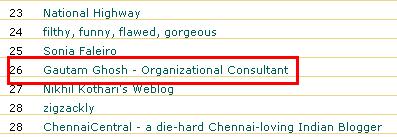
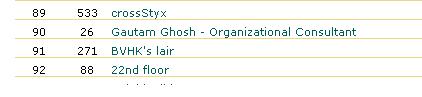
On Blogstreet's list of Indian blogs the blog features at number 26, while on the influence list it's am down at number 90 (I guess that's because not too many Indian blogs link to me :-)
What is more exciting is the number of Indian OD and HR professionals who have started to blog in 2006. 2007 promises to be very exciting !

Watson Wyatt evangelises blogging and social media

A pretty good measure to judge whether a trend is really a trend or a fad is to see if advisory firms start practices around it. Seems so, if one goes by the article by Michael Rudnick, national intranet and portal leader, Watson Wyatt. Published in Strategic HR Review, Volume 6, Issue 2. (via the Melcrum HR newsletter)

Rudnick lists down some points for employers to embrace social media. But hey, you don't have to spend millions of dollars to get useful advice on how to embrace social media in HR. You can always ask us ;-) We'll probably do it for one tenth of what WW would charge :D

Well what Rudnick lists down are some common points to us social media enthusiasts but with the article going to high level decision makers, what it has done is raised awareness of social media.

1. Embrace the "new normal"
The core tenet of social media is user-generated content. While the prospect of giving employees unvetted ability to publish content seems too risky to many HR practitioners, attempting to limit such activity is futile. There's plenty of content that HR must control for compliance purposes but look for opportunities in areas of the business that don't require constant surveillance.

2. Make collaboration easy

Provide best practices and off-line communities where interested employees can learn about how they can participate. According to research by Watson Wyatt, nearly 50% of the employee population will soon prefer – and expect – collaborative and interactive methods of communication with their employers.

3. Encourage content communities
Employees want best practices and core direction without overbearing policy regulation. User communities should get the ball rolling. They provide content creators with a means to learn, share and explore new ideas and opportunities. Examples include deciding which health-care plan is right for your organization or increasing the engagement of Generation Y employees.

4. Think big, start small
Don't take too long planning, start introducing social-media tools using a small group of employees whose profile fits the Web 2.0 criteria. Then gradually introduce social-media tools to other employees and functions across the business.

5. Drive effective change
If your population is skewed to a younger audience, or a large number of knowledge workers, user-generated content can be a valuable option to use in conjunction with existing vehicles and channels, such as your intranet. Leverage its appeal to your younger employees, and over time, others with more traditional views will embrace it as well. Watson Wyatt's research found that during the last three years there's been a 400% increase in social media behavior.

Hmm, I wonder how long before other HR consultancies like Hewitt, Mercer, and the Human Capital practices of E&Y, KPMG jump on to the bandwagon? And how long before that growth spreads to India? According to some estimates around a million Indians read blogs, and these are the demographic that are desired by employers.

Hmm, interesting times ahead.

Bring 'em on.

IT folks get bored easily?

Rediff reports on what Infosys' HR head said recently. Hmm, coming from a former CFO, shouldn't the statement have had more grounding in numbers? Heh, maybe making fuzzy statements without data comes with the territory of a HR job ;-) [Hat-tip: Bis]

New IT pros get bored easily:
"'I think the people, who have been joining in the last one-two years, have a feeling of restlessness among them,' T V Mohandas Pai, who is in charge of human resources at the Bangalore-headquartered Nasdaq-listed firm, said.

Pai, who is also chairman of Infosys BPO, said IT professionals joining today are restless, they want to go up the ladder very fast and see rapid change in the work they do.

* Infosys Q3 PAT up at Rs 983 crore

'They get easily bored. They do just one project and they get bored and they want something else,' he said in response to questions at a press conference, where the company announced its third quarter results.

Pai sought to term the trend as a 'qualitative change' and 'symbiotic' of what is happening in the society today."


Seriously, I think Mr Pai doth protest too much ! If these are indeed " 'symbiotic' of what is happening in the society today" then Infosys and he should be doing something about it.

Firms today claim to be super-responsive to ever changing client demands and specifications.

Well helllooo, welcome to your other client, your employee. Dear HR heads, your employee is not just a resource (oh, how I hate that term !) anymore, but a stakeholder. You are no longer the high and mighty 'mai-baap' who can say 'take it or leave it'.

Welcome to the new world of work!

Jan 11, 2007

Writing an article for Consultants News

Sorry folks, for the lull in postings.

I thought, I'd share what happened recently. After reading one of my recent posts on this blog, Deb Navas Co-Editor of Consultants News (published by Kennedy Information) got in touch and asked me if I'd like to expand the post into a full length article for (gasp!) the Consultants News.

So the last couple of days Deb and I were emailing each other the edited versions of the article and thankfully it's all done, so if you subscribe to CN you would be able to read my article in the February issue.

Whew ! I won't say this is a dream come true...because I've never even dreamt of something like this.

Personalised consulting or tools consulting

Prasad posts on an approach to HR consulting he dubs "wisdom consulting". As he explains:

The kind of HR consulting that I now look forward to do goes beyond tools/ techniques/ methodologies/ approaches. It is highly customized (to the client context) and highly 'personal' (that would enable me to 'bring more of myself into the work'). In addition to the difference in terms of the degree (of customization /personalization), there is also a difference in terms of the intention (see the note below). This way of consulting mainly uses patterns/broad principles (and not methodologies) so that effective solutions can be developed and implemented in complex and dynamic environments.


This got me thinking, that traditionally consulting (the advice business and not technology services or outsourcing that goes by the name of consulting these days ;-) has been of these two approaches. The wisdom of 'thought leaders' like Drucker or other pathbreakers in their fields has been markedly different from the tools, methodology laden focus of larger consulting firms (for example, BCG's 2x2 product matrix). The focus of course is as Prasad mentions on the leverage that tools provide.

However another difference is the purpose of the consulting assignment itself. Larger consulting firms are driven by the expertise model. They are sought to be hired for a skill (of strategic analysis, financial modelling, business process mapping etc) that are lacking in the client system. The end result is a report and a choice of decisions that the client needs to implement.

However, in the case of a single person 'guru', what the client is hiring is not so much of 'content' expertise as it is 'insight or process' expertise. Their focus is to help the client discover the issues/blind spots that is holding it back. The aim is the develop the client system's internal processes and learning so that the next time there is an issue they can solve it for themselves.

Of course, sometimes larger consulting firms also do the collaborative consulting approach, but they cannot be done by all consultants in the firm. It is usually handled more by internal thought leaders of the firm, like Arun Maira of BCG does in India.

Jan 10, 2007

The Curse of Knowledge

Guy Kawasaki interviews the authors of "Made to Stick", Chip Heath and Dan Heath, and this is what I found most interesting in the post:

The better we get at generating great ideas—new insights and novel solutions—in our field of expertise, the more unnatural it becomes for us to communicate those ideas clearly. That’s why knowledge is a curse. But notice we said “unnatural,” not “impossible.” Experts just need to devote a little time to applying the basic principles of stickiness.


It's a great point, and sometimes is the reason why a Marketing head cannot fathom why the Production head cannot understand why he is saying demand will go up for the new product :-)

How do the experts communicate their ideas within your organization? Can you help them make that language and communication simpler?

Jan 9, 2007

Welcoming Prasad to the Blogosphere

There are a quite a few people whose conceptual depth in Human Resources always take my breath away.

And whenever one of them joins the blogging community, I am very pleased :-) as that makes it easier to know what they are thinking and reading these days.

So it is with Prasad O Kurian, my senior at XLRI. Before his MBA in HR, Prasad was a bona-fide rocket scientist, working with ISRO (Indian Space Research Organization). I guess when he ran out of intellectual challenges, he thought, what's the biggest intellectual challenge than rocket science, and he must have said - human beings !

So let me not keep you from Prasad's blog - go here to read and learn more. I love the name he's chosen for the blog, Simplicity at the other end of complexity.

Emotional intelligence and executive success

It's a wonder how people still do not recognize the importance of Emotional Intelligence for executive success. On linkedin answers someone asked:
What is more important for a successful Executive career - Intelligence or good Communication skills? My colleagues and friends often debate and discuss the key factors for success among C-level Executives. Obviously both of these factors are important, but which do you feel is most important in the business world, and why?
This is what I replied:

Most research has pointed out that as one interacts more with people, it is emotional intelligence that is more important. The abilities to recognise one's own emotions, managing them, recognising other's emotions and empathising is more important than IQ or plain communication skills.

Intelligence is the basic threshold block for many jobs. For other jobs communication skills are minimum criteria. But to really grow in firms, and to succeed, emotional intelligence is the key differentiator.

Jan 7, 2007

For laid off Jobster employees

The Animal recently had a great brainwave (he keeps having them regularly, proving that animals are better than human beings ;-) for the Jobster employees who are getting laid off.

So I am joining in on this plan. If any laid off Jobster employee wants to highlight his/her skills and profile, this blog will host it for their help with their job search.

There are about 240 blogs linking here and it has a Google PageRank of 6, so it will get a decent exposure on the search engines.

For people looking at hiring sales and marketing profiles like
  • Implementation managers or project managers
  • Account managers
  • Field sales people
  • Channel development and sales
  • Customer support
Then keep an eye out on this blog (or you can contact Dave L directly)

HR case studies

For the HR event at Great Lakes, I had to make a small role play for the participant B Schools to act out. All of them did a pretty good job of the scenarios that I had handed out :-) The B Schools were ISB, NMIMS, JBIMS, SCMHRD, XLRI and FMS.

The scenarios are given below. How would you carry these conversations as a HR or OD professional? You can leave your comments :-) and I'll let you know how you did vis-a-vis the participants :-))

The Scenarios:

1. The HR head has discovered that his recruiting head has been taking kickbacks from recruitment consultants for selecting their candidates. Play out the difficult conversation that you as the HR head will have with your Recruitment head following this accusation. Please note that you have no proof but just the accusation of one rejected candidate.

2. According to the performance management system the bottom 5% of the 500 employees in the sales organization need to be asked to resign. However, the Sales Director accuses you, the HR VP of coming up with a change in the system and of coming up with an "arbitrary system" to specifically target the Sales function as compared to other functions. The fact is that the Sales function is the largest group in the organization and identifying lower performers is relatively easier compared to R&D and marketing which have less than 50 employees each. Role play the discussion you have with the Sales Director.

3. As the HR Manager of a business unit in a large telecom firm you have been facing large scale attrition in your business. You find recently from the market that one of the Operations Manager of your business is going to attrite to a competitor and is also planning to wean away his full team of 12 engineers. The reason is because the competitor has no team ready and the skills are rare to get, and that he is comfortable leading the people he already knows. He is also going to get a hefty referral bonus if he gets them to the new firm. Play out the conversation that you will have with him.

4. As the HR head of a large pharma company, you have been hired to make the transition in terms of culture from a Indian organization to a global pharma company. The firm has grown inorganically from a small generic pharma company. The R&D head has been throughout the growth period. However, the CEO and you have come to the conclusion that he will not be the correct person to lead the R&D efforts of a global firm. What is the conversation you and the CEO will have with the R&D head.

5. You are the Learning & Development head of a large consulting firm. The new managing partner of the firm has asked you to present your plans for the learning and development 250 consultants and 60 support staff. In the past you have primarily addressed only initial orientation training and 10-15 soft skills programs when demanded by the consulting practices. The new managing partner wants to link learning and development more closely to business. You know that is not going to be easy as the various practice heads and major engagement managers arrange their own technical training without any inputs from your group. In your meeting with the partner share your struggles as well as your plan for the future of learning in the firm.

6. You are the OD Manager of a Indian private bank. Your CEO is concerned that the gender diversity of your firm is much lower than your competitors. You have found out that your organization's driven culture and 'macho' brand image is what keeps women away from your firm. HR policies and processes also do not help. The rest of the top management is however not concerned over such comparison so long as the top line and bottom line is taken care of. What will your approach be to convince them on the need for a more diverse workplace as well as what will be your plan to be given to your CEO to change the status quo.

Deloitte Canada Blogs

It's always great to know that an ex-employer of yours has started blogging. Deloitte & Touche LLP Canada has started blogging. (Hat tip : Steve Shu)

Oh yes, not my direct employer. I was an employee with Deloitte Consulting India Pvt Ltd which itself was a part of Deloitte & Touche USA LLP :-)

The interesting thing is that it's hosted in the Careers section ....and it has an RSS feed ! Some interestings posts in the blogs (it's actually a collection of many individual blogs)
The Interview Process


So how is your firm using blogs to appeal to jobseekers?

Search engine marketing for Jobs

This is from the Pinstorm IAMAI "state of Search Engine Marketing in India". You can download a copy from this site.

If you notice, jobs advertising by organizations will result in better click throughs than job advertising by job sites or third party recruiters. See how Accenture by investing much lesser amount than other sites got the best click throughs rates.
It is time that Indian firms start looking at Search Engine Marketing as a much better way to target relevant job seekers than using half page advertisements in newspaper classifieds !

So if you are a recruiter in a company, are you even thinking about using keyword search advertising for getting employees?

Rahul Bajaj on the Indian Economy


It was a pleasure to hear Rahul Bajaj (Chairman of Bajaj, and Member of Congress) speak at the Great Lakes fest yesterday. Madhur Bajaj and he were in Chennai in connection with the marriage of Madhur's daughter and they took out an hour to address us all there.

Some points he touched upon were:

  1. Reforms need to be speeded up to bring prosperity to Indians.
  2. We need to focus on intrastrcuture, health and education.
  3. CSR is good for companies' shareholder value.
  4. Good corporate governance is going to be a law whether businesses like it or not.
  5. There are still discretionary areas with the government which gives rise to corruption.
  6. "I am for the underprivileged and the Dalits" he said, "But I voted against the reservation bill in Parliament because what they need is high quality primary education to compete on merit"
  7. I asked him if he sees a role for a the private sector in primary education, and he replied that primary education should be free until the age of 14-16 and should be given by the government. "Even in the capitalist world of the US, the world of the primary education is socialist" he said. He said that private public partnership could be looked at as a way to go forward, however.
  8. He was sceptical of a one lakh car project by the Tatas and said by the time it reaches the consumer it could probably be one and a half lakh rupees.
  9. He dismissed the suggestion that it could be a threat to the two wheeler market.
  10. He said that Bajaj would enter the four wheeler segment in the LCV segment by 2008.
  11. He also asked the students to work so that not only India is the second or third largest economy in the world but also focus on metrics like per capital income and reduce the 30% population who live on less than a dollar a day to negligible.
  12. He was categorical that not everyone needs to do a masters degree to add to the mass of over educated and underemployed people, but that people who get second and third class in bachelor's degrees should get into vocational training and add employable skills.
  13. He regretted that the Left held back the most committed economic reformers in the world like Manmohan Singh, Montek Ahluwalia, P Chidambaram and Kamal Nath.
  14. He also stressed that the Tatas were the only Indian company competing against foreign firms in the sector. However in the two wheeler sector Indian firms like Bajaj and TVS rules because the foreign firms' understanding of the market is very low.
  15. Speaking about the two wheeler motorcycle market he said that Bajaj had the value segment and the high end segment, but Hero Honda had Splendor in the massive mid-segment and they were unlikely to launch a frontal attack against Splendor.
Swati, the journalist from Business Line who was there reports on Bajaj's speech:

In a persuasive speech delivered extempore, Mr Bajaj spoke of the urgent need to bridge the gap between the haves and the have-nots. "The elite have a big responsibility," he thundered, pausing to let his thought sink in among the assembled bright youngsters who held the promise of joining the ranks of tomorrow's elite. "Wherever you are, remember that you are batting for your country," urged Mr Bajaj, and everyone listened in rapt attention.

Jan 5, 2007

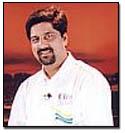
Krish Srikkanth's tips for success


It was great to hear and see Krish Srikkanth as the keynote speaker of the CEO Conclave at the fest of the Great Lakes Institute at Chennai.

Srikkanth recounted his cricket playing days and particularly the 1983 world cup victory for getting his message of success to the people gathered there.

He said that he was dropped from the Indian team when it toured West Indies in 1983 and that was the time he got married. After a brief honeymoon which he spent at Sri Lanka, he returned to Chennai and recieved a call from Sunil Gavaskar. Sunny asked him "Cheeka, do you want to go for a second honeymoon to the USA?"

Srikkanth said "Sure, what do I have to do?"

"Oh, just play some exhibition games and have a good time. You can impress your wife" Sunil replied.

"Sure, count me in"

"Ok Cheeka, by the way, we will all go to the US with a stopover at London. You know, play a couple of games for the World Cup, probably watch the semi finals and finals at Lords' and then head to the US"

Srikkanth shared "Yes, we were that confident that we won't last until the quarter finals, that the World Cup was just a trip for us en route to the US"

He then shared "Well our first game was against the West Indies, two time winner of the World Cup with names like Gordon Greenidge, Desmond Haynes, Viv Richards, Jeff Dujon, Clive Lloyd, Gus Logie and those four fast bowlers whose names I don't want to remember!"

"Kapil addressed the team meeting and said, boys, we have beaten the West Indies once in the tour we had before this and we can beat them again today. I told myself, this guy has gone bonkers. Beat the West Indies? That's not possible. But Kapil is an aggressive guy, he was insistent ...chhodna nahin, he told us. And that team meeting is what made us believe in ourselves. People say we became a champion side after we won the world cup, but no, we became a champion side after that team meeting. Only Kapil Dev was responsible for that achievement, he made us believe we could do it"

"We played all our roles and Kapil led from the front. Remember that match against Zimbabwe when we were 17 for 5. Any other captain would have buckled under and played safe. Not Kapil. He only knew one way to play. By being aggro"

The other points he shared was to take a decision based on your heart instead of your head. "People will mock you. Chandu Borde was the manager when I sent Chetan Sharma to be a pinch hitter at number 3 against England and he was livid. But Chetu scored 105 ! That was because I had to take a decision and I knew I could ask him to score a quickfire 20-25 at more than a ball. I couldn't ask Dilip or Mohinder to do that. Cricket is a team sport, as a captain you have to take decisions . The brain will only give you options, but your heart takes the decision"

Talking about self growth he told people "Listen to what your heart tells you to be. That is eventually what you will be. "

Then he dwelt about his form slump after the 1983 world cup when he was chucked from the team and almost got ejected from the Tamil Nadu team too. "Making a comeback at the World Championship of Cricket in Australia I was determined to prove my critics wrong, to be acknowledged as a great one-day player. Our first match was against Pakistan and I was thinking so much about what I could be that I forgot to concentrate on my basics. My feet were not moving and I was out for a low score. I believed I would never play for India again. In the second match I batted without any worries and played my natural game and scored 50 odd runs and we won against England. Focus on the means and the ends will follow. Do not get attached to the outcome. Be detached."

By the way, how many knew that Srikkanth had turned entrepreneur and had a cricket gaming site ?