Was chatting with a journalist friend today.
She interviews some bona fide gurus.
Was asking me about blogging, how to go about it, how long does it take, etc.
Why did she want to know?
Somebody told her that she should blog. The interviews that she does are usually 8000 word transcripts that get published in 800 word articles. She could put the full transcript on a blog.
My question was, would her employer approve?
Probably not, she said. "but if I need another job, these could be shown to my prospective employer"
So I suggested that she try the new blogger beta. It has privacy settings that can restrict people's access to your blog. So it can effectively act as one's online database/portfolio.
Give the access to your new recruiter and say goodbye to emailing bulky attachments.
Feindishly simple !
Blogs are actual job hunting tools this way and not just to build one's brand !
Aug 31, 2006

Virgin Comics Issue 1 reviewed
Non-business related post, please skip if you're not interested.
As part of Desicritics I got the opportunity to read the first issue of Virgin Comics. You can find the detailed review here on my personal blog.
As part of Desicritics I got the opportunity to read the first issue of Virgin Comics. You can find the detailed review here on my personal blog.
Aug 30, 2006
Infosys' Corporate Blog - Think Flat
Infosys launched its corporate blog, Think Flat with a post from CEO Nandan Nilekani, last month and then by Stephen Pratt of Infosys Consulting Stephen Pratt.
Most of the posts seem to be stuck to the "Flat world" theme, and the first two posts don't acknowledge the fact that they are being posted on a blog. Hmm, cut and paste job by someone in Corporate Communications, I guess.
Thankfully there is a RSS feed, and comments are not moderated. Sample this comment to Nandan's post
Heh.
And no post or comment back from NN.
The recent posts are by a lady called Richa Govil. She posts a thankfully more bloggish post here. Who is she? No idea. An introduction might have been in order.
What else is missing? A blogroll. Or links. We'd like to see who the bloggers at Flat World read. Tom Peters is a great Infy advocate, maybe they should add him to the blogroll.
What really the blog needs is less posturing and more conversation. More themes. Flat World is too narrow a category for the blog, unless Infy plans to launch multiple blogs. Which the domain http://www.infosysblogs.com seems to suggest.
Lets hope the blog does not die the death of the Wipro Blog ! But as of now it's quite a flat blog
Update: Review is also up at Desicritics.
More Update: When I logged into Linkedin I realised that Infy is advertising the blog through linkedin ! That's such a traditional way of thinking ! Why can't they just link to other blogs and respond to what the blogosphere is talking?
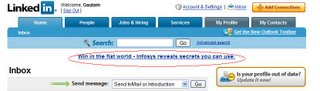 And just what is meant by that line - "Win in the flat world - Infosys reveals secrets you can use" ? Some clueless advertising copywriter obviously came up with that one ! A big thumbs down to this one !
Most of the posts seem to be stuck to the "Flat world" theme, and the first two posts don't acknowledge the fact that they are being posted on a blog. Hmm, cut and paste job by someone in Corporate Communications, I guess.
Thankfully there is a RSS feed, and comments are not moderated. Sample this comment to Nandan's post
"What a terrible waste of time and storage space.
Is that the best thing you could write in your blog. bla h d' blah blah about your company and the tripe you serve your minions. Thats not what we want to read. Its a blog.
Don't you know what a blog is?
Don't make this another space for you to serve your corporate bull crap man. Talk of how you can inspire and elevate the youth in your company. How you can stop them from jumbing into Microsoft.
Talk of your life. There should be something interesting. Chill out. "
Heh.
And no post or comment back from NN.
The recent posts are by a lady called Richa Govil. She posts a thankfully more bloggish post here. Who is she? No idea. An introduction might have been in order.
What else is missing? A blogroll. Or links. We'd like to see who the bloggers at Flat World read. Tom Peters is a great Infy advocate, maybe they should add him to the blogroll.
What really the blog needs is less posturing and more conversation. More themes. Flat World is too narrow a category for the blog, unless Infy plans to launch multiple blogs. Which the domain http://www.infosysblogs.com seems to suggest.
Lets hope the blog does not die the death of the Wipro Blog ! But as of now it's quite a flat blog
Update: Review is also up at Desicritics.
More Update: When I logged into Linkedin I realised that Infy is advertising the blog through linkedin ! That's such a traditional way of thinking ! Why can't they just link to other blogs and respond to what the blogosphere is talking?
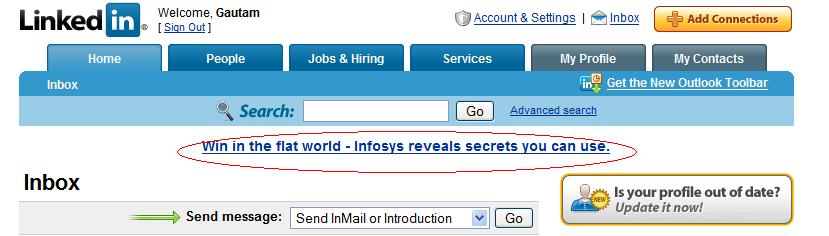 And just what is meant by that line - "Win in the flat world - Infosys reveals secrets you can use" ? Some clueless advertising copywriter obviously came up with that one ! A big thumbs down to this one !
How to kill creativity
Don't stretch things till the eleventh hour, says Teresa Amabile.
She also busted 5 other myths of creativity, which are:
So if you want your organization to be creative then focus on collaboration and trust, and make employees happy and not stressed !
That sounds like a great place to work !
She also busted 5 other myths of creativity, which are:
1. Creativity Comes From Creative Types
2. Money Is a Creativity Motivator
3. Fear Forces Breakthroughs - " we found that creativity is positively associated with joy and love and negatively associated with anger, fear, and anxiety. The entries show that people are happiest when they come up with a creative idea, but they're more likely to have a breakthrough if they were happy the day before. "
4. Competition Beats Collaboration
5. A Streamlined (or Downsized) Organization Is a Creative
Organization.
So if you want your organization to be creative then focus on collaboration and trust, and make employees happy and not stressed !
That sounds like a great place to work !
Aug 29, 2006
Bigfoot Recruiting: How to recruit candidates that do not exist !
A Blogswap post by Jim Stroud, Internet savvy recruiter and sourcer, podcaster, cartoonist and blogger extraordinaire, who happens to work (and blog!) for Microsoft.
-------------------------------------------------------------------------------------------------
Bigfoot Recruiting: How to recruit candidates that do not exist!
© 2006, Jim Stroud
It is sometimes a comedy of errors to observe the (sometimes) disconnect from reality between recruiters and well-meaning hiring managers.
A recent article in VOIP Magazine discussed how a certain HR manager of a certain cable broadband provider contacted a certain expert for assistance in finding experienced IP communications people. It seems that this certain company had made a decision to deploy Voice over IP next year to round out a consumer package. What this certain HR manager wanted specifically was a Director Of VoIP Operations. Since Director Of VoIP is a brand spanking-new position, involving a new technology, and a new service model for the company, whomever landed that gig would need an excellent understanding of emerging technologies and a crystal clear view of the impact that this service would have on this cable broadband provider's business model. The writer of the article was not wholly optimistic of the HR manager's success. Why? Long story short, there are not many people around that fit the job description the HR manager described. And this had me thinking.
"Self," I said to myself, "How would you go about recruiting Bigfoot candidates?"
"Bigfoot candidates?"
"Yes," I continue to say to... ummm... myself. "Bigfoot candidates are those candidates that some people believe exist, but most folks accept them as general myth."
Bigfoot citings are not uncommon in HR, as they usually occur whenever new technologies become popular. Case in point, when the JAVA programming language was released in 1995 (or was it 1996?), it was not uncommon to see job postings for Java developers with 5 years (or more) experience. This was laughable on one level and frustrating in every other sense for both recruiters and hiring managers alike. How was a recruiter going to find the perfect candidate when (overall) they did not exist as the technology itself was barely a few months old?
I ran into this when I was recruiting Executive and Technical personnel for startup companies in the 90's. So what happenned back then? Well, some businesses changed their mind on how they chose to proceed on certain projects, delayed their initiatives (until the dotcom bubble burst), or dropped them alltogether. If I could go back in time, I would rattle off a list of what they could do (or I could have done) to find Bigfoot candidates skilled in Java or any other hot new emerging technology. Alas, I can not go back in time; but perhaps you dear reader can benefit from these finite pearls of wisdom.
When you are asked to find a candidate with years of experience in a technology that is only a few months old, do one (or all) of the following:
1. Look for the best of the best in last year's technology.
Ask yourself this, "What technology out there is like (fill-in-the-blank) technology?" If (fill-in-the-blank) technology does the same thing as (last year's technology), but faster, perhaps I can find a potential hire from someone who is really good with (last year's technology) and potentially could take it to the next level? I should focus on those candidates that innovated (last year's technology) and really stretched it in different ways.
2. Convince the business to add training time into its development cycle.
Explain to your client that experts in (fill-in-the-blank) technology are in short supply and that it would be infinitely easier, more productive and cost effective to train the engineers already on the payroll in (fill-in-the-blank) technology and factor their training with the development cycle of the new product.
3. Consider the source
Every technology, has a creator, so consider recruiting the people who invented the (fill-in-the-blank) technology (or buying the company they started).
4. Forget about Beta, go Alpha!
Get a working prototype online ASAP and post it online for people to kick around. Pay close attention to those who give the best technical feedback and recruit them.
5. Use your Lego building blocks
Look for technology that can perform a portion of what the (fill-in-the-blank) technology can do and then find another and then another. Imagine putting these technologies together (like a Lego set) as a means of competing against the (fill-in-the-blank) technology. Once you have all of the parts together, search the patents behind each piece of technology. Every artist signs his work, so find out who was good at making these pieces and then recruit them as well.
6. Spill the beans
This is a risky play and worth it in the end, but I advise doing this ONLY with the full approval of the company (especially the tech department). Leak reports on what you are doing to the blogosphere and study the reactions. I speculate that you will find:
A. People who will debunk it as heresay.
B. Who will be impressed and speculate on the final product.
C. People who will not be impressed and cite other companies who are doing similar things and doing it better (at least, in their opinion).
You want to pay closest attention to "C." Why? Elementary my dear Watson, they are providing you information on companies and/or technology that you might not have been aware of. This is intelligence you can use to find more potential hires. Its a sneaky play, but works VERY well if executed correctly. Ummm... At least, I have heard that it works well (wink).
When confronted with a Bigfoot search, convince your customer of the time wasted in finding what does not exist (or is extremely rare at best) and steer them in the direction of training the developers they have in the latest technical fashion trend. Afterall, it is easier to build a "Bigfoot" than to waste time looking for one. Still, I am reminded of all those explorers who refuse to believe what is most likely true and pursue a mythical beast that has been seen (only) with a shaky camera. For those recruiters who service clients with similar folktale faith, you have my pity.
###
ABOUT JIM STROUD
Jim Stroud is a "Searchologist" with an expertise in the full life-cycle placement of Executive and Technical personnel, Recruitment Research and Competitive Intelligence. He has consulted for such companies as Google, Siemens, MCI and a host of start-up companies. He presently serves Microsoft as a Technical Sourcing Consultant and is a regular contributor to Microsoft’s Technical Careers Blog. His personal blog – Jim Stroud 2.0 features podcasts, comics, video and commentary about the recruiting industry. Jim Stroud was nominated for a "Best Blog Award" by Recruiting.com in 2005.
-------------------------------------------------------------------------------------------------
Bigfoot Recruiting: How to recruit candidates that do not exist!
© 2006, Jim Stroud
It is sometimes a comedy of errors to observe the (sometimes) disconnect from reality between recruiters and well-meaning hiring managers.
A recent article in VOIP Magazine discussed how a certain HR manager of a certain cable broadband provider contacted a certain expert for assistance in finding experienced IP communications people. It seems that this certain company had made a decision to deploy Voice over IP next year to round out a consumer package. What this certain HR manager wanted specifically was a Director Of VoIP Operations. Since Director Of VoIP is a brand spanking-new position, involving a new technology, and a new service model for the company, whomever landed that gig would need an excellent understanding of emerging technologies and a crystal clear view of the impact that this service would have on this cable broadband provider's business model. The writer of the article was not wholly optimistic of the HR manager's success. Why? Long story short, there are not many people around that fit the job description the HR manager described. And this had me thinking.
"Self," I said to myself, "How would you go about recruiting Bigfoot candidates?"
"Bigfoot candidates?"
"Yes," I continue to say to... ummm... myself. "Bigfoot candidates are those candidates that some people believe exist, but most folks accept them as general myth."
Bigfoot citings are not uncommon in HR, as they usually occur whenever new technologies become popular. Case in point, when the JAVA programming language was released in 1995 (or was it 1996?), it was not uncommon to see job postings for Java developers with 5 years (or more) experience. This was laughable on one level and frustrating in every other sense for both recruiters and hiring managers alike. How was a recruiter going to find the perfect candidate when (overall) they did not exist as the technology itself was barely a few months old?
I ran into this when I was recruiting Executive and Technical personnel for startup companies in the 90's. So what happenned back then? Well, some businesses changed their mind on how they chose to proceed on certain projects, delayed their initiatives (until the dotcom bubble burst), or dropped them alltogether. If I could go back in time, I would rattle off a list of what they could do (or I could have done) to find Bigfoot candidates skilled in Java or any other hot new emerging technology. Alas, I can not go back in time; but perhaps you dear reader can benefit from these finite pearls of wisdom.
When you are asked to find a candidate with years of experience in a technology that is only a few months old, do one (or all) of the following:
1. Look for the best of the best in last year's technology.
Ask yourself this, "What technology out there is like (fill-in-the-blank) technology?" If (fill-in-the-blank) technology does the same thing as (last year's technology), but faster, perhaps I can find a potential hire from someone who is really good with (last year's technology) and potentially could take it to the next level? I should focus on those candidates that innovated (last year's technology) and really stretched it in different ways.
2. Convince the business to add training time into its development cycle.
Explain to your client that experts in (fill-in-the-blank) technology are in short supply and that it would be infinitely easier, more productive and cost effective to train the engineers already on the payroll in (fill-in-the-blank) technology and factor their training with the development cycle of the new product.
3. Consider the source
Every technology, has a creator, so consider recruiting the people who invented the (fill-in-the-blank) technology (or buying the company they started).
4. Forget about Beta, go Alpha!
Get a working prototype online ASAP and post it online for people to kick around. Pay close attention to those who give the best technical feedback and recruit them.
5. Use your Lego building blocks
Look for technology that can perform a portion of what the (fill-in-the-blank) technology can do and then find another and then another. Imagine putting these technologies together (like a Lego set) as a means of competing against the (fill-in-the-blank) technology. Once you have all of the parts together, search the patents behind each piece of technology. Every artist signs his work, so find out who was good at making these pieces and then recruit them as well.
6. Spill the beans
This is a risky play and worth it in the end, but I advise doing this ONLY with the full approval of the company (especially the tech department). Leak reports on what you are doing to the blogosphere and study the reactions. I speculate that you will find:
A. People who will debunk it as heresay.
B. Who will be impressed and speculate on the final product.
C. People who will not be impressed and cite other companies who are doing similar things and doing it better (at least, in their opinion).
You want to pay closest attention to "C." Why? Elementary my dear Watson, they are providing you information on companies and/or technology that you might not have been aware of. This is intelligence you can use to find more potential hires. Its a sneaky play, but works VERY well if executed correctly. Ummm... At least, I have heard that it works well (wink).
When confronted with a Bigfoot search, convince your customer of the time wasted in finding what does not exist (or is extremely rare at best) and steer them in the direction of training the developers they have in the latest technical fashion trend. Afterall, it is easier to build a "Bigfoot" than to waste time looking for one. Still, I am reminded of all those explorers who refuse to believe what is most likely true and pursue a mythical beast that has been seen (only) with a shaky camera. For those recruiters who service clients with similar folktale faith, you have my pity.
###
ABOUT JIM STROUD
Jim Stroud is a "Searchologist" with an expertise in the full life-cycle placement of Executive and Technical personnel, Recruitment Research and Competitive Intelligence. He has consulted for such companies as Google, Siemens, MCI and a host of start-up companies. He presently serves Microsoft as a Technical Sourcing Consultant and is a regular contributor to Microsoft’s Technical Careers Blog. His personal blog – Jim Stroud 2.0 features podcasts, comics, video and commentary about the recruiting industry. Jim Stroud was nominated for a "Best Blog Award" by Recruiting.com in 2005.
Job Sculpting - Time to relook
Butler and Waldroop in the HBR suggested that retaining talent is dependent on not just giving people great and challenging work. In these days of talent wars, the best way to keep your stars is to know them better than they know themselves –and then use that information to customize the careers of their dreams.
It requires a manager to be both Detective as well as Psychologist !
As they say:
So what are these life interests? Fast Company lists them here.
So how well do you know your subordinates, team members or even yourself? What do you think are your own life interests?
Of course, it's not easy to guess, unless a leader actually knows their people. That's no fun compared to a faddish theory, which explains why its not such a big hit with practitioners.
It requires a manager to be both Detective as well as Psychologist !
As they say:
strong skills don’t always reflect or lead to job satisfaction. Many professionals, particularly the leagues of 20- and 30-somethings streaming out of today’s MBA programs, are so well educated and achievement oriented that they could succeed in virtually any job. But will they stay? The answer is, only if the job matches their deeply embedded life interests. These interests are not hobbies – opera, skiing, and so forth – nor are they topical enthusiasms, such as Chinese history, the stock market, or oceanography.
Instead, deeply embedded life interests are long-held, emotionally driven passions, intricately entwined with personality and thus born of an indeterminate mix of nature and nurture. Deeply embedded life interests do not determine what people are good at – they drive what kinds of activities make them happy. At work, that happiness often translates into commitment. It keeps people engaged, and it keeps them from quitting.
So what are these life interests? Fast Company lists them here.
So how well do you know your subordinates, team members or even yourself? What do you think are your own life interests?
Of course, it's not easy to guess, unless a leader actually knows their people. That's no fun compared to a faddish theory, which explains why its not such a big hit with practitioners.
Aug 28, 2006
Developing People - whose job is it?
I was recently talking to a Director Operations of a BPO during my recent vacation. He was telling me how he and his fellow Directors were evaluating Managers to get promoted to Senior Manager positions, and in the 10 candidates they interviewed and assessed in detail, 9 were definite "no-nos".
And these were people who had worked for the firm for the last three years.
So their boss the MD asked them, "These 10 people have worked with you (3 Directors) over the last 3 years, and yet you feel none of them are ready for promotion?"
The Directors nodded "yep"
The MD then asked the question that really silenced them, "So whose fault is it?"
Then the Director told me "After that day we've been having discussions...and the whole thing is this pull between today's needs and tomorrow's needs. Today I need to concentrate on getting my SLAs and metrics perfect, so I end up telling my Managers what to do instead of letting them figure out, even though I know that's important for their growth to the next level"
So as a manager is that your dilemma too? How do you handle that?
And as a subordinate, can you realise if your supervisor is having the same dilemma? What can you do to help them? (Hint: Ask for a mentor/coach/cross-functional opportunity)
What organizations can do is publish what competencies are needed at various levels and therefore make it evident for people to take charge of their own development. Doing so would also ensure that levels exist because there is a need and not just to show promotions for the employees :-)
And these were people who had worked for the firm for the last three years.
So their boss the MD asked them, "These 10 people have worked with you (3 Directors) over the last 3 years, and yet you feel none of them are ready for promotion?"
The Directors nodded "yep"
The MD then asked the question that really silenced them, "So whose fault is it?"
Then the Director told me "After that day we've been having discussions...and the whole thing is this pull between today's needs and tomorrow's needs. Today I need to concentrate on getting my SLAs and metrics perfect, so I end up telling my Managers what to do instead of letting them figure out, even though I know that's important for their growth to the next level"
So as a manager is that your dilemma too? How do you handle that?
And as a subordinate, can you realise if your supervisor is having the same dilemma? What can you do to help them? (Hint: Ask for a mentor/coach/cross-functional opportunity)
What organizations can do is publish what competencies are needed at various levels and therefore make it evident for people to take charge of their own development. Doing so would also ensure that levels exist because there is a need and not just to show promotions for the employees :-)
NHRD, CII and XLRI to accredit HR professionals
This news is quite interesting.
“We want to develop competencies in the HR professional, so we have tied up with the CII and XLRI, who will design and develop the competency. We are developing a model where accreditation like a chartered accountant’s could be given to an HR professional,” Mr Dwarkanath remarked. Mr Dwarkanath said that although details are to be worked out, there will be a grading of HR practitioners, from expert, professional, operational, etc. He added they still have to work out relating higher grades to monetary or other benefits. “This is a blue print and we need to work out benefits for the employer and the employee,”
As I have stressed before, getting into a HR career in India has never been easier. There is such a shortage of HR professionals that an entry is almost guaranteed in HR Operations and Recruitment to a graduate who has basic competencies.
But when it comes to growth often a Psychology/Industrial Psychology/OB/HR certification becomes a necessity, and that is where such accreditions will become useful.
I hope they adapt the HR certifications which have been worked on in the US for this and not really reinvent the wheel !
“We want to develop competencies in the HR professional, so we have tied up with the CII and XLRI, who will design and develop the competency. We are developing a model where accreditation like a chartered accountant’s could be given to an HR professional,” Mr Dwarkanath remarked. Mr Dwarkanath said that although details are to be worked out, there will be a grading of HR practitioners, from expert, professional, operational, etc. He added they still have to work out relating higher grades to monetary or other benefits. “This is a blue print and we need to work out benefits for the employer and the employee,”
As I have stressed before, getting into a HR career in India has never been easier. There is such a shortage of HR professionals that an entry is almost guaranteed in HR Operations and Recruitment to a graduate who has basic competencies.
But when it comes to growth often a Psychology/Industrial Psychology/OB/HR certification becomes a necessity, and that is where such accreditions will become useful.
I hope they adapt the HR certifications which have been worked on in the US for this and not really reinvent the wheel !
Aug 25, 2006
The MBA story at Pune
We went to Pune for my wife's MBA institute's alumni meet. The next day I met a friend of mine whose spouse is Dean Academics for another MBA institute there.
These meetings and visits showed me a reality of India's MBA story that the gushing stories of the business press hardly covers. Pune currently has 90 odd management institutes and they operate almost totally on the basis of visiting faculty and guest lectures from people who work in the industry there.
Earlier these people used to be from the thriving industries of Pune, the Bajajs, the Kirloskars, the Thermaxs and others. Nowadays, they are also from Pune's booming IT and BPO sector. In fact, which awesome mechanical talent already there, CAD/CAM firms find Pune a great place to start off.
Rumors have it that some visiting faculty members earn more from their moonlighting jobs than their day job in this place. As someone said "One of the executives has kept an administrative assistant at home whose only job is to schedule classes at 4 institutes in the morning as he goes to work, and 4 classes in the evening."
Each 90 min class pays Rs 1000. And each 3 credit course is 20 classes long. That's Rs. 20,000 from one MBA institute in three months. People can easily make some really heavy duty money doing teaching in Pune. No, you don't need a Ph.D. to teach there and you are not required to do research.
Some people claim that if the focus of the MBA course is to give a life-like picture of corporate life, then this is the best way to go ahead with it. Of course, there are no original case studies for a teacher but plenty of real life examples they can use.
Hmm. I think I should start moonlighting some HR and OB courses at Pune over the weekend ;-)

These meetings and visits showed me a reality of India's MBA story that the gushing stories of the business press hardly covers. Pune currently has 90 odd management institutes and they operate almost totally on the basis of visiting faculty and guest lectures from people who work in the industry there.
Earlier these people used to be from the thriving industries of Pune, the Bajajs, the Kirloskars, the Thermaxs and others. Nowadays, they are also from Pune's booming IT and BPO sector. In fact, which awesome mechanical talent already there, CAD/CAM firms find Pune a great place to start off.
Rumors have it that some visiting faculty members earn more from their moonlighting jobs than their day job in this place. As someone said "One of the executives has kept an administrative assistant at home whose only job is to schedule classes at 4 institutes in the morning as he goes to work, and 4 classes in the evening."
Each 90 min class pays Rs 1000. And each 3 credit course is 20 classes long. That's Rs. 20,000 from one MBA institute in three months. People can easily make some really heavy duty money doing teaching in Pune. No, you don't need a Ph.D. to teach there and you are not required to do research.
Some people claim that if the focus of the MBA course is to give a life-like picture of corporate life, then this is the best way to go ahead with it. Of course, there are no original case studies for a teacher but plenty of real life examples they can use.
Hmm. I think I should start moonlighting some HR and OB courses at Pune over the weekend ;-)
Meeting bloggers at Mumbai
There's one thing that I haven't really done in my 4 years of blogging. And that is participating in a blogger meet. When I was in Bangalore, I missed it a couple of times and after moving back to Hyderabad I really haven't discovered a blogging community in the city.
Currently on vacation, after three days at Pune and two days at lovely green Manori Island off Mumbai, I am looking forward to meeting some bloggers tomorrow (26th August) at Mumbai. Saket has the details here. So if you are a blogger and happen to be at Mumbai, then please feel free to join in.
Rashmi and Dilip SMSed me to let me know that they are out of the city tomorrow. And even Dina seems to be busy. Hey Naina, hope you make it there.
Currently on vacation, after three days at Pune and two days at lovely green Manori Island off Mumbai, I am looking forward to meeting some bloggers tomorrow (26th August) at Mumbai. Saket has the details here. So if you are a blogger and happen to be at Mumbai, then please feel free to join in.
Rashmi and Dilip SMSed me to let me know that they are out of the city tomorrow. And even Dina seems to be busy. Hey Naina, hope you make it there.
Aug 17, 2006
A sponsor for a laptop?
I'm considering buying a laptop for my startup HR, OD and Blogging consulting venture.
Any suggestions? Techies and laptop gurus from India, I'm really interested to hear your opinion.
I am also exploring some sponsorship scheme by a PC maker or other firm (yeah yeah, I know, the idea is totally borrowed from Jeremy!).
So here's my offer, if you sponsor my laptop you get coverage on this blog, get mentioned on my speaking assignments and in stories in the media.
You'll also get post ads, once every 10 posts.
Any takers ?
Geez, I'm a shill...already !
Any suggestions? Techies and laptop gurus from India, I'm really interested to hear your opinion.
I am also exploring some sponsorship scheme by a PC maker or other firm (yeah yeah, I know, the idea is totally borrowed from Jeremy!).
So here's my offer, if you sponsor my laptop you get coverage on this blog, get mentioned on my speaking assignments and in stories in the media.
You'll also get post ads, once every 10 posts.
Any takers ?
Geez, I'm a shill...already !
Visiting Pune and Mumbai next week
We're taking a vacation from 19th to 27th August.
The family will be visiting Pune and Mumbai and taking some time off to visit some scenic spots in between the two cities. However, I'd still be reachable on my cell phone at +91-98665-11236.
If anybody in Pune or Mumbai would like to meet over a mug of coffee or beer to discuss HR, OD or Blogging, just give me a call.
The family will be visiting Pune and Mumbai and taking some time off to visit some scenic spots in between the two cities. However, I'd still be reachable on my cell phone at +91-98665-11236.
If anybody in Pune or Mumbai would like to meet over a mug of coffee or beer to discuss HR, OD or Blogging, just give me a call.
Atypical Uses of Blogs in a Corporate World - Blogswap post by Jim Durbin
This post is part of the Recruiting.com Blog Swap. The author is Jim Durbin
of StlRecruiting.com.
We all know that blogs enable conversations between corporate monoliths and the freedom loving masses that make up the public. Someone, somewhere, figured out that a comment feature allows for a rich interaction between MegaCorp's chief executives and Bob the Customer, who spends approximately $11 with MegaCorp every quarter.
This interaction is the key, not only to profitability, but to the very survival of MegaCorp in a Web 2.0 21st Century.
Except that it isn't.
I am a business blog consultant, much like Gautam. Like Gautam, I left a career in employment to start my own consulting business because I saw that business blogs had a real demand that was not being met. This is probably giving away company secrets, but the truth about blogs is they are a wonderful tool that can be used in numerous ways other than enabling the CEO
to carry on a conversation with a customer.
Use #1:
Press Release Generator:
Do you know that News button on websites that sits between About Us and Services? You click the News button, and are whisked to a page with press releases and announcements, usually dated 2 years ago and never relevant.
Imagine using blog software to allow your Public Relations department or Marketing department the ability to push-button publish relevant industry and company information in a blog format, but without actually calling it a blog. You get the SEO results, the individual entries to send out, and the ease of updating content without involving several developers.
Use #2:
Job Board:
One of the problems with using job boards or scrolling software to post your positions is the individual entries aren't visible to search engines. If companies used blogs to post their jobs, they could organize the jobs, give each job an individual page, and create RSS feeds for candidates to put in their readers. Looking to hire Java developers? Have a Java Developer feed that allows your candidates to check your open positions from their desktop
instead of hoping they will come back to your site.
Use #3
Trade Show Announcement
Are you a company that markets primarily through trade shows? Use a blog to announce which trade shows you will be at, what you are presenting, and encourage people to come on by your booth. This has the SEO benefit mentioned above, allows website readers to know where they can find you, and allows you to prep people both before and after the conference.
The beauty of each of these uses of blogs is you don't have to call them blogs. The name doesn't matter - the results do. Far too many companies think a blog is about exposing all of their faults to ridicule. That's not the case. The blog is just a tool, and the more we help companies generate results from these tools, the more likely they are to feel more comfortable with the blogging public in general.
Free your mind, and the blog ideas will follow.
About the author:
Jim Durbin is the Director, Corporate Communication for Durbin Media Group, an interactive marketing firm specializing in blog consulting. He blogs at BrandStorming for blog marketing, and StlRecruiting.com for online employment.
of StlRecruiting.com.
We all know that blogs enable conversations between corporate monoliths and the freedom loving masses that make up the public. Someone, somewhere, figured out that a comment feature allows for a rich interaction between MegaCorp's chief executives and Bob the Customer, who spends approximately $11 with MegaCorp every quarter.
This interaction is the key, not only to profitability, but to the very survival of MegaCorp in a Web 2.0 21st Century.
Except that it isn't.
I am a business blog consultant, much like Gautam. Like Gautam, I left a career in employment to start my own consulting business because I saw that business blogs had a real demand that was not being met. This is probably giving away company secrets, but the truth about blogs is they are a wonderful tool that can be used in numerous ways other than enabling the CEO
to carry on a conversation with a customer.
Use #1:
Press Release Generator:
Do you know that News button on websites that sits between About Us and Services? You click the News button, and are whisked to a page with press releases and announcements, usually dated 2 years ago and never relevant.
Imagine using blog software to allow your Public Relations department or Marketing department the ability to push-button publish relevant industry and company information in a blog format, but without actually calling it a blog. You get the SEO results, the individual entries to send out, and the ease of updating content without involving several developers.
Use #2:
Job Board:
One of the problems with using job boards or scrolling software to post your positions is the individual entries aren't visible to search engines. If companies used blogs to post their jobs, they could organize the jobs, give each job an individual page, and create RSS feeds for candidates to put in their readers. Looking to hire Java developers? Have a Java Developer feed that allows your candidates to check your open positions from their desktop
instead of hoping they will come back to your site.
Use #3
Trade Show Announcement
Are you a company that markets primarily through trade shows? Use a blog to announce which trade shows you will be at, what you are presenting, and encourage people to come on by your booth. This has the SEO benefit mentioned above, allows website readers to know where they can find you, and allows you to prep people both before and after the conference.
The beauty of each of these uses of blogs is you don't have to call them blogs. The name doesn't matter - the results do. Far too many companies think a blog is about exposing all of their faults to ridicule. That's not the case. The blog is just a tool, and the more we help companies generate results from these tools, the more likely they are to feel more comfortable with the blogging public in general.
Free your mind, and the blog ideas will follow.
About the author:
Jim Durbin is the Director, Corporate Communication for Durbin Media Group, an interactive marketing firm specializing in blog consulting. He blogs at BrandStorming for blog marketing, and StlRecruiting.com for online employment.
On not having a plan
There are certain kind of people that always made me feel inadequate. You know, the folks who always seem to have figured out their future down to the last dot. They are the examples we quote in time management classes, who write 20 year goals, then break it down gradually down to granules of 2 weeks !
In a lot of ways, I've been an anti-thesis of that. My inbox is messy and the future is always imagined, never planned. Only recently I've got in touch with a underlying theme of my strengths and have figured out a mission for myself.
So it came as a relief when I read this on Tom Peters' blog:
In a lot of ways, I've been an anti-thesis of that. My inbox is messy and the future is always imagined, never planned. Only recently I've got in touch with a underlying theme of my strengths and have figured out a mission for myself.
So it came as a relief when I read this on Tom Peters' blog:
I have never had a plan, and that is no lie. I just go from speech to speech and Post to Post and book to book—with no thought about "impact." Your question is interesting, because the idea has never crossed my mind. (E.g., after every book I write I vow never to write another. Then something new pisses me off—and away I go.)Years ago I named my power boat (sold long ago) "Cromwell." It was because of a Cromwell quote I love/loved: "No one rises so high as he who knows not where he is going." (Or something close to that.) For example, I get fanatic about design or women's stuff for a few years. It's not because it fits a framework—it's because some inadvertent remark/s gets me going. You must believe me about this—as you know, I am blunt and personal and truthful to the best of my ability in these Posts.
So, I've discovered my strengths and have found my battle.
Have you?
Quoted in the Economic Times
On an article on getting bitchy about your boss.
It was this post that led to the reporter to give me a call and ask me for my opinion.
I know, it may not be a big deal for famous bloggers, but hey this is only the second time that the biz papers have quoted me (first time here), so I feel like trumpeting about it.
And when I said "Also for GenY, this is the best way to express their feelings" what I meant, is that it is the easiest way to express feelings, since they are so comfortable online.
It was this post that led to the reporter to give me a call and ask me for my opinion.
I know, it may not be a big deal for famous bloggers, but hey this is only the second time that the biz papers have quoted me (first time here), so I feel like trumpeting about it.
And when I said "Also for GenY, this is the best way to express their feelings" what I meant, is that it is the easiest way to express feelings, since they are so comfortable online.
Aug 16, 2006
My fave bloggers are blogging at the FCnow Blogjam
Dave Pollard, Joel, Heather, Rashmi...they all are at the Fast Company Blogjam 2006.
Go ahead...read FC-Now !
Me? Oh well, I did that last year ;-))
Been there, done that ;-)
Go ahead...read FC-Now !
Me? Oh well, I did that last year ;-))
Been there, done that ;-)
Bridging the gap
Lilia blogs about two types of blogging, author centric and topic centric.
As more and more people in the workplace start to blog, Lilia's question will become very pertinent for them as well as their employers:
As more and more people in the workplace start to blog, Lilia's question will become very pertinent for them as well as their employers:
Maybe this won't be true for large organizations (you know the type where people are warned "don't use company assets for personal use" or they say "blogs what?") but for smaller organizations this could be a valuable way to gain visibility to the bloggers community. Ultimately it depends on the engagement the blogger has with the organization to how much visibility she/he gives in the blog, and if that is stronger than the commitment he/she has towards the community of his/her readers.
So, what happens when an author-centred, author-driven and author-dependent weblog on work-related topics becomes recognised, valued and supported by the company that pays the author to work on those topics? The weblog turns into a middlespace for negotiations and interplay of powers - those of a person and of an organisation...
Aug 15, 2006
How long should a resume be?
Guy Kawasaki thinks it should never be more than 1 page long.
Gretchen thinks that's not true.
I think that if you can pull it off then you should stick to 2 pages, at least in India. However the majority of mid management CVs that I have seen were well into their 3rd and 4th pages. (heh, even I was guilty on that count 3 years into my post MBA career!)
Remember that very often a hiring manager who himself/herself has made a 5 page resume might not be very impressed with a one page resume. Sure, it's first impressions, and it's unfair, but so is life ;-)
So keep the important stuff in the resume. If you are applying from India to the US then as Priya says, don't put hobbies, single/married status/age/date of birth on your resume. Please, please don't add a picture of you looking uncomfortable in a formal dress. You may not be as great looking as your mother would have you believe ;-))
Keep the following stuff and cut everything, and I mean everything else out !
1. Your achievements in your past roles. Take this thumb rule. For every 3-4 years choose one (and I mean ONE!) greatest achievement. Don't (I repeat, don't!) put your job descriptions in the resume.
2. List your educational institutes, and your grades/CGPA/percentage. Don't add stuff that seems irrelevant.
3. Unless it's your first job, don't take up more than 3 lines to list positions of authority held in social communities or educational institutions.
Now tell me, is it more than 2 pages?
And if your response is that the resume doesn't reflect your true self and all your achievements, keep in mind that it's first and foremost a marketing document. Its job is to get you the call for the interview. You will have the opportunity in the interview to show off your true self :-))
Oh another thing, keep the decorations like shading, text boxes, tables on a resume to the bare minimum. Not all resumes get read on your word processor. Copy paste your resume on the notepad application to get an idea of how it could seem to your prospective employer !
All the best !

Get the latest on diversity issues in the workplace at Diversity Jobs.
Gretchen thinks that's not true.
I think that if you can pull it off then you should stick to 2 pages, at least in India. However the majority of mid management CVs that I have seen were well into their 3rd and 4th pages. (heh, even I was guilty on that count 3 years into my post MBA career!)
Remember that very often a hiring manager who himself/herself has made a 5 page resume might not be very impressed with a one page resume. Sure, it's first impressions, and it's unfair, but so is life ;-)
So keep the important stuff in the resume. If you are applying from India to the US then as Priya says, don't put hobbies, single/married status/age/date of birth on your resume. Please, please don't add a picture of you looking uncomfortable in a formal dress. You may not be as great looking as your mother would have you believe ;-))
Keep the following stuff and cut everything, and I mean everything else out !
1. Your achievements in your past roles. Take this thumb rule. For every 3-4 years choose one (and I mean ONE!) greatest achievement. Don't (I repeat, don't!) put your job descriptions in the resume.
2. List your educational institutes, and your grades/CGPA/percentage. Don't add stuff that seems irrelevant.
3. Unless it's your first job, don't take up more than 3 lines to list positions of authority held in social communities or educational institutions.
Now tell me, is it more than 2 pages?
And if your response is that the resume doesn't reflect your true self and all your achievements, keep in mind that it's first and foremost a marketing document. Its job is to get you the call for the interview. You will have the opportunity in the interview to show off your true self :-))
Oh another thing, keep the decorations like shading, text boxes, tables on a resume to the bare minimum. Not all resumes get read on your word processor. Copy paste your resume on the notepad application to get an idea of how it could seem to your prospective employer !
All the best !
Get the latest on diversity issues in the workplace at Diversity Jobs.
Aug 14, 2006
When organizations become big
....they lose their sense of humor?
I agree that brand names becoming generic (like "to xerox") is scary for companies.
In fact, the 1970s book by Ries and Trout called Positioning warned companies that becoming generic means that competitors are ready to take over your brand.
Is that what is scaring Google so much?
But the bit about Apple is too much. ipod can be trademarked but not any word with pod in it !
Seems like being a lawyer is the hottest job in Silicon Valley !
I agree that brand names becoming generic (like "to xerox") is scary for companies.
In fact, the 1970s book by Ries and Trout called Positioning warned companies that becoming generic means that competitors are ready to take over your brand.
Is that what is scaring Google so much?
But the bit about Apple is too much. ipod can be trademarked but not any word with pod in it !
Seems like being a lawyer is the hottest job in Silicon Valley !
What you do depends on who you are
So says the bizpundit, quoting some research.
You can't empower employees with freedom and authority because it's the fad of the week, only to worry about whether or not they are really working or if they are goofing off.
As the Gallup survey would say, it doesn't really matter. If both the coaches can identify the strengths of their players and get them to leverage those strengths, then they are good coaches :-)
You can't empower employees with freedom and authority because it's the fad of the week, only to worry about whether or not they are really working or if they are goofing off.
As the Gallup survey would say, it doesn't really matter. If both the coaches can identify the strengths of their players and get them to leverage those strengths, then they are good coaches :-)
Indra Nooyi becomes PepsiCo CEO
On the eve of India celebrating its 59 Independence Day, it is somehow apt that an Indian woman has become CEO of a global food and beverage behemoth like the $ 33 billion PepsiCo.
The 50 year old Nooyi is an alumnus of IIM Calcutta and has worked earlier at Motorola, BCG, Johnson & Johnson. (via)
PepsiCo names Nooyi CEO - reuters report.
The 50 year old Nooyi is an alumnus of IIM Calcutta and has worked earlier at Motorola, BCG, Johnson & Johnson. (via)
PepsiCo names Nooyi CEO - reuters report.
Some advice from Peggy
When I let people know that I was venturing into freelance work, one of the best bit of practical advice came from my ex-colleague at HP, Peggy Parskey. She started on a similar journey almost a year ago and with her permission I am sharing her advice:
I’ve been working harder than ever, but have accomplished much more than I
ever envisioned. There is a lot of work out there for high quality people who have:a) Consultative skills
b) Can balance pragmatism with innovation
c) Can adapt to the needs and culture of the client
d) Have significant value to add.
e) Have some basic but critical skills. This may sound silly, but here’s what I see:
- Writing abilities: being able to draft emails, communiqués, proposals, etc.
- Know their way around the MS Suite (or equivalent): Can create a good looking Word document or a professional looking slide deck.
- Know how to use excel at a high level
- Know how to use other tools to present ideas, e.g., Mind mapping, creating graphical models, flow charts
Sorry to say, but I’ve run into a lot of consultants who are more mouth than action and sell more than they can deliver.
Good luck!
search engine optimization jobs at Oaseo.
Aug 12, 2006
How do I network? 7 years of learning
I often get questions from friends who want to know what is the secret of my networking? Or as the Hindi Surf ad goes "Tera networking mere networking ke zyaada safed kaise?"
The reason I get these questions is because most people are told that if they are not networking these days they are not doing the X-factor that would grant them career success (whether that is in getting a deal or finding a job).
For me networking in the digital world started 7 years ago as part of my job. I was part of the Knowledge Management team at my first job post my MBA and my boss told me that we should be doing something to brand our organization's work in the KM area.
I had just become aware of email based virtual communities on egroups.com (since then acquired by yahoo to form Yahoogroups.com ) and I ended up creating the KMSI egroup. Then I created the HRGyan egroup to share HR related knowledge with fellow professionals in India.
From egroups I moved to web based communities like Howard Rheingold's Brainstorms community, which I am no longer a member of, but plan to go back again after some time. My areas of interest were developing into how virtual communities and Communities of Practice interact to share knowledge and improve productivity. So while I was enagaged in the content of these communities, I was even more involved in the processes of interaction behind them. I learnt the pros and cons of virtual communities and became a community junkie for some time. I still retain memberships of Ryze, Linkedin and Orkut whereas my profiles on hi5, MySpace are languishing :-)
So coming back to the point on which I began this post, what works for me in networking, specially virtually? Here are my top 10 learnings over the last 7 years:
The reason I get these questions is because most people are told that if they are not networking these days they are not doing the X-factor that would grant them career success (whether that is in getting a deal or finding a job).
For me networking in the digital world started 7 years ago as part of my job. I was part of the Knowledge Management team at my first job post my MBA and my boss told me that we should be doing something to brand our organization's work in the KM area.
I had just become aware of email based virtual communities on egroups.com (since then acquired by yahoo to form Yahoogroups.com ) and I ended up creating the KMSI egroup. Then I created the HRGyan egroup to share HR related knowledge with fellow professionals in India.
From egroups I moved to web based communities like Howard Rheingold's Brainstorms community, which I am no longer a member of, but plan to go back again after some time. My areas of interest were developing into how virtual communities and Communities of Practice interact to share knowledge and improve productivity. So while I was enagaged in the content of these communities, I was even more involved in the processes of interaction behind them. I learnt the pros and cons of virtual communities and became a community junkie for some time. I still retain memberships of Ryze, Linkedin and Orkut whereas my profiles on hi5, MySpace are languishing :-)
So coming back to the point on which I began this post, what works for me in networking, specially virtually? Here are my top 10 learnings over the last 7 years:
- Always look to help people out who come to you for any issue
- If you cannot it then redirect them to someone who can.
- To be able to do #2 you should know people at a personal level to engage with.
- Move the relationship to phone or offline level to take it to the next level
- Ignore personal attacks. It can get tempting to react, but does not do any good for anybody.
- Keep your contacts "warm". Let them know what's happening in your life.
- Except for very close realtionships most relationships have a "what's in it for me" attitude. Meet that question and make it clear.
- If you need any help, broadcast. You never know from where help can come.
- Blog.
- Comment on others blogs.
I am now recommended by Chimby
Who or what is Chimby, you might ask? It claims to be the "career advice search engine". I got a mail from CM Russell, who said I could put this button on my blog.
So there you have it folks:

So does that mean I am a career coach too?
Well, let's just say that if you meet me online or offline and want to understand careers in Human Resources, as well as the IT/ITES/KPO industry, I might be able to guide you in some way.
So there you have it folks:
So does that mean I am a career coach too?
Well, let's just say that if you meet me online or offline and want to understand careers in Human Resources, as well as the IT/ITES/KPO industry, I might be able to guide you in some way.
Pros of turning freelance in India
Deepak left a comment on my blog and gave a link to his post.
In my opinion this is one of the most down to earth explanations of the logistics of turning entrepreneur in India that I have seen. He even gives the working of how much tax can you save if you turn entrepreneur (heh, assuming that you make enough through consulting as your salaried job). As he says:
On a related note Jim Durbin weighs the pros and cons of working from home
In my opinion this is one of the most down to earth explanations of the logistics of turning entrepreneur in India that I have seen. He even gives the working of how much tax can you save if you turn entrepreneur (heh, assuming that you make enough through consulting as your salaried job). As he says:
In terms of income, Salaried people pay taxes and then spend money. Freelancers spend money and pay taxes on the remaining amount.
On a related note Jim Durbin weighs the pros and cons of working from home
Aug 10, 2006
Another Blogswap post
Heh...I managed to clear a little backlog of Blogswap posts that were pending.
This one is hosted at the blog of the CEO of ERE, David Manaster. ERE is the leading information provider for the Recruiting industry in the US.
My post is about Evolving a Recruiting Body of Knowledge.
So what do you think?
Hop over to David's blog and leave us a comment !
This one is hosted at the blog of the CEO of ERE, David Manaster. ERE is the leading information provider for the Recruiting industry in the US.
My post is about Evolving a Recruiting Body of Knowledge.
So what do you think?
Hop over to David's blog and leave us a comment !
Blogswap post at Tod's blog
Tod Hilton is one of the non-recruiter, non-HR folks participating in the Blogswap. Tod works in Microsoft and is a hiring manager, which is the reason he's interested in recruiting. He says about his blog: "My blog is a mix of software development issues/code-snippets, what it's like to work at Microsoft, my video game habit, funny stuff I find online and a bit of dog stuff thrown in every now and then."
My post for Tod's blog is about 2 weeks late :(( That's because I know zilch about software development or what its like to work at MS (though I have a very good friend who works at MSR ;-), neither am I interested in video games...or dogs (after I left school that is !)
Here is what I finally thought was apt for his blog.
My post for Tod's blog is about 2 weeks late :(( That's because I know zilch about software development or what its like to work at MS (though I have a very good friend who works at MSR ;-), neither am I interested in video games...or dogs (after I left school that is !)
Here is what I finally thought was apt for his blog.
Aug 9, 2006
Online branding
Two informative posts by Shannon which should get companies (1) excited, (2) worried.
The first one is how recruiting through social software has officially become Job Search 2.0 !
The second is the rise of sites like Boss Bitching, created by an Unknown Tech Guy. Boss Bitching is a user driven social content website that allows anonymous postings of stories about bosses.
As Shannon asks: What will this (and the numerous other sites that will undoubtedly launch in the coming months) do to employer brands? How will companies manage their Online Boss Brands?
On a related note: The CH/RA waxes uncharacteristically philosophical and says "This too shall pass". Well he doesn't actually say it...but that's what he means.
Truthiness is philosophy at some level, I guess :-))
The first one is how recruiting through social software has officially become Job Search 2.0 !
The second is the rise of sites like Boss Bitching, created by an Unknown Tech Guy. Boss Bitching is a user driven social content website that allows anonymous postings of stories about bosses.
As Shannon asks: What will this (and the numerous other sites that will undoubtedly launch in the coming months) do to employer brands? How will companies manage their Online Boss Brands?
On a related note: The CH/RA waxes uncharacteristically philosophical and says "This too shall pass". Well he doesn't actually say it...but that's what he means.
Truthiness is philosophy at some level, I guess :-))
Korn/Ferry buys Lominger
Posted by fellow OD blogger Terry on the trdev egroup:
Hmm, looks like clients are asking Korn/Ferry to not just source leaders but also to help them develop leaders (external hires? Internal people?). Very interesting. Hmm, now do I need to work closely with the folks at Recruiting.com ? ;-))
So would the Korn Ferry search consultants now be having conversations like this?
Client Chairman: Dear Headhunter, I need a turnaround CEO for the widgets business that has gone through a rough patch recently. We're losing market share, the Chinese are beating us on price, our suppliers are screaming hoarse, and my previous three CEOs were fired by the board.
Headhunter: Hmm...we'll draw up a list of possible candidates, but I want to let you know that widget CEOs are people who've never managed a turnaround since the business was always sych a cash cow. Would you be willing to look at someone who's not a CEO, maybe a CMO or COO of the swidgets industry?
CC: Swidgets? But that would mean teaching them all about our industry !
HH: Ah well, for that we have our newly acquired leadership development division ....of course now my billing will comprise of two components, the search and the development !
Korn/Ferry International, a California executive search firm, is paying $24 million to buy Lominger Ltd. Inc., a leadership development company.Lominger really is a great brand for us HR folks, specially if you consider that Eichinger has co-authored a book with Dave Ulrich (!!) called 100 things you need to know
The all-cash deal gets KFI Lominger Limited Inc., Lominger Consulting and Lominger Intellectual Property.
Lominger, based in Minneapolis, will become a wholly-owned unit of KFI and part of the company's Leadership Development Solutions business. The company will be branded as Lominger International, A Korn/Ferry Company. Robert W. Eichinger, Co-Founder and CEO of Lominger, has signed an agreement to join Korn/Ferry as President of Lominger, while Co-Founder Michael M. Lombardo will also stay on in the role of Senior Research Fellow.
"Korn/Ferry has built a significant presence in the leadership development marketplace that will be enhanced by this acquisition. Lominger has a gold-standard reputation among HR and OD professionals," said Gary Hourihan, President of Korn/Ferry's Leadership Development Solutions business. "Clients recognize the quality of the research that the Lominger products are built upon, and they respect the methodology and the results."
Hmm, looks like clients are asking Korn/Ferry to not just source leaders but also to help them develop leaders (external hires? Internal people?). Very interesting. Hmm, now do I need to work closely with the folks at Recruiting.com ? ;-))
So would the Korn Ferry search consultants now be having conversations like this?
Client Chairman: Dear Headhunter, I need a turnaround CEO for the widgets business that has gone through a rough patch recently. We're losing market share, the Chinese are beating us on price, our suppliers are screaming hoarse, and my previous three CEOs were fired by the board.
Headhunter: Hmm...we'll draw up a list of possible candidates, but I want to let you know that widget CEOs are people who've never managed a turnaround since the business was always sych a cash cow. Would you be willing to look at someone who's not a CEO, maybe a CMO or COO of the swidgets industry?
CC: Swidgets? But that would mean teaching them all about our industry !
HH: Ah well, for that we have our newly acquired leadership development division ....of course now my billing will comprise of two components, the search and the development !
Blogging and Non-Disclosures
What is the line between privacy of corporate information and the right to blog about them?
Some of the rules are simple: If you are an employee don't blog about your company private information like your salary, confidential company reports, identifiable customer or supplier information.
But the lines get hazy in something like this event. Apple invites people to its developer forum and then says, by the way, don't blog or talk about it. (check out the comments there...some interesting points of views).
My view is that if the rules apply for printing, presentations, sharing through non-viral means then they need to apply for bloggers also. Bloggers cannot say "Hey we're your biggest fans, so treat us differently". So if there is an expectation of conversations staying private, then that expectation has to be respected.
I also agree that Apple is missing the woods for the trees. Maybe it's part of their closely guarded culture and they're quite conscious about it. But that age is past. Now, involving your fans into the corporate decision making process and helping you co-evolve your services and products is not a sign of weakness anymore, Steve!
Some of the rules are simple: If you are an employee don't blog about your company private information like your salary, confidential company reports, identifiable customer or supplier information.
But the lines get hazy in something like this event. Apple invites people to its developer forum and then says, by the way, don't blog or talk about it. (check out the comments there...some interesting points of views).
My view is that if the rules apply for printing, presentations, sharing through non-viral means then they need to apply for bloggers also. Bloggers cannot say "Hey we're your biggest fans, so treat us differently". So if there is an expectation of conversations staying private, then that expectation has to be respected.
I also agree that Apple is missing the woods for the trees. Maybe it's part of their closely guarded culture and they're quite conscious about it. But that age is past. Now, involving your fans into the corporate decision making process and helping you co-evolve your services and products is not a sign of weakness anymore, Steve!
Aug 8, 2006
Can't you hurry it up?
No. Every natural process takes time.
A video learning lesson from John Stewart of McKinsey, addressing why change programs always take longer to implement in practise than initially expected on paper.
A video learning lesson from John Stewart of McKinsey, addressing why change programs always take longer to implement in practise than initially expected on paper.
Dave Snowden starts a blog
Another KM guru starts blogging. Dave Snowden who was earlier with IBM has started his consulting blog called Cognitive Edge. This adds to the Babsonknowledge blog to actually follow the thought processes of gurus in KM
This goal of Cognitive Edge resonated with me at a very deep level !
This goal of Cognitive Edge resonated with me at a very deep level !
The creation of an open source approach to the development of consultancy methods. All methods created by Cognitive Edge can be downloaded for free, subject to agreement to a creative commons license. An international Cognitive Edge Network of accredited practitioners is being created through training and practice in collaboration with a variety of organisations.I wonder what they would look for in prospective accredited practitioners :-)
The CH/RA asks...
...whether I made any money yet.
Heh.
No CH...not yet !
My organization has managed to hold me back for an additional month to do some assignments before they let me go. And the assignments sound very interesting, something that'll look good on my marketing collateral (what the heck is that anyway? People have started asking me for that!) when I do end up making it!
My Independence Day is not going to be August 15th, but Sept 8th.
Ah well...maybe there are reasons for co-incidences and patterns for everything :-)
Heh.
No CH...not yet !
My organization has managed to hold me back for an additional month to do some assignments before they let me go. And the assignments sound very interesting, something that'll look good on my marketing collateral (what the heck is that anyway? People have started asking me for that!) when I do end up making it!
My Independence Day is not going to be August 15th, but Sept 8th.
Ah well...maybe there are reasons for co-incidences and patterns for everything :-)
Process Work's Relevance for HR
On a HR egroup I recently championed the cause of HR people being exposed to process work and preferably becoming trained facilitators. Here is what I wrote:
Why is process work suggested for HR people?
Process work originated in the T groups and S group labs in the National Training Labs in the US, with people like Kurt Lewin, Edgar Schein and Chris Argyris leading the way. It helps people become sensitve to their own behavioral processes and the underlying processes that guide group and organizational behavior. Here is a great historical perspective!
Most of the times these processes are unacknowledged, invisible and not acted upon, this leads to organizational processes being short-circuited and people not knowing what caused that issue. HR people by nature of their role are custodians of both people and processes and it becomes imperative for them to sense and understand the undercurrents that guide such behavior.
Some more resources and links are here .
Organizations in India helping people become facilitators:
ISABS
ISISD
Sumedhas
Aastha
Why is process work suggested for HR people?
Process work originated in the T groups and S group labs in the National Training Labs in the US, with people like Kurt Lewin, Edgar Schein and Chris Argyris leading the way. It helps people become sensitve to their own behavioral processes and the underlying processes that guide group and organizational behavior. Here is a great historical perspective!
Most of the times these processes are unacknowledged, invisible and not acted upon, this leads to organizational processes being short-circuited and people not knowing what caused that issue. HR people by nature of their role are custodians of both people and processes and it becomes imperative for them to sense and understand the undercurrents that guide such behavior.
Some more resources and links are here .
Organizations in India helping people become facilitators:
ISABS
ISISD
Sumedhas
Aastha
Aug 7, 2006
Gallup's Clifton StrengthsFinder
I recently had the good fortune to take Gallup's Clifton StrengthsFinder questionnaire over the web. For those who don't know, the CSF looks at the presence of 34 talents in an individual.
Gallup believes that to make these talents into strengths they must be developed and refined with acquired skills and knowledge. Talents are therefore defined as recurring patterns of thought, feeling, or behavior that can be productively applied and naturally exist in an individual.
So how can organizations use such a tool?
After an individual has completed the assessment, a group of developmental suggestions is customized to the individual’s top five themes — called his or her Signature Themes — and his or her role.
Gallup believes that to fully realise one's potential organizations must leverage these themes and rather not focus on "filling the gaps" that are euphemistically called 'development needs' but everybody knows are 'weaknesses'.
Good managers according to Gallup do one thing really well...they focus on the strengths of that employee. For that they have to have an insight into their employees. Read this book to know more about their research.
Are you a good manager? Do you know what your subordinates are good at, individually? And are they in roles that correctly utilize their talents to make them into strengths?
Gallup believes that to make these talents into strengths they must be developed and refined with acquired skills and knowledge. Talents are therefore defined as recurring patterns of thought, feeling, or behavior that can be productively applied and naturally exist in an individual.
So how can organizations use such a tool?
After an individual has completed the assessment, a group of developmental suggestions is customized to the individual’s top five themes — called his or her Signature Themes — and his or her role.
Gallup believes that to fully realise one's potential organizations must leverage these themes and rather not focus on "filling the gaps" that are euphemistically called 'development needs' but everybody knows are 'weaknesses'.
Good managers according to Gallup do one thing really well...they focus on the strengths of that employee. For that they have to have an insight into their employees. Read this book to know more about their research.
Are you a good manager? Do you know what your subordinates are good at, individually? And are they in roles that correctly utilize their talents to make them into strengths?
The Mittal and Ambani war for training talent
From ET:
That's a load of interesting developments for the training world !
Led by Sanjiv Duggal, till recently the CEO of ADAG-controlled training outfit NIS Sparta, around 25-30 key executives of NIS Sparta are learnt to have quit or are in the process of doing so to join Bharti Comtel, which is being positioned as a training and manpower sourcing company.
Insiders say the Mittals’ plan to consolidate their training and manpower competencies under Bharti Comtel. It would cater to the group’s manpower and training requirements, as well as offer services to external clients. “We get this sense from the fact that Mr Duggal has also pulled many NIS people who may not be relevant to Bharti’s core businesses,” a source told ET.
With the group entering new businesses such as financial services and retail as well as following a strategy of converting its temporary employees into permanent staff, its training and manpower needs are likely to rise.
That's a load of interesting developments for the training world !
Anurag Shrivastava launches headhunting firm

Anurag Shrivastava, till recently VP of Human Resources in Prudential ICICI, India's largest Asset Management Company ( Mutual fund ) has started out life as a freelance consultant, as CEO of headhunting firm HRNext.

It has been founded to focus on the most critical need of today's organisations - Middle and senior management. The assignments the company undertakes are confined companies/roles in the knowledge space - financial services , software product development and consulting.
You can check Anurag's Linkedin profile for more details.
Another one gets citizenship of the Free Agent Nation.
The blogswap posts
For some who don't know about the Recruiting.com blogswap, you can find some great posts as part of the initiative here.
You don't have to be a HR guy or recruiter to enjoy the posts...some great resources on job hunting there too.
You don't have to be a HR guy or recruiter to enjoy the posts...some great resources on job hunting there too.
HRSEO provides Internet recruiting solutions to employers.
Aug 5, 2006
The future of Indian youth
Rashmi does some crystal ball gazing drawing parallels with Japan.
I believe that we are seeing these generational changes in the Indian workforce too. Employees are motivated by very different things than their parents were. These 'generations' of employees also shift every five years or so.
7 years ago when my 'generation' emerged into the post MBA world we were not to digitally savvy. Email was the most comfortable thing for us, and search came second.
These days undergrad college students congregate virtually rather than the real world using social software like Orkut and continue their associations after they separate in real life. They are always on, always connected and have huge influence on each others' likes and dislikes.
As my generation which was born in the 70s saw the world, we were more likely to be cynical and wry. This was the time when the Emergency and arms race were in full swing. We carry these values with us into the workplace and I guess that defines how we make sense of organizations too.
The generation that was born after 1984, when Rajiv Gandhi started the liberalisation process is apparently more hedonistic, but I also believe, is more authentic and does not give up their needs for an imaginary motive. Rashmi's chronicled their value system very accurately and my only input is that our organizations have not evolved enough to be exciting enough for them. The blame can be laid on labour laws and government regulations but a majority of the blame is lack of insight by the employers.
I see the same lack of understanding when the post 1985 generation is entering the workforce.
Can we provide them work that is exciting not just on the intellectual but also the emotional level for these individualists? If they are excited by brands, can you turn your workforce into a brand? How do you remain 'hip' and 'cool' as time changes?
I believe that we are seeing these generational changes in the Indian workforce too. Employees are motivated by very different things than their parents were. These 'generations' of employees also shift every five years or so.
7 years ago when my 'generation' emerged into the post MBA world we were not to digitally savvy. Email was the most comfortable thing for us, and search came second.
These days undergrad college students congregate virtually rather than the real world using social software like Orkut and continue their associations after they separate in real life. They are always on, always connected and have huge influence on each others' likes and dislikes.
As my generation which was born in the 70s saw the world, we were more likely to be cynical and wry. This was the time when the Emergency and arms race were in full swing. We carry these values with us into the workplace and I guess that defines how we make sense of organizations too.
The generation that was born after 1984, when Rajiv Gandhi started the liberalisation process is apparently more hedonistic, but I also believe, is more authentic and does not give up their needs for an imaginary motive. Rashmi's chronicled their value system very accurately and my only input is that our organizations have not evolved enough to be exciting enough for them. The blame can be laid on labour laws and government regulations but a majority of the blame is lack of insight by the employers.
I see the same lack of understanding when the post 1985 generation is entering the workforce.
Can we provide them work that is exciting not just on the intellectual but also the emotional level for these individualists? If they are excited by brands, can you turn your workforce into a brand? How do you remain 'hip' and 'cool' as time changes?
Aug 4, 2006
Business and Management blogging in India
My contribution on Desipundit completing one year of blogging, and compiling the best that the Indian blogosphere has to offer.
My earlier related post on the Indibloggies site: Possibilities boggle the mind
My earlier related post on the Indibloggies site: Possibilities boggle the mind
Hey mom, I got featured in the Recruiting.com Newsletter !
Thanks Recruiting.com for featuring this blog in the latest newsletter (PDF) under "Tools of the Trade"
Here's what they say:
Here's what they say:
Our best source into the mind of the Asian world is Gautam Ghosh, the Indian Employment Expert. Gautam’s two site are fascinating to me because they reveal that best practices in India mirror those in the US. In a world where we are known by our differences, it’s comforting to know that Human Resources tends to stay the same.
I-Banks starting to move to undergrad colleges
Is doing an MBA from IIM not really the benchmark to get into an Investment Bank anymore?
Lehmann Brothers, Tokyo went to IIT Chennai to pick up folks to do the quantitative analysis, while Lehmann India went to 5 of the IITs.
Considering that a significant percentage of the IBankers who get into the Goldman Sachs and Lehmann Brothers, from the IIMs are from IITs , does this mean that those engineers who want to specialise in quant analysis will turn up the chance to do an MBA and use the two years to earn money?
Even the strategy consulting firms are moving down the path. McKinsey, BCG, Deloitte US have gone to the IITs to pick up business analysts in significant numbers.
In the long run I see a trend of MBA education mirroring the US, once the high paying jobs move down to the undergrad colleges. People from the blue chip colleges (IITs and RECs for engineering, Stephens and Xaviers and Presidencys for basic graduation) will start moving into jobs and probably do an MBA not for a job but for leearning 5-10 years later down the line.
Lehmann Brothers, Tokyo went to IIT Chennai to pick up folks to do the quantitative analysis, while Lehmann India went to 5 of the IITs.
Considering that a significant percentage of the IBankers who get into the Goldman Sachs and Lehmann Brothers, from the IIMs are from IITs , does this mean that those engineers who want to specialise in quant analysis will turn up the chance to do an MBA and use the two years to earn money?
Even the strategy consulting firms are moving down the path. McKinsey, BCG, Deloitte US have gone to the IITs to pick up business analysts in significant numbers.
In the long run I see a trend of MBA education mirroring the US, once the high paying jobs move down to the undergrad colleges. People from the blue chip colleges (IITs and RECs for engineering, Stephens and Xaviers and Presidencys for basic graduation) will start moving into jobs and probably do an MBA not for a job but for leearning 5-10 years later down the line.
Get call center outsourcing services from Furst Person.
Aug 3, 2006
Posting on The Guerilla Job Hunting blog
My Blogswap post is up at The Guerilla Job Hunting blog. Yeah, I am batting for people moving to India.
:-))
:-))
Aug 2, 2006
Declaration of job independence
My blogging buddies have been a great source of support in this time of transition. Shannon of EXCELER8ion.com points me to this great post by Kathy Sierra who also links to Pamela Slim's blog. I had earlier come across Pam's post courtesy Guy's blog one day.
Which brought me to one question...are bloggers more inclined to entrepreneurship?
I don't think so. We are quite an opinionated, self-obsessed and independent bunch...but I think those of us who choose not to remain anonymous and keep on blogging year after year also end up doing two things:
And that I think is what has helped me get the confidence to launch our own firm !
Rob has a contrarian view, and I think the difference is in the life contexts of individuals : Why Entrepreneurship Isn't All It is Cracked Up To Be
Which brought me to one question...are bloggers more inclined to entrepreneurship?
I don't think so. We are quite an opinionated, self-obsessed and independent bunch...but I think those of us who choose not to remain anonymous and keep on blogging year after year also end up doing two things:
- Stretching our own risk taking abilities
- Building our own brand
And that I think is what has helped me get the confidence to launch our own firm !
Rob has a contrarian view, and I think the difference is in the life contexts of individuals : Why Entrepreneurship Isn't All It is Cracked Up To Be
ERE.net provides the best of recruiting, including jobs, articles and blogs.
Aug 1, 2006
The bible for going it alone
The Asia Pacific headhunter posts this week on this blog as part of the Recruiting BlogSwap !
~~~~~~~~~~~~~~~~~~~~~~~~~~~~~~~~~~~~~~~~~~~~~~~~~~~~~
Having just read Gautam's big news on going it alone. I think it is necessary that I pass a recommendation for one of the best things I read when I started up my business, Search Niche, four years ago. The Bootstrappers Bible by Seth Godin has been with me since then. I am one of the people who actually paid real money for it! Seth actually started giving it away not so long ago and you can buy it here for less than $3. Or if your Google-fu is up to scratch you can probably find it for free online somewhere. Seth's advice is for any Bootstrapper who takes the jump to go it alone and live their dreams. It won't matter if you are in Bangalore or Budapest.
Here are a few of my favourite lines to get you warmed up:
Tape this to your bathroom mirror and read it out loud every night before you go to bed.
I am a bootstrapper, I have initiative and insight and guts, but not much money.
I am in it for the long haul. Building a business that will last separates me from the opportunists, and is an investment in my brand and my future.
Surviving is succeeding, and each day that goes by makes it easier still for me to reach my goals.
A true bootstrapper worries about survival all the time. Why? Because if you fail, it's back to company cubicles, to work you do for someone else until you can get enough together to try again. And YOU CAN'T WIN IF YOU'RE NOT IN THE GAME.
Good luck Gautam from The Asia Pacific Headhunter.
~~~~~~~~~~~~~~~~~~~
Thanks Steven. And for those of you, dear readers who haven't visited his blog, Steven's blog gives you information on Headhunting, Recruiting, Executive Search and Careers across the Pacific Rim!
~~~~~~~~~~~~~~~~~~~~~~~~~~~~~~~~~~~~~~~~~~~~~~~~~~~~~
Having just read Gautam's big news on going it alone. I think it is necessary that I pass a recommendation for one of the best things I read when I started up my business, Search Niche, four years ago. The Bootstrappers Bible by Seth Godin has been with me since then. I am one of the people who actually paid real money for it! Seth actually started giving it away not so long ago and you can buy it here for less than $3. Or if your Google-fu is up to scratch you can probably find it for free online somewhere. Seth's advice is for any Bootstrapper who takes the jump to go it alone and live their dreams. It won't matter if you are in Bangalore or Budapest.
Here are a few of my favourite lines to get you warmed up:
Tape this to your bathroom mirror and read it out loud every night before you go to bed.
I am a bootstrapper, I have initiative and insight and guts, but not much money.
I am in it for the long haul. Building a business that will last separates me from the opportunists, and is an investment in my brand and my future.
Surviving is succeeding, and each day that goes by makes it easier still for me to reach my goals.
A true bootstrapper worries about survival all the time. Why? Because if you fail, it's back to company cubicles, to work you do for someone else until you can get enough together to try again. And YOU CAN'T WIN IF YOU'RE NOT IN THE GAME.
Good luck Gautam from The Asia Pacific Headhunter.
~~~~~~~~~~~~~~~~~~~
Thanks Steven. And for those of you, dear readers who haven't visited his blog, Steven's blog gives you information on Headhunting, Recruiting, Executive Search and Careers across the Pacific Rim!
Work life balance for management consultants
If you are a management consultant, Tony Restell of Top Consultant wants to know if you :
So you can hop across to his blog and tell him your views on !
o have a problem in your office that consultants are disturbed whilst on holiday or go away on holiday uneasy at the prospect that they might be called?
o leave the office for the weekend either knowing that you've got to come back in over the weekend or dreading the fact that you're likely to get a call asking you to?o find a long-hours culture prevails?
So you can hop across to his blog and tell him your views on
More CEOs should blog
Jason Goldberg urges fellow jobsite vertical CEOs to start blogging.
Heh. That's provocative. Now let's see if any of them rise up to the challenge ;-))
Heh. That's provocative. Now let's see if any of them rise up to the challenge ;-))
a fellow named damien over at simplyhired, responded by noting that simply is the process of "getting someone to work on our blog (a respected blogger in the HR field)." BLAH! come on gautam, blog yourself dude. don't hire someone else to do it. you're a stud (seriously, he is smart as hell and is building a great company), let everyone out there get to know you personally. last time anyone at simply contributed to the simply blog was on april 19th. and you too paul. last time you blogged was june 4th! over here, we've got 400+ customers and are selling millions of dollars of product every month and i'm still finding time to blog. can't you guys?
Subscribe to:
Comments (Atom)